Bánh Mì — The Classic Build
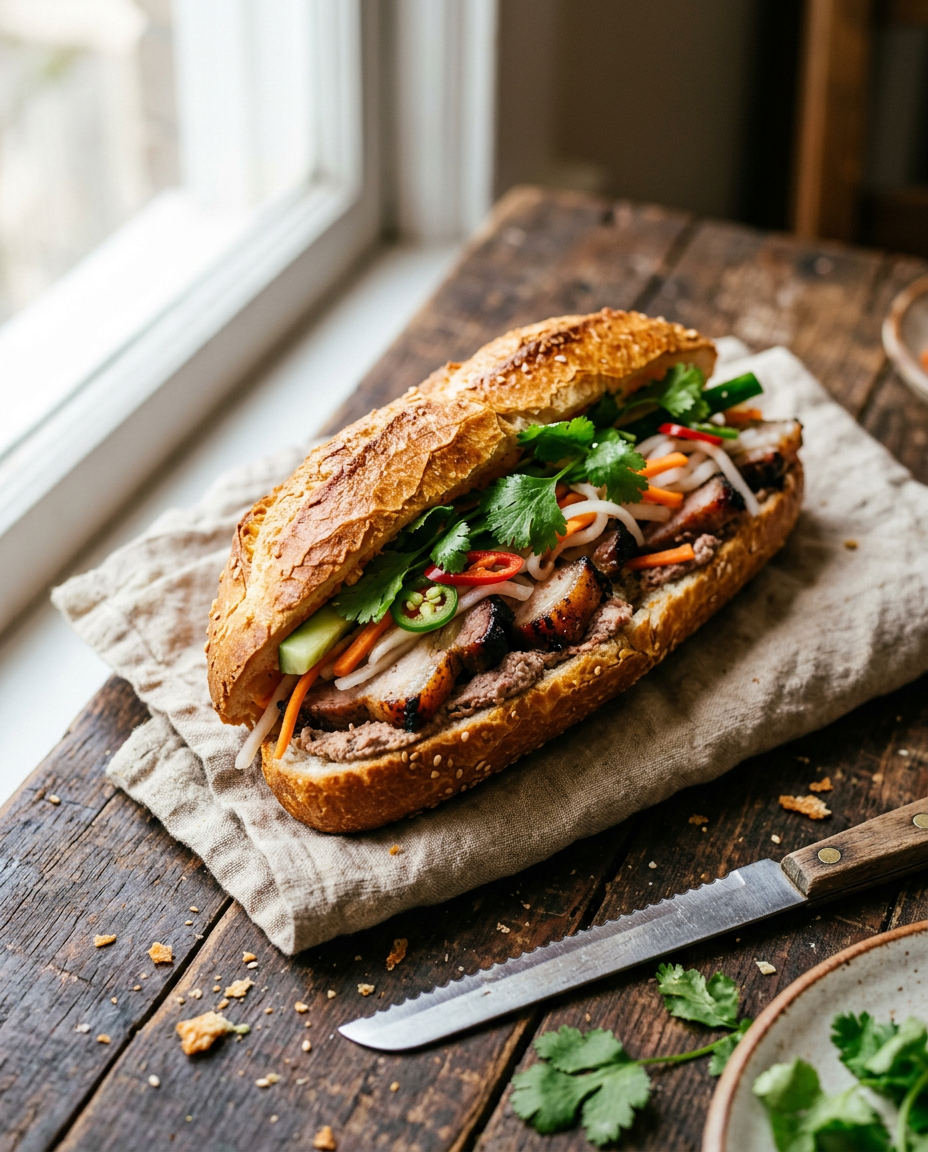
| Active time | 40 minutes |
| Hands-off time | 30 minutes (marinade, cooling) |
| Difficulty | Moderate |
| Key techniques | the pâté foundation, the five-register balance, the light-handed assembly |
| Make-ahead | pickles 1 week; grilled pork 3 days; assembled, 30 minutes |
Bánh Mì — The Classic Build
Prep: 40 minutes · Cook: 20 minutes · Total: About 1 hour (plus the pickles' head start) · Makes 4 sandwiches
Ingredients
The classic bench
- 1 individual Vietnamese baguette (about 30 cm), light and airy
- 15 g (about 1 tbsp) chicken liver pâté — the foundation; store-bought runs honest, #25's-related traditions aside
- 100 g grilled lemongrass pork (#45's marinade and method) or the cold-cut council: sliced pork chả (cha lua), ham, and head cheese or mortadella in rotation
- 15 ml (1 tbsp) mayonnaise, the light spread
The freshness and the fire
- One batch #11's do chua pickles (carrot and daikon), at least the 10-minute quick cure
- 1/2 Lebanese cucumber per sandwich (about 60 g), quartered lengthwise
- 10 g cilantro per sandwich, stems and leaves
- 1–2 slices jalapeño or serrano (about 5 g)
- 1 scallion, sliced thin, optional
- 3–4 drops Maggi or dark soy — the old-country signature
- Black pepper
The quick pork, if grilling
- 700 g pork shoulder, sliced 1 cm; the marinade: 2 stalks lemongrass minced to a paste (about 40 g), 4 garlic cloves, 1 tbsp ginger, 3 tbsp fish sauce, 1 tbsp brown sugar, 1 tsp soy, pepper — 2 hours' marination, grilled hot 3–4 minutes per side
Instructions
- Prepare the bread — the crumb pull. Split the baguette lengthwise with a hinge; run your fingers along the crumb and pull out a strip of the interior's softest bread from each half, a channel about 2 cm wide and deep. The Vietnamese baguette's design is mostly crust already; the pull keeps the filling's channel generous and the sandwich's proportions honest. Checkpoint — the channel runs the bread's length with the walls intact — a trough for the pâté and the layers, not a hollowed wreck. The pulled crumb is the cook's tax, eaten standing at the board.
- Lay the pâté foundation, then the mayo. Spread the pâté along the bottom channel first — the classic's foundation layer, its richness and depth under everything — then the mayo lightly over both faces. The pâté goes down first because it belongs to the bread: spread over the vegetables it would smother; under them it seasons every bite from below. Checkpoint — the channel carries a thin, even pâté coat and the faces a mayo film; the bread smells savory before anything else lands. The pâté is not optional in the classic build — it is the difference between a bánh mì and a Vietnamese sub.
- Layer the proteins and the pickles. The sliced pork (or the cold-cut council's array) laid in the channel over the pâté; the do chua, squeezed of their liquid, laid over the meat in a bed; then the cucumber spears, the jalapeño slices, and the scallion if running. Checkpoint — the cross-section's first half: bread, pâté, protein, pickles — with the pickles' volume visibly equal to the meat's. The balance law (#45's note, carried here as the family's shared constitution) holds: vegetables and herbs at the sandwich's half, or the richness wins and the sandwich loses its refreshing argument.
- The herbs, the shake, and the gentle press. A generous bed of cilantro pressed over everything — stems and all, the stems' clean bitterness is traditional — then the Maggi's 3–4 drops along the channel, black pepper over, the lid closed, and one gentle press with the flat of the hand. Checkpoint — eating test: crust's shatter, pâté's savory depth, the pork's lemongrass char, pickles' bright sour, cucumber's cool, chili's slow build, cilantro's clean finish — the five registers (rich, sour, sweet, hot, herbal) arriving in sequence and resetting for the next bite. It should taste like Saigon's sidewalk in the hand — the whole colonial collision, baguette and fish sauce, at peace in one sandwich.
- Wrap and cut. Half-wrapped in parchment or a paper sleeve — the wrap's grip holds the architecture for eating — and cut on the diagonal if serving at a table. Checkpoint — the wrapped sandwich holds its layers for the first bite through the last; an unwrapped bánh mì sheds its herbs from the open end within minutes. The paper is part of the sandwich's own design.
Doneness & Quality Checkpoints
- The crumb pull's channel, walls intact — the bread's own preparation
- Pâté first, into the channel; mayo light on both faces
- Pickles at the meat's equal volume — the balance law
- Cilantro pressed as a bed, stems included; Maggi's 3–4 drops
- Wrapped before the cut — the paper's architecture
Finish & Plate
The half-paper wrap is the service: eat one-handed, standing or walking, as the sandwich's own tradition demands. A Vietnamese iced coffee (cà phê sữa đá) beside it is the canonical pairing, and #11's remaining slaw makes the plate a full table.
Troubleshooting
| Symptom | Cause | Fix |
|---|---|---|
| Sandwich rich, heavy by half | Pâté-and-meat heavy, vegetables light | The half-vegetables law — the family's constitution |
| Bread soggy at the base | Wet pickles or heavy mayo | Squeeze the do chua; the light film's measure |
| Sandwich falls apart at the bite | Dense bread or no wrap | The light Vietnamese baguette; the paper's grip |
Storage, Make-Ahead & Variations
- The pickles keep 1 week, the grilled pork 3 days, and the assembly takes 8 minutes from a stocked fridge — the working format. The assembled sandwich holds 30 minutes wrapped; the bread's crust is the clock. - Variations: the cold-cut council's full rotation (chả, ham, head cheese); the meatball build (xiu mai); the tofu lane; the breakfast bánh mì with a fried egg over the pâté — and #45's butcher-tall pork build as the American register's own seat.