Buffalo Chicken Wrap
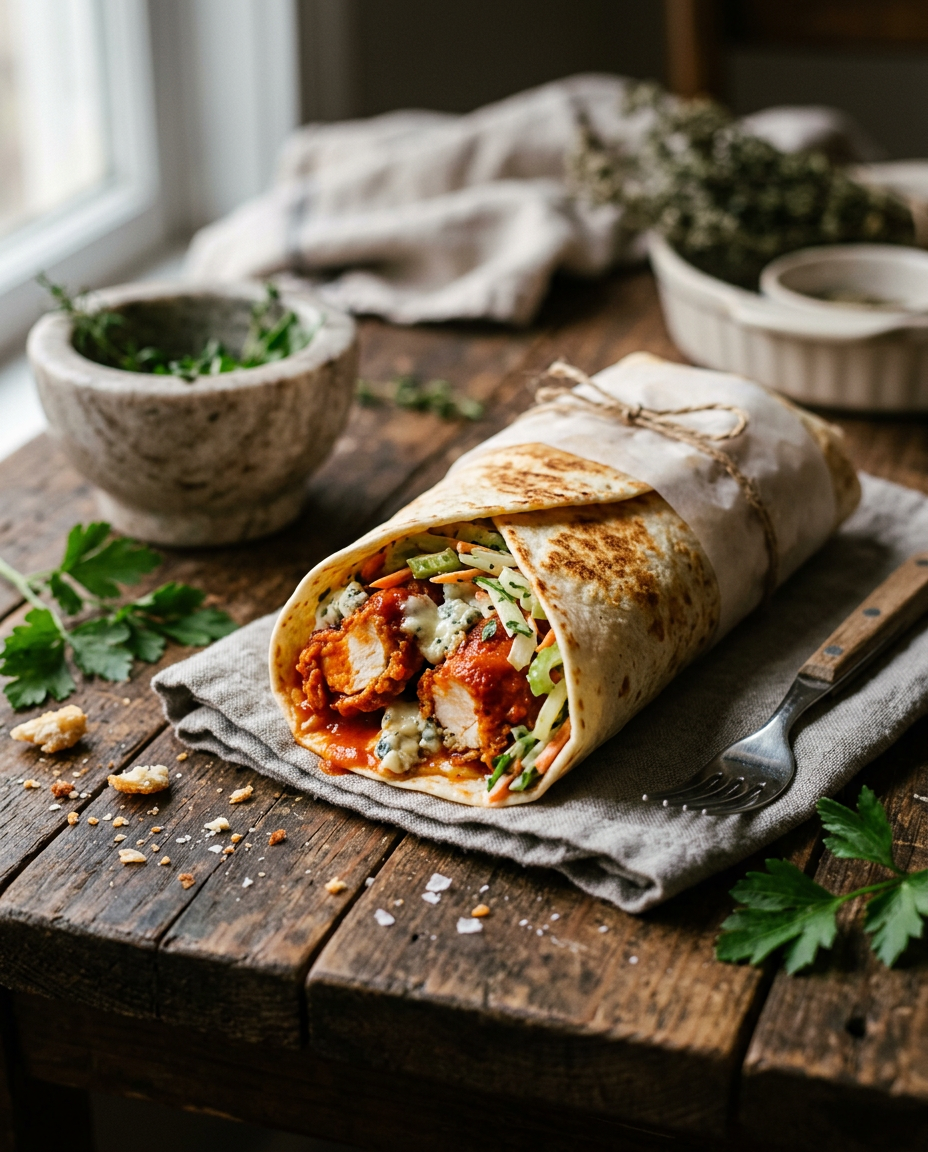
| Active time | 30 minutes |
| Hands-off time | 15 minutes (baking, slaw rest) |
| Difficulty | Easy |
| Key techniques | the crumb crust, buffalo's butter-emulsion toss, the roll's architecture |
| Make-ahead | slaw 1 day; tenders 2 days; wrapped, 30 minutes |
Buffalo Chicken Wrap
Prep: 25 minutes · Cook: 20 minutes · Total: 45 minutes · Makes 4 wraps
Ingredients
The chicken
- 700 g (1.5 lb) chicken tenders or breasts cut in strips
- 120 g (1 cup) flour
- 2 large eggs (about 100 g), beaten with 1 tbsp water
- 180 g (2 cups) panko breadcrumbs
- 1 tsp (3 g) salt, 1 tsp (2 g) garlic powder, 1/2 tsp (1 g) paprika
- 90 ml (6 tbsp) neutral oil, for pan-frying — the shallow lane; or the oven at 220 °C per the note
The buffalo toss
- 90 g (6 tbsp) hot sauce — Frank's is the canonical register
- 45 g (3 tbsp) butter, melted
- 1 tsp (5 g) honey, optional — the rounder lane
The cooling wrap
- 200 g (about 2 cups) shredded cabbage or coleslaw mix
- 80 g (about 1/3 cup) ranch dressing (#4's jar) or blue cheese dressing
- 1 tbsp (10 g) celery leaves or sliced celery (about 20 g), the traditional crunch
- 4 large 25 cm flour tortillas (about 60 g each)
- Extra ranch at the table
Instructions
- Bread the tenders — the three-station law. Each strip: flour (both sides, shaken), egg (coated, drained), panko (pressed firmly — the crumbs should be packed on, not dusted). The press matters more than any other step: loose panko falls in the pan and burns while packed panko fries to the crust's lattice. Checkpoint — each tender carries a full, even, pressed coat with no wet spots showing through. Rest the breaded strips 5 minutes on the rack — the coating sets and adheres instead of sliding in the pan.
- Pan-fry to deep gold, 3 minutes a side. The oil in a wide pan over medium to a shimmer (about 175 °C — a crumb sizzles at once but does not blacken); tenders in without crowding, 3 minutes to the first side's deep gold, flip once, 3 minutes more, to 71 °C at the thickest strip's center. Drain on the rack. Checkpoint — the crust is deep gold and audible — a tap cracks — and the meat inside is just cooked through. The oven lane (220 °C, 15–18 minutes on a rack, flipped once, with a spray of oil over the panko) runs lighter and honest; the pan's crust runs deeper. Either serves.
- The buffalo toss — the emulsion's law. The hot sauce, melted butter, and honey whisked in a wide bowl to an emulsion; the hot tenders dropped in and tossed with two spoons (or the bowl's shake, covered) until every strip carries the orange-red lacquer. The toss happens hot: the butter is the sauce's body, and it sets to a glaze on the hot crust. Checkpoint — the tenders glisten with a lacquered, even coat — not drowned, not patchy. Buffalo's ratio runs roughly 2:1 sauce to butter; more butter rounds the heat, more sauce runs sharper, and both dials are legitimate.
- Build the wrap — the three temperatures, one roll. The tortilla warmed pliable (10 seconds a side in the dry pan — the #43 law); the slaw bedded in the center third; the buffalo tenders laid over the slaw (2 strips per wrap, or the tenders halved crosswise for easier rolling); celery's crunch over; a zigzag of ranch on top of everything. Checkpoint — the filling occupies the center third with the bottom margin kept — the #43 fold's real estate — and the architecture reads in the cross-section: cool slaw below, hot lacquered chicken above, the cooling layer between the buffalo and the tortilla (the architecture's whole point — buffalo sauce direct on the tortilla softens it by the second quarter).
- The fold-and-tuck, seam down, and the half-cut. Checkpoint — eating test: the tortilla's soft give, the crust's crack under the buffalo's butter-heat, the slaw's cool crunch and ranch's calm between them — the three temperatures negotiating in every bite, the heat building and the slaw answering. It should be a little messy, structurally sound, and gone before the commercial break; that is the format's own measure of success.
Doneness & Quality Checkpoints
- Panko pressed on and rested 5 minutes before the pan
- 175 °C oil, deep gold, 71 °C at center
- Buffalo emulsified and tossed while hot — the lacquer, not a pour
- Slaw between buffalo and tortilla — the architecture's law
- The #43 fold-and-tuck, seam down
Finish & Plate
The diagonal half, cut face showing the strata — cool below, hot above — with the ranch cup and extra napkins at the side. It belongs beside a game, with celery sticks and the blue-cheese crumbles for the traditionalists; the wrap contains its own sides and knows it.
Troubleshooting
| Symptom | Cause | Fix |
|---|---|---|
| Crust fell off in the pan | Panko dusted, not pressed | The firm press and the 5-minute rest |
| Sauce separated, greasy | Butter whisked into cold sauce | Emulsify first; toss while both are hot |
| Wrap soggy by the second half | Buffalo direct on the tortilla | The slaw-fence law — the architecture |
Storage, Make-Ahead & Variations
- The slaw keeps 1 day; the breaded tenders keep 2 days cooked (re-crisp 6 minutes at 200 °C, then re-toss in the warmed buffalo) — the game-day staging that works. The wrapped sandwich holds 30 minutes. - Variations: the blue-cheese lane for the ranch-skeptic; the grilled-chicken light build (no crust, the toss halved); the #99's teriyaki sibling as the counter-register; the lettuce-wrap lane for the no-tortilla table.