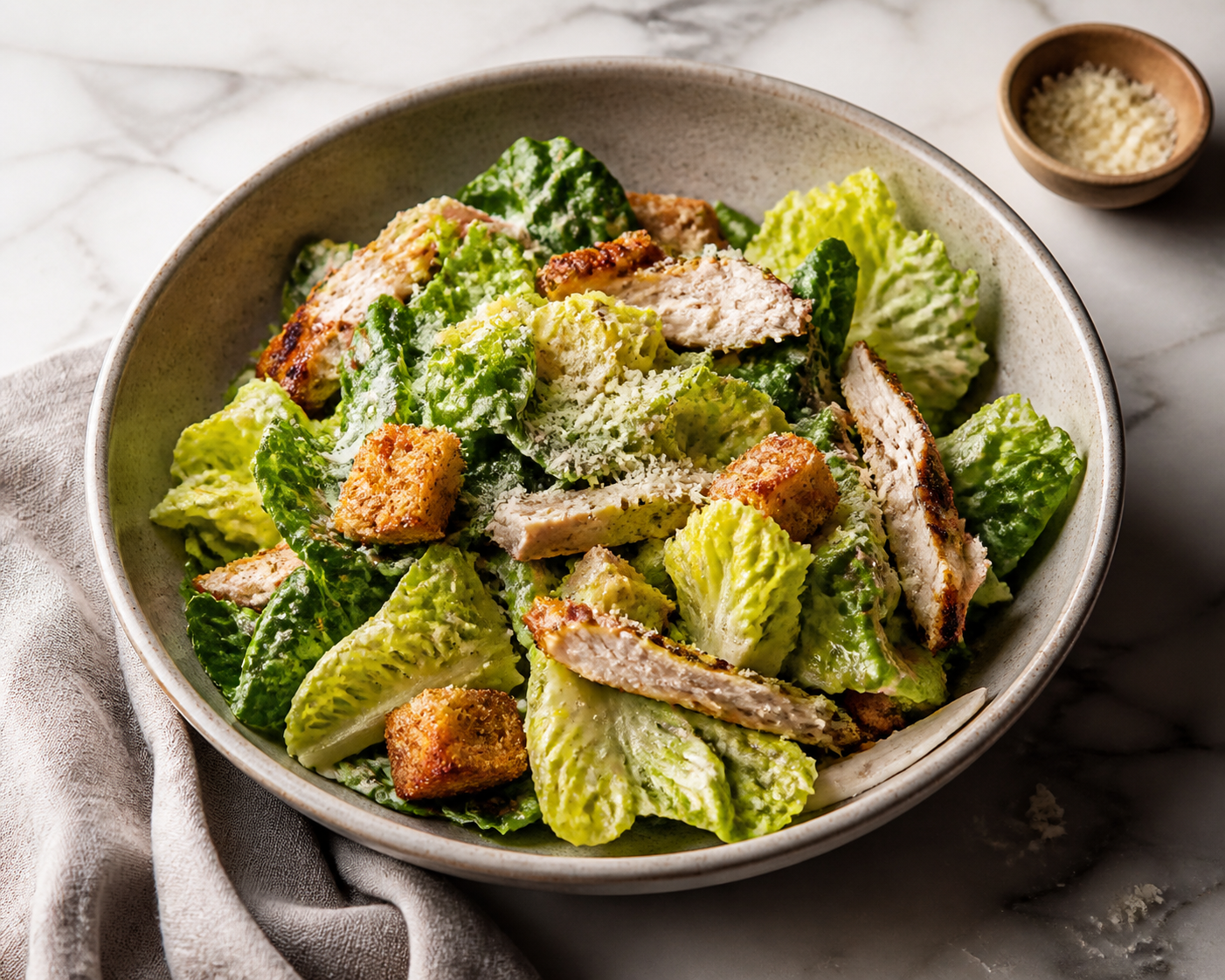
Classic Caesar
| Active time | 15 minutes |
| Hands-off time | 20 minutes (croutons) |
| Difficulty | Easy |
| Key techniques | the mayo-stabilized emulsion, torn croutons, dressing at 3/4 |
| Make-ahead | dressing 3 days; croutons 2 days; assembled, 5 minutes |
Classic Caesar
Prep: 15 minutes · Cook: 20 minutes · Total: 35 minutes · 4 as a main, 6 as a side
Ingredients
The croutons
- 300 g (about 6 thick slices) day-old country bread, torn into 3–4 cm chunks
- 45 ml (3 tbsp) extra-virgin olive oil (about 41 g)
- 1 garlic clove, halved (about 3 g)
- 1/2 tsp (2 g) salt
The salad
- 600 g (3 hearts) romaine, washed and dried thoroughly
- 120 ml (about 1/2 cup) the #1 anchovy-caesar dressing, chilled
- 40 g (1/2 cup) shaved or finely grated parmesan
- Black pepper, coarsely ground
- Half a lemon (about 30 g), for the final squeeze
The protein option
- 400 g (14 oz) cooked chicken or 8 crispy chickpeas per plate — grilled, poached, or the rotisserie's mercy
Instructions
- Toast the croutons, 15–20 minutes at 200 °C. Toss the torn bread with the oil, salt, and the cut garlic clove rubbed around the inside of the mixing bowl first (the bowl's garlic ghost is enough; raw garlic pieces burn). Spread on a sheet pan and bake, turning once, until golden and dry through. Checkpoint — a chunk cracked open is dry and airy inside, crisp at every edge, with no chewiness at the center. Chew means underbaked, and underbaked croutons go stale-soggy in the salad within minutes.
- Cut the romaine for fork and bite. Slice the leaves crosswise into 3 cm ribbons, or — the menu version's nicer move — tear the larger leaves and keep the small heart leaves whole. Uniform size is what matters; the classic forkful carries crouton, leaf, and dressing together, and mixed sizes drop half their load. Checkpoint — no ribbon longer than a fork's width; the small inner leaves left whole for texture contrast.
- Dress in the bowl, at three-quarters. Pile the romaine in your largest bowl, pour over about 90 ml of the dressing, and toss with your hands, lifting from the bottom, for a full 20 seconds. Hands coat every leaf; tongs press and bruise. Assess, then add the remaining dressing only if leaves still look matte. Checkpoint — every leaf is glossy but no dressing pools at the bottom — the pool means stop, because Caesar's failure mode is drowning, not underdressing. Reserve any extra; the last leaves in the bowl want a touch more.
- Finish and serve immediately. Add two-thirds of the croutons and two-thirds of the parmesan, toss twice more, then mound on plates and scatter the rest of the croutons and cheese on top. The lemon squeeze and the pepper go on at the table — the last-second acid lift is the classic's finish, and it beats any lemon mixed into the jar. Checkpoint — eating test: crisp romaine with the dressing's anchovy depth, croutons that crackle and then give, parmesan salt in every third bite, and lemon brightness arriving at the swallow. The whole plate should be gone in ten minutes — Caesar does not revere leftovers, and neither should you.
Doneness & Quality Checkpoints
- Croutons dry through the center, torn and rough-surfaced
- Romaine bone-dry, uniform fork-size
- Three-quarter dressing, hand-tossed 20 seconds, no pool
- Croutons and cheese added last, extra on top
- Lemon and pepper at the table only
Finish & Plate
Wide, shallow bowls — depth crushes croutons. The mounded lettuce slightly overflowing, the final crouton-and-parmesan scatter visible on top, pepper ground over at the table's height for the aroma alone. With the chicken or chickpeas it stands alone at dinner; without, it walks beside anything off the grill.
Troubleshooting
| Symptom | Cause | Fix |
|---|---|---|
| Salad wet, dressing at the bottom | Wet romaine or over-poured | Dry leaves; three-quarter pour rule |
| Croutons leathery | Underbaked or drowned early | Dry-through bake; crown them on top |
| Dressing invisible on the leaves | Cold, stiff dressing | 10 minutes at room temperature before tossing |
Storage, Make-Ahead & Variations
- The dressed salad does not store — its whole life is 10 minutes. The components are the make-ahead: dressing 3 days refrigerated (4 °C), croutons 2 days in a paper bag at room temperature, romaine washed and rolled in a towel 2 days. - Variations: the #27 full-classic ceremony (coddled yolk, garlic paste, drop-by-drop oil); the #43 wrap format for tomorrow's lunch; kale Caesar (massage 2 minutes with a pinch of salt first); the anchovy-double version for the devoted.