Chicken Caesar Wrap
| Active time | 20 minutes |
| Hands-off time | 15 minutes (chicken, optional crouton bake) |
| Difficulty | Easy |
| Key techniques | the pliable-tortilla law, dry-hand dressing, the fold-and-tuck roll |
| Make-ahead | 1 wrap 4 hours; components 3 days |
Chicken Caesar Wrap
Prep: 20 minutes · Cook: 15 minutes · Total: 35 minutes · Makes 4 wraps
Ingredients
The chicken
- 500 g (about 2 large) chicken breasts — or 400 g rotisserie meat, sliced
- 1 tbsp (12 g) neutral oil, salt and pepper
- Or poached per #34's cold-start law, 74 °C
The tortillas and greens
- 4 large 25 cm flour tortillas (about 60 g each)
- 300 g (about 1 1/2 hearts) romaine, shredded in ribbons, bone-dry
- 60 ml (about 1/4 cup) the #1 anchovy-caesar dressing, chilled
- 30 g (about 1/3 cup) parmesan, finely grated
The crunch insurance
- 40 g (about 1 cup) croutons, the #21 recipe's or store's honest ones — or 2 tbsp (15 g) toasted panko for the crush-proof lane
Optional builders
- 4 thin slices tomato, patted dry — the moisture law below
- 2 tbsp (20 g) Parmesan crisps, the elegant crunch
- Black pepper, lemon wedge
Instructions
- Cook and slice the chicken flat. Season and pan-sear the breasts 5–6 minutes per side over medium to 74 °C at the center (or poach per #34), rest 5 minutes, and slice across the grain in thin, wide pieces. Flat slices layer into the wrap's cylinder; cubes roll to the bottom and exit at first bite. Checkpoint — 74 °C read before the rest; the slices are thin enough to bend — they will coil with the wrap instead of resisting it.
- Warm the tortillas to pliable — the law. Heat a dry pan over medium and give each tortilla 10–15 seconds per side, just until it flexes like cloth and shows the faintest toast spots. Stack them under a towel as they come off. Checkpoint — a warmed tortilla folds without cracking at the crease — bend one over your palm; if it creaks or splits, back to the pan. A cold tortilla shatters at the first fold and leaks for the wrap's whole life.
- Dress light and layer in order. Toss the chicken and romaine separately: the chicken with 30 ml of the dressing, the romaine with the remaining 30 ml and the parmesan. Per tortilla, the layer order is the architecture — chicken slices laid in a band across the center third (not edge to edge), romaine over, tomato if using on top of the greens (its moisture lands on lettuce, not tortilla), crunch last. Checkpoint — the filling occupies the tortilla's middle third, with bare tortilla at the edges and a 4 cm margin at the bottom — the fold's real estate. Overfilling is the wrap's only common fatal error; four wraps' filling should look sparse before the roll.
- The fold-and-tuck, the technique this format owns. Fold the bottom margin up over the filling, then fold one side over the filling and — with the side held flat — tuck and roll the wrap over itself toward the other side, keeping the roll tight as a sleeping bag. The bottom fold stays underneath, sealing the base. Checkpoint — the finished wrap is a tight cylinder with the seam facing down; squeeze it gently — nothing shifts. A loose roll sheds filling from the ends at the first bite; tension at the tuck is the whole craft.
- Toast the seam, if the wrap serves now. For the fresh serving, lay the wrap seam-down in the warm pan 1–2 minutes to seal and crisp the seam, then roll it to toast the other face lightly, and halve on the diagonal. For packed lunches, skip the toast and wrap the cylinder in parchment or foil, rolled tight. Checkpoint — eating test: the tortilla gives with a slight chew, then crunch — chicken, dressing's anchovy-lemon tang, romaine's snap, parmesan's salt — and the wrap holds its architecture to the final third, which is the file's whole definition of wrap success.
Doneness & Quality Checkpoints
- Chicken at 74 °C, sliced flat and thin, not cubed
- Tortillas warmed to cloth-pliable, never cold-creaked
- Filling in the center third, bottom margin kept for the fold
- The fold-and-tuck's tight cylinder, seam down
- Crunch insurance chosen for the serving clock
Finish & Plate
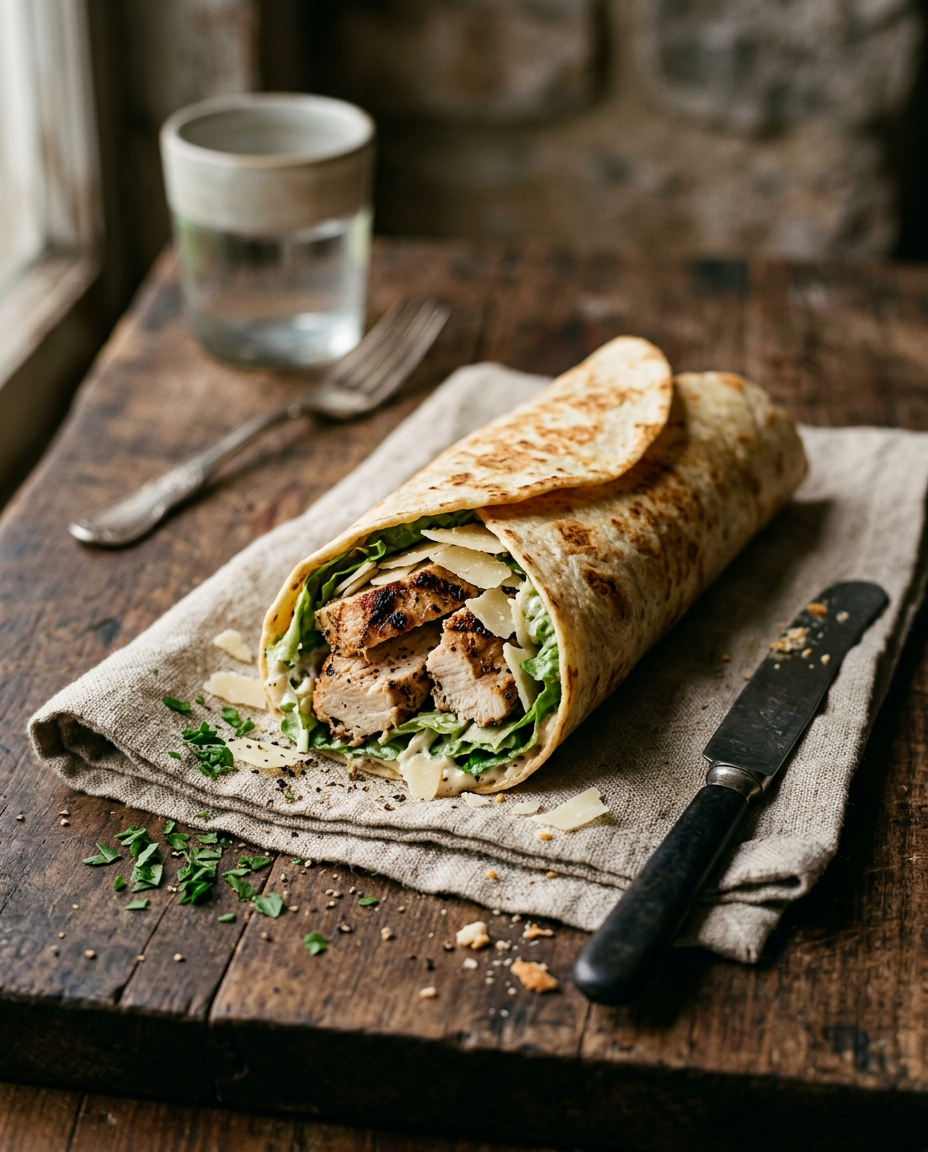
Diagonal halves, cut faces showing the spiral — the filling's bands visible in cross-section, the parmesan's white through the green. A lemon wedge and pepper at the plate; a pickle spear if the wrap has deli aspirations. It replaces the salad at any lunch where a fork is the wrong tool.
Troubleshooting
| Symptom | Cause | Fix |
|---|---|---|
| Wrap burst at the seam | Tortilla cold or overfilled | The warming law; the center-third law |
| Soggy tortilla by hour two | Wet romaine, tomato against the tortilla, dressed too early | Dry greens; tomato on lettuce; the noon re-roll |
| Filling fell out the ends | Loose roll, no bottom fold | The fold-and-tuck with real tension |
Storage, Make-Ahead & Variations
- Dressed wraps hold 4 hours; the split-format (dressing/chicken in, greens/crunch at noon) holds a full workday. Components keep 3 days refrigerated (4 °C) — chicken, dressing, dry romaine ribbons, panko jar. - Variations: the #27 full-classic dressing for the ceremony wrap; the avocado-and-bacon build (a half-club in Caesar's clothing); the kale wrap (massaged #39-style, holds a full day); the spinach tortilla for the lunchbox's color politics.