Chicken Parm Sandwich
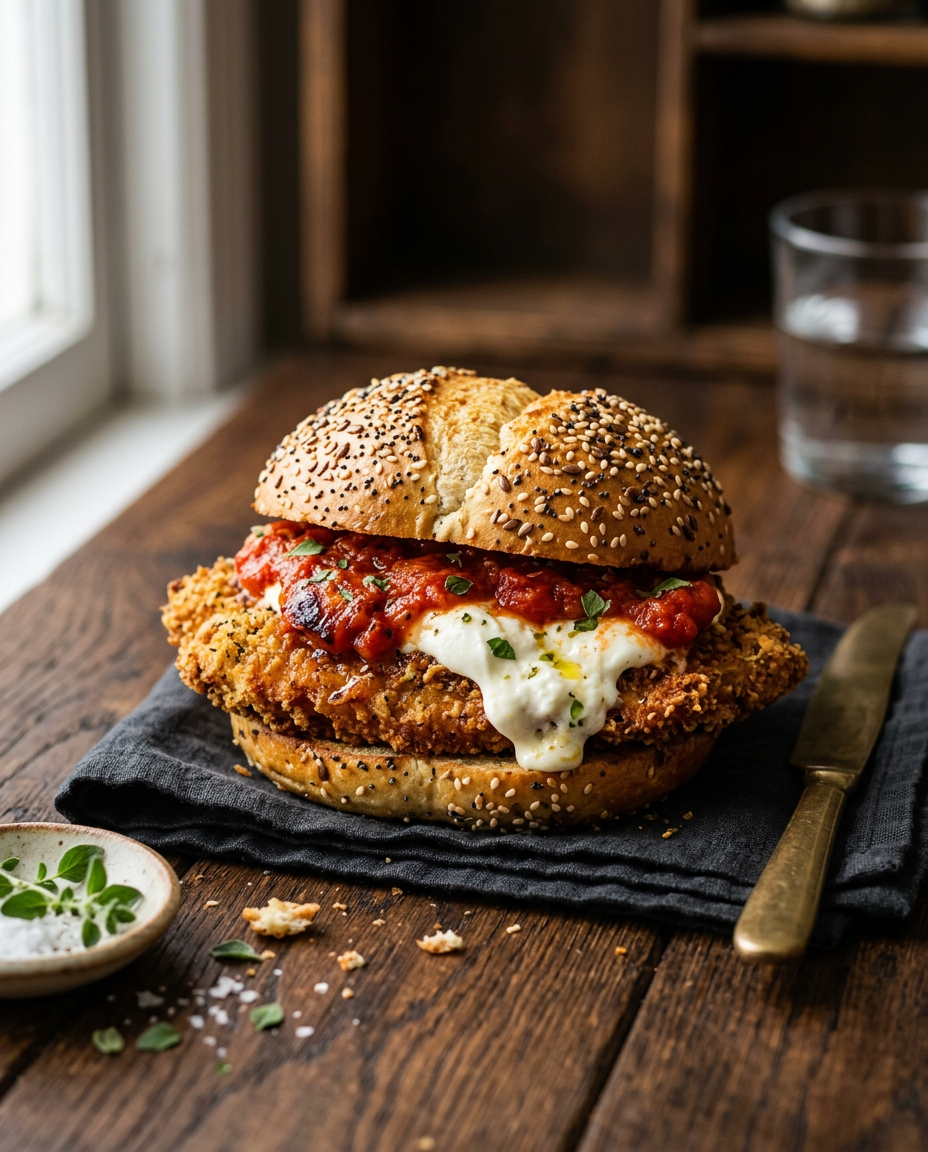
The red-sauce hero: a crisp breaded cutlet, hot tomato sauce, and molten mozzarella in a roll that must survive both. The craft is the cutlet's crust (it fights the sauce and must not surrender) and the bread's defense — the hollow, the toast, and the sauce's measured spoon — a sandwich built to be eaten in ten minutes and to stay crisp for all ten.
| Active time | 40 minutes |
| Hands-off time | 20 minutes (sauce, cutlets bake) |
| Difficulty | Moderate — the crust's discipline |
| Key techniques | the pané crust, the sauce's measured spoon, the broiler's finish |
| Make-ahead | cutlets 2 days; sauce 4; assembled, the minute |
Chicken Parm Sandwich
Prep: 30 minutes · Cook: 30 minutes · Total: About 1 hour · Makes 4 sandwiches
Ingredients
The cutlets
- 4 boneless chicken breasts (about 650 g), butterflied and pounded to 1 cm
- 120 g (1 cup) flour, 2 eggs (about 100 g) beaten, 180 g (2 cups) breadcrumbs — panko half-and-half with fine crumbs runs the best crust
- 1 tsp (5 g) salt, 1 tsp (3 g) garlic powder, 1/2 tsp (1 g) dried oregano, black pepper
- 120 ml (about 8 tbsp) neutral oil, for pan-frying
The sauce
- 2 tbsp (25 ml) olive oil, 3 garlic cloves (about 12 g) sliced, 700 g crushed tomatoes (one can), 1 tsp (1 g) oregano, 1/2 tsp (2 g) salt, a pinch of sugar (about 2 g), 5 g basil
- Simmered 12–15 minutes to a thick, spoonable sauce — thicker than pasta's; the sandwich's version must cling, not run
The build
- 4 hoagie or torpedo rolls (about 90 g each)
- 200 g low-moisture mozzarella, sliced
- 30 g (about 1/3 cup) grated parmesan
- Fresh basil (about 8 g)
Instructions
- Bread the cutlets with the press-and-rest law. Flour (shaken), egg (drained), crumbs (pressed firmly on both sides and the edges); the breaded cutlets rest 10 minutes on a rack — the coating sets and adheres. Checkpoint — an even, fully-adhered coat with no wet patches; the edges crumbed (the sauce attacks a cutlet from its edges, and an uncrumbed edge is the crust's breach).
- Pan-fry to deep gold, 3 minutes a side. Oil at a shimmer (about 175 °C) in two batches; the cutlets fried to deep gold and 71 °C at center, drained on the rack — never paper's steam. Checkpoint — the crust is deep gold, dry, and audible at a tap, the meat just cooked; a pale crust has not fried long enough to build its sauce-resisting lattice.
- Reduce the sauce while the cutlets fry. Garlic in the oil 1 minute, tomatoes and seasonings, simmered 12–15 minutes uncovered to a thick sauce that holds a spoon's coat — the water's departure is the sandwich's survival. Checkpoint — a spoon drawn through the pan's sauce leaves a clean trail that closes slowly; the sauce tastes concentrated and clings to the spoon's back. This is thicker than pasta sauce on purpose.
- Assemble in the defense's order. Rolls split, the crumb pulled to a channel (#60's law), the faces toasted golden under the broiler or in a dry pan — the toast is the moisture barrier. Bottom face: a spoon of sauce spread thin (the mortar, not a pool), the cutlet laid over it, 2–3 spoons of sauce on the cutlet's top only (never the bread's sides), mozzarella over the sauce, parmesan over the mozzarella. Checkpoint — the sauce touches bread only at the bottom's thin mortar; the rest rides on the cutlet, which is the architecture's entire argument. The roll's sides and top run dry, waiting for the broiler.
- The broiler's finish, 2–3 minutes at 230 °C. The assembled open rolls under the broiler to the cheese's melt and the first brown blisters, the crown toasted alongside; basil laid on the hot cheese, the crown pressed on. Checkpoint — eating test: the roll's toast giving to the cutlet's crack — the crust still crisp under its sauce — molten mozzarella's pull, the sauce's bright-garlic depth, parmesan's salt at the edge, basil's perfume over all. The cutlet should resist to the last third (the crust's victory); if it went soft, the sauce ran thin or the toast ran light — both defenses above.
- The sauce runs first and reduces thicker than instinct suggests — the sandwich's sauce must be a coating, not a soup, and the reduction is the bread's first defense.
- Bread station staged (flour, egg, crumb) and the cutlets pressed to true evenness; the crust's evenness is the sauce-resistance's foundation.
Doneness & Quality Checkpoints
- Crust pressed, rested, deep gold, edges sealed
- Sauce reduced to the spoon-coat thickness
- Bread toasted and channeled; sauce as thin mortar below, on top only above
- Broiler to the cheese's blister, crown toasted
- The crust's resistance at the last third
Finish & Plate
The whole roll wrapped in paper's grip — the chicken parm sandwich's own etiquette — or halved to show the strata. A fork's support at the end is traditional and honest. It pairs with nothing; it is the meal.
Troubleshooting
| Symptom | Cause | Fix |
|---|---|---|
| Roll soggy before the end | Thin sauce or untoasted bread | The 15-minute reduction; the golden toast both faces |
| Cutlet's crust soft at first bite | Pale fry or steamed under sealed cheese | The deep gold fry; the broiler's open melt |
| Sandwich slides apart | No mortar, cheese unmelted | The bottom's thin sauce spoon; broil to blister |
Storage, Make-Ahead & Variations
- Cutlets keep 2 days and re-crisp 6 minutes at 200 °C; the sauce keeps 4 — the 10-minute reassembly. The broiled sandwich serves in its minute. - Variations: the spicy fra diavolo sauce; the double-cutlet tower for the hungry; the chicken parm sliders on the #44 tray; the eggplant swap running the same architecture meatless.