Classic Reuben
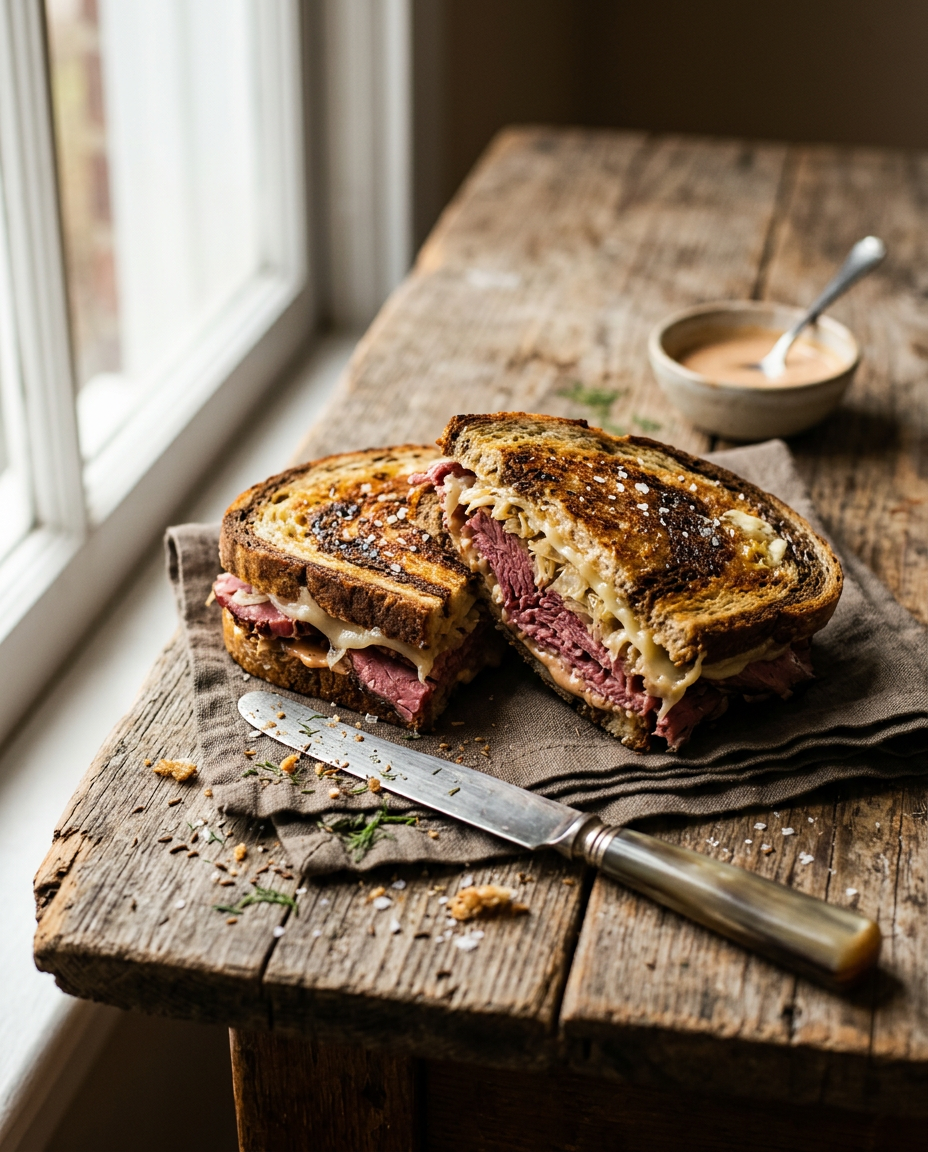
Corned beef, sauerkraut, Swiss, and Russian dressing griddled between buttered rye until the whole stack fuses into one hot, tangy, dripping institution. The craft is the griddle law — buttered outside, low and slow, pressed, flipped once — and the draining discipline that keeps the sauerkraut from steaming the bread into submission.
| Active time | 25 minutes |
| Hands-off time | 15 minutes (beef heating) |
| Difficulty | Moderate — the griddle's patience |
| Key techniques | the butter-outside griddle, kraut drained and warmed, Russian from scratch |
| Make-ahead | dressing 1 week; assembled 30 minutes |
Classic Reuben
Prep: 20 minutes · Cook: 25 minutes · Total: 45 minutes · Makes 4 sandwiches
Ingredients
The stack
- 600 g sliced corned beef, from the deli counter thick-sliced (about 1.5 mm) or the #95-style home-brisket's leftovers
- 400 g sauerkraut (about 2 cups), drained and squeezed
- 200 g (about 8 slices) Swiss cheese
- 8 slices rye bread (about 70 g each) — marble or pumpernickel run honest variants
The Russian dressing
- 100 g (about 7 tbsp) mayonnaise
- 2 tbsp (30 g) ketchup
- 1 tbsp (15 g) sweet pickle relish, finely chopped if coarse
- 1 tsp (5 g) Dijon mustard
- 1 tsp (about 5 g) grated onion
- 1/2 tsp (2 ml) Worcestershire
- Black pepper, a pinch of paprika
The griddle
- 45 g (3 tbsp) butter, softened, for the bread's outsides
Instructions
- Build the dressing. Whisk the mayo, ketchup, relish, Dijon, onion, Worcestershire, pepper, and paprika to a uniform pale coral. Taste: tangy-sweet with pickle's hum, faintly sharp — the Russian should read brighter than Thousand Island (its sibling) and less sweet. Checkpoint — the dressing ribbons off a spoon and tastes like a deli's best burger sauce; it should be slightly too assertive alone, because the sandwich's beef and kraut will halve it.
- Warm the beef and the kraut. Corned beef in a covered pan over low with a tablespoon of water, 4–5 minutes, just to steaming warmth, never browning — corned beef's cure turns bitter at a sear. The squeezed kraut in a dry pan alongside, 3 minutes to drive its last surface water off. Checkpoint — the beef is steaming-hot and still juicy; the kraut hisses dry and smells fermented-tangy, with no liquid in its pan. Two pans, five minutes, the whole sandwich's stability assured.
- Assemble in the Reuben's order. Butter the outsides of all eight slices; on the insides, Russian on all faces. Per sandwich: Swiss on the bread, the warm corned beef folded in a shingled, lofted layer (the #51 fold law carried), kraut over the beef, and the second Swiss face closed — cheese against bread on both sides, the melt's anchor. Checkpoint — from the side: butter, rye, Russian, Swiss, folded beef, kraut, Swiss, Russian, rye, butter — the cheese always adjacent to the bread, the kraut always buffered between beef and cheese. Cheese directly against kraut slides at the melt; this order fuses.
- Griddle low and slow — the law. A heavy pan or griddle over medium-low (the butter's first sizzle gentle, not violent), sandwiches in batches of two, pressed with a spatula or a light pan-weight. Four to five minutes to the first side's deep gold, flip once, three to four minutes more, pressed again. Checkpoint — the first side releases from the pan without effort when it is done — deep, even gold, the rye's structure visible under the butter's toast. If it sticks or the color runs dark before the cheese melts, the heat runs high: the Reuben's whole window is the time low heat takes to melt Swiss through a cold-center stack, and only patience covers it.
- Rest one minute, cut on the diagonal, serve in pairs. Checkpoint — eating test: the rye's butter-crisp shatter, then the molten strata — corned beef's salt-spice depth, kraut's sour crunch, Swiss's nutty pull, Russian's sweet-tang — every flavor the deli canon knows in one dripping bite. The sandwich should barely hold together, and the plate should need a fork's support by the end. That is not a flaw; that is a Reuben.
- Drain and squeeze the sauerkraut hard — a fist over the sink extracts a shocking volume — then warm it in a dry pan 3 minutes. Undrained kraut steams the bread from inside; cold kraut cools the beef; the warm-and-dry version makes the sandwich work.
- Make the Russian first and let it sit: its flavors marry in ten minutes while everything else heats.
- Warm the corned beef gently in a covered pan with a splash of water, 5 minutes — cold beef slices refuse the cheese's melt, and dry heat toughens them.
Doneness & Quality Checkpoints
- Russian dressing married 10 minutes; tasting brighter than its parts
- Kraut squeezed and warmed dry; beef steamed, never seared
- Cheese adjacent to bread on both floors; kraut buffered between
- Medium-low griddle, pressed, flipped once, deep gold both faces
- Rested one minute before the diagonal
Finish & Plate
The diagonal halves, cut face up, a pickle spear and the Russian jar alongside. Cold beer or an egg cream, the deli canon's two answers. Napkins — the honest count is more than you think.
Troubleshooting
| Symptom | Cause | Fix |
|---|---|---|
| Bread dark, cheese unmelted | Heat too high | Medium-low and patience; the arithmetic note |
| Sandwich soggy, steamed | Undrained kraut | The fist-squeeze and the dry pan — both, always |
| Beef tough, gray | Seared instead of steamed | The covered pan with a splash of water |
Storage, Make-Ahead & Variations
- The dressing keeps 1 week refrigerated (4 °C); assembled sandwiches hold 30 minutes before the kraut wins; the griddled sandwich serves in the minute. Components keep days — the beef 3, the kraut weeks. - Variations: the Rachel (turkey or pastrami for the corned beef, slaw for the kraut); the #69 pastrami-on-rye as the purist's counterargument; the open-faced Reuben under the broiler for the knife-and-fork school; the #78's breakfast lane running a fried egg under the Swiss.