Croque Monsieur
| Active time | 30 minutes |
| Hands-off time | 20 minutes (sauce rest, assembly) |
| Difficulty | Moderate — the béchamel's discipline |
| Key techniques | the béchamel (roux to silk), sauce inside and out, the griddle-then-broiler finish |
| Make-ahead | béchamel 2 days; assembled 30 minutes |
Croque Monsieur
Prep: 25 minutes · Cook: 25 minutes · Total: 50 minutes · Makes 4 sandwiches
Ingredients
The béchamel
- 30 g (2 tbsp) butter
- 30 g (about 1/4 cup) flour
- 350 ml (1 1/2 cups) whole milk, warmed
- 1/4 tsp (1 g) salt, black pepper, a whisper of nutmeg (about 0.5 g)
- 40 g (about 1/3 cup) grated Gruyère, stirred in off heat
The sandwiches
- 8 slices white sandwich bread, Pullman or brioche-style (about 65 g each), crusts trimmed
- 8 slices (about 250 g) good Parisian ham
- 150 g Gruyère, sliced thin or grated — the inside layer
- 2 tbsp (28 g) softened butter, for the outsides
Instructions
- Make the béchamel — the sandwich's engine. Melt the butter over medium-low, whisk in the flour, and cook 2 full minutes, stirring, until the roux smells faintly of toasted pastry and has gone pale gold. Add the warm milk in three additions, whisking each to full smoothness before the next — the first addition makes a thick paste, the second a sauce, the third a silk. Simmer 2–3 minutes to a pourable, coating sauce; season with salt, pepper, and the nutmeg's whisper. Off heat, stir in the 40 g Gruyère. Checkpoint — the sauce coats a spoon and holds a finger-drawn line for 2 seconds — thicker than cream, looser than pudding — and tastes rounded, faintly nutty, with the cheese melted through. Lumps mean the milk went in too fast; whisk hard over low heat and they surrender, mostly.
- Build: sauce inside, cheese and ham in layers. Spread béchamel on all eight inner faces. Per sandwich: a layer of Gruyère on the bottom slice, ham folded over it, another thin béchamel schmear, and the top slice — sauce facing the ham. Butter the outsides. Checkpoint — the inside runs cheese-sauce-ham-sauce-cheese: Gruyère on both floors for the melt's anchors, the ham buffered, and béchamel everywhere the bread's crumb can drink it. This sandwich is a sauce delivery system wearing a bread suit, and the build should look it.
- Griddle golden, medium-low, 3–4 minutes per side. A heavy pan over medium-low, the sandwiches griddled to deep, even gold both faces — the butter's toast carrying the bread's structure, the inside's cheese beginning to melt. Checkpoint — both faces deeply gold and the sandwich warm through — press gently with the spatula; the feel is pliant, not floppy. The croque griddles at one notch below the grilled cheese's heat (the béchamel's sugars brown faster than butter alone), and the watch runs closer here.
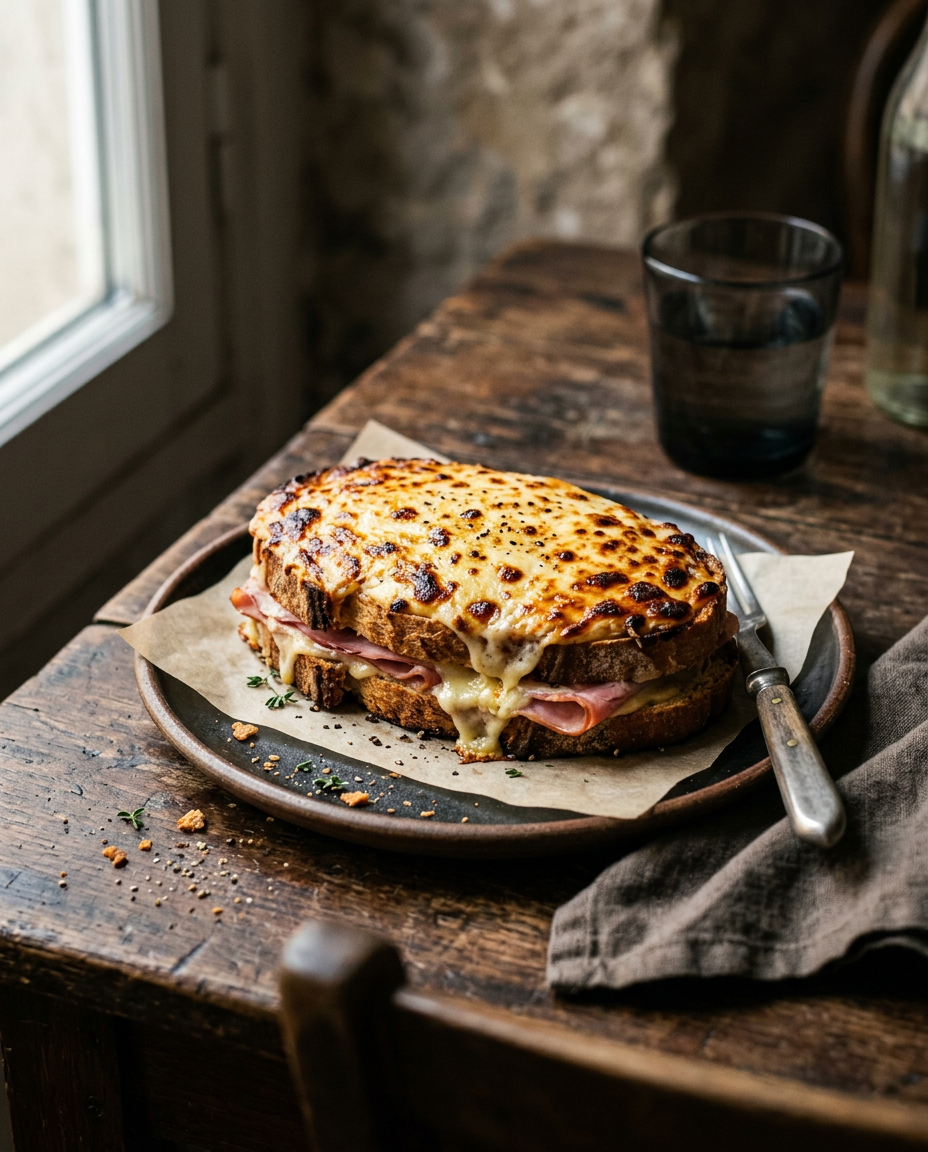
- The broiler finish — the signature. Heat the broiler (230–250 °C). Spread a spoonful of béchamel over each sandwich's top face, scatter or lay Gruyère over the sauce, and broil 2–3 minutes until the sauce blisters and browns in spots — the croque's own tuxedo. Checkpoint — the top sauce bubbles at the edges, browns in freckles, and the cheese at the sandwich's sides has gone molten-visible. The broiler runs fast at this range; the 30-second window between blistered and burnt is watched, not assumed.
- Rest 2 minutes, halve, serve. Checkpoint — eating test: the top's blistered sauce giving to the bread's butter-crisp, then the inside's molten strata — Gruyère's nutty pull, ham's gentle salt, the béchamel's cream through every layer — rich, savory, and complete without any condiment's help. It should taste like a café counter in Paris: a ham sandwich promoted by its sauce. The Madame (a fried egg on top) is the famous addition; the file notes it belongs at the table's request, runny-centered.
Doneness & Quality Checkpoints
- Béchamel at finger-line thickness, nutmeg's whisper, cheese melted through
- Cheese on both inside floors; ham buffered; sauce everywhere
- Medium-low griddle — deeper gold than a grilled cheese, watched closer
- Broiler finish to blister and freckle, 2–3 minutes at 230 °C-plus
- The 2-minute rest before the halving
Finish & Plate
Halved on the diagonal, the blistered top up, served on a warm plate with the classic's classic sides: a small bitter-green salad (frisée or arugula, mustard vinaigrette) to cut the richness. The French café's answer, and the file's.
Troubleshooting
| Symptom | Cause | Fix |
|---|---|---|
| Béchamel lumpy | Cold milk added fast | Warm milk, three additions, hard whisk over low |
| Top burnt under the broiler | Broiler unwatched | The 30-second window; distance from the element |
| Sandwich greasy | Butter and sauce doubled up on the outsides | Sauce inside only; butter outside only |
Storage, Make-Ahead & Variations
- Béchamel keeps 2 days refrigerated (4 °C); the assembled sandwich holds 30 minutes, the finished one serves in its minute. Reheat gently at 150 °C if it must wait — the broiler's blister does not survive, and the sandwich is still good. - Variations: the Croque Madame (the fried egg, runny yolk); the croque provençal (a spoon of tomato confit under the ham); the Mornay-forward version (extra cheese in the sauce); the open-faced tartine format for a lighter plate.