Cuban Sandwich
| Active time | 35 minutes |
| Hands-off time | The pork's braise (hours, ahead) |
| Difficulty | Moderate — the press's patience |
| Key techniques | the canon's layer order, the weighted press, the slow plancha |
| Make-ahead | pork 4 days; assembled 30 minutes; pressed, the minute |
Cuban Sandwich
Prep: 30 minutes (plus the pork's slow project) · Cook: 15 minutes · Total: About 45 minutes active (the pork runs hours ahead) · Makes 4 sandwiches
Ingredients
The layers, in order
- 1 Cuban bread loaf or 30 cm of French or Italian bread's closest width (about 100 g)
- 60 g sliced roast pork — mojo-marinated per below or the #46 braise's leftover
- 40 g sliced ham — boiled ham's plain tradition, not the honeyed lane
- 2–3 slices Swiss cheese (about 40 g)
- 3–4 pickle slices, dill, cut lengthwise in thin planks
- Yellow mustard, spread to the edges (about 15 g)
The mojo pork, if running the full project
- 700 g pork shoulder, in 4 cm pieces: marinated 4 hours or overnight in 90 ml orange juice, 45 ml lime juice, 6 garlic cloves (about 24 g) mashed with 1 tsp (5 g) oregano and 1 tsp (6 g) salt, 60 ml olive oil — then braised per #46's law (150 °C, 3 hours) and shredded or sliced
The press
- 2 tbsp (28 g) butter, softened
- A plancha or heavy pan, and a weight (a second pan, a foil-wrapped brick)
Instructions
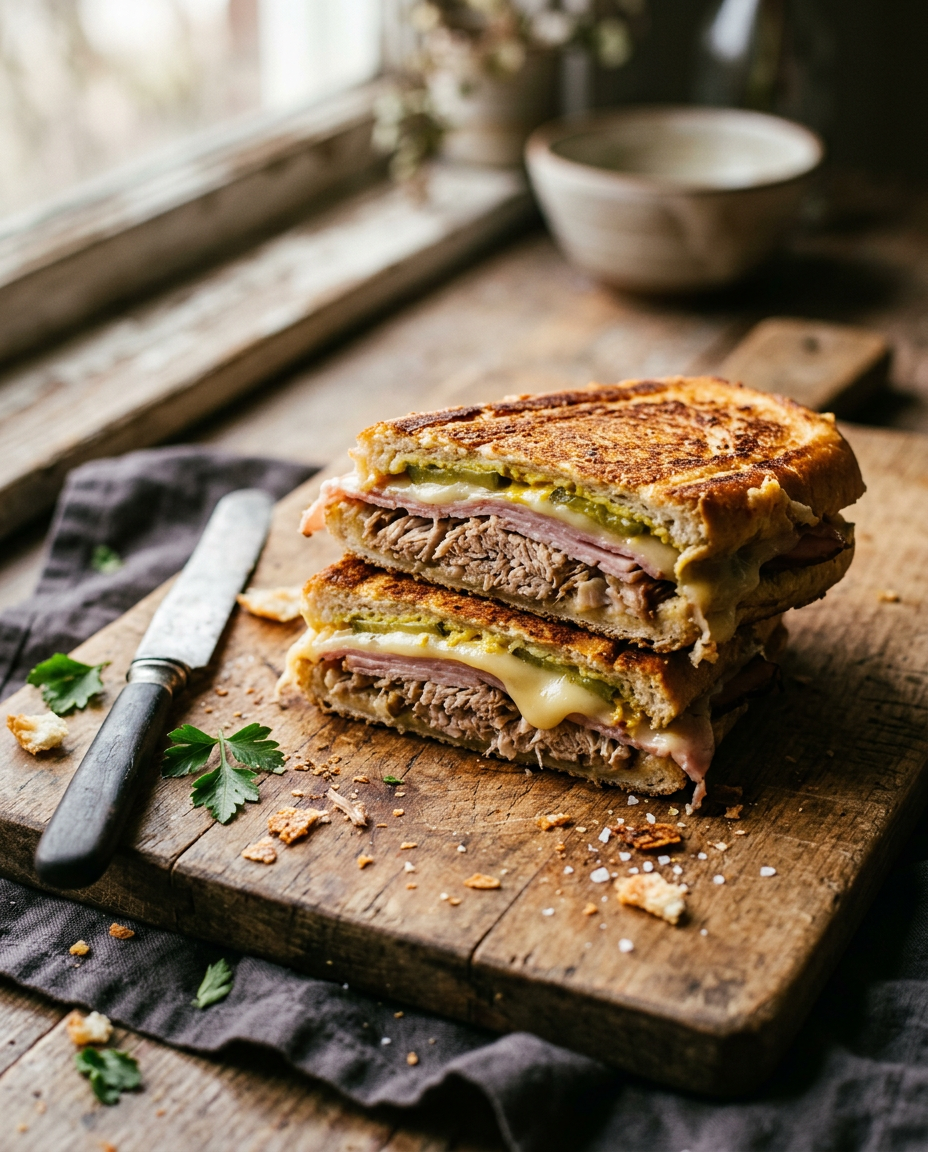
- Build in the canon's order — the blueprint. Bread split lengthwise, hinged; butter the outsides, mustard the insides (both faces, to the edges). Then, bottom up: roast pork, ham, Swiss, pickle planks, and the crown — pork nearest the bottom bread, cheese on both the top and (by the layer's position) meeting the crown's mustard. Checkpoint — from the side, the layers read in order: bread, mustard, pork, ham, Swiss, pickles, mustard, bread. The order is the sandwich's engineering — the pork (the moist layer) sits on the bottom bread's mustard barrier; the cheese's two positions anchor the melt to both faces; the pickles sit at the crown, their brine held by the cheese below them. Reordered, the sandwich still tastes right and presses wrong.
- Press on the hot plancha, weighted, 3–4 minutes a side. The pan over medium (about 190 °C at the surface — a water drop skitters), the sandwich in, and the weight set flat on top: a true press, the sandwich compressed to half its height over the first minute and held there. Checkpoint — the compression is visible and held — the bread flattens to a dense 2 cm, the cheese begins to run at the edges within the first 2 minutes, and the smell runs mustard, toasted pork, and dill. The press's weight is the technique: an unweighted sandwich toasts on two faces; a pressed one fuses to a single laminate.
- Flip once, press again, finish to shatter. The second side runs 3 minutes under the weight to matching flat gold; the cheese should be fully molten and visible at every edge, the pickles' ridges faintly printed through the crown's bread. Checkpoint — both faces flat, evenly golden, and crisp to the tap — the Cuban's signature shatter — with the laminated cross-section holding at the press's removal. If the bread springs back, the weight came off early.
- Halve on the diagonal and serve at the press's heat. Checkpoint — eating test: the bread's flat shatter giving to the fused strata — mojo pork's citrus-garlic depth, ham's clean salt, Swiss's nutty melt, mustard's tang and pickle's brine cutting every second bite — hot, crisp, dense, and complete in a way only a pressed sandwich achieves. The pickles and mustard should be unmistakable in every bite; they are the canon's clock, and the sandwich without them is a hot ham-and-pork that forgot its name.
Doneness & Quality Checkpoints
- The canon's layer order, mustard to the edges, planks not rounds
- A true weighted press — compressed to half and held
- Medium plancha, 3–4 minutes a side, cheese running at the edges
- The flat shatter at the tap, the laminate at the cut
- Pickles and mustard in every bite
Finish & Plate
The diagonal halves, laminate face out — the pressed cross-section is the presentation. A small café con leche beside it is the Miami tradition, and the plantain chips are the plate's usual companion. The sandwich needs nothing; it insists on everything.
Troubleshooting
| Symptom | Cause | Fix |
|---|---|---|
| Bread doughy, never crisped | Soft roll or unweighted press | The sturdy loaf; the true weight |
| Filling squeezed out the sides | Overfilled or pressed too hard too fast | The canon's measures; the steady weight, not a slam |
| Sandwich dry | Mustard thin, pickles skipped | Both to the edges — the canon's wet architecture |
Storage, Make-Ahead & Variations
- The mojo pork keeps 4 days refrigerated (4 °C) and the assembled (unpressed) sandwiches hold 30 minutes — the press runs at service. The pressed sandwich serves in its minute; a re-press at medium for 2 minutes a side restores most of the shatter. - Variations: the Tampa Cuban (salami's addition — a real regional canon, not a heresy); the #85 house version's liberties; the medianoche's sweet-egg-bread night build; the turkey substitution for the pork's lighter lane.