Egg and Cheese Breakfast Sandwich
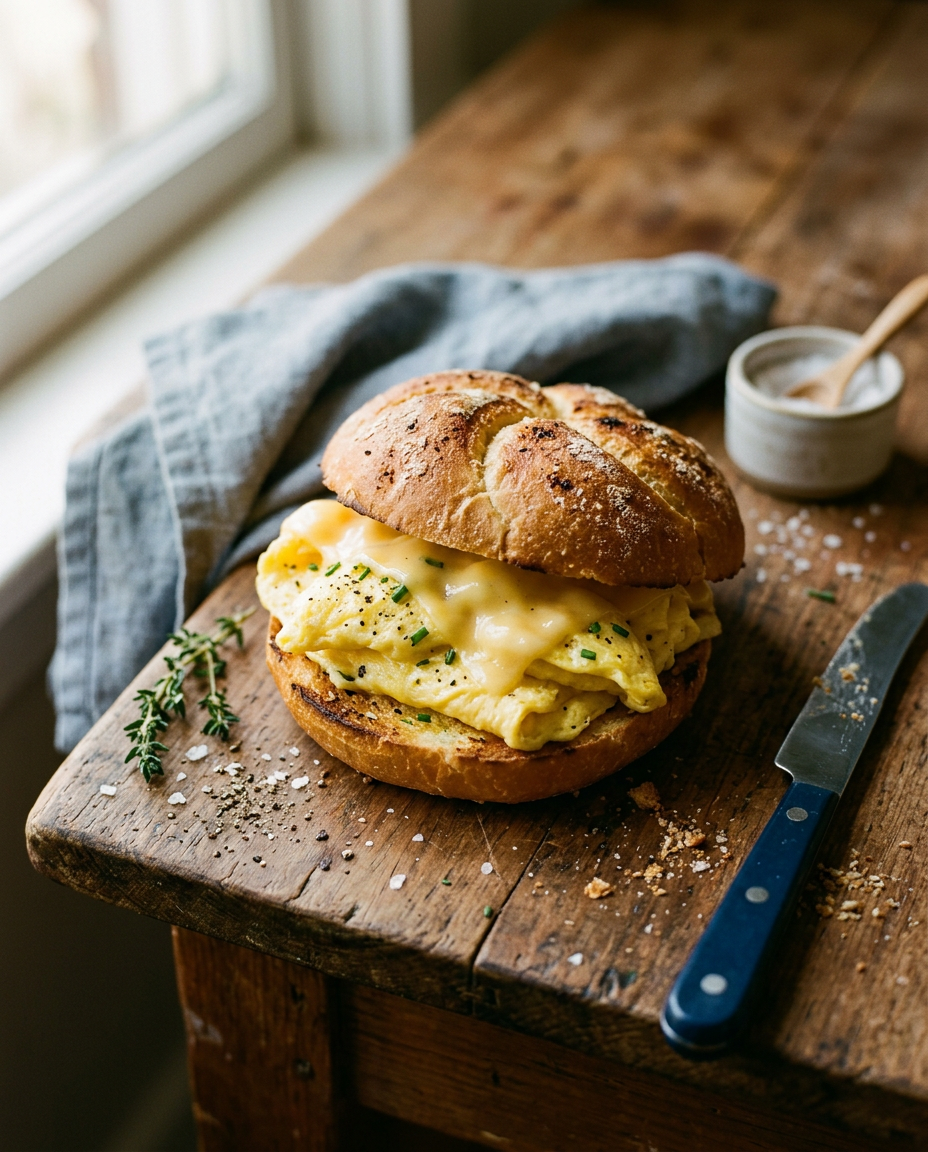
The deli flat-top classic: a soft egg pad — not a scramble, not an omelet — folded once around American cheese and tucked into a roll with salt, pepper, and the table's ketchup-or-hot-sauce decision. This is #78's bacon-free foundation: the flat-top egg's three-minute law and the roll's steam-toast, the two techniques every bodega egg sandwich runs on.
Egg and Cheese Breakfast Sandwich
Prep: 5 minutes · Cook: 8 minutes · Total: 13 minutes · Makes 2 sandwiches
Ingredients
The build
- 2 kaiser, telera, or hard rolls (about 80 g each) — or 2 English muffins for the McDonald's-adjacent lane
- 4 large eggs (about 200 g)
- 4 slices American cheese (about 70 g)
- 1 tbsp (12 g) butter
- Salt and black pepper
The optional builders
- 1 tbsp (15 g) ketchup or 1 tsp (5 g) hot sauce
- 1 tbsp (15 g) sliced onion or pepper, softened in the pan first
- 2 slices tomato (about 50 g), patted dry
Instructions
- Cook the eggs as pads, low and slow. Melt the butter over medium-low; crack the eggs directly into the pan's pool, keeping them clustered in pairs (or one at a time for tidiness), and let them set 60–90 seconds undisturbed until the whites go opaque at the edges and the yolks still dome. Puncture each yolk with the spatula's corner and swirl it once through the white — the yolk's liquid becomes the pad's moisture. Checkpoint — the whites are fully opaque with the yolks just losing their dome — one solid pad forming, not a scramble's curds and not a fried egg's distinct circles. The low heat is the law: high heat's browned, lacy edges are the wrong sandwich's signature.
- Fold into a pad with the cheese inside. Fold each pair of eggs in half once — a half-moon pad — laying the cheese slices inside the fold; give it 30 seconds on the heat, then flip the whole pad once for 20 seconds more, just to the cheese's first soften. Salt and pepper on the surface. Checkpoint — the pad is a soft, square-ish packet with cheese visibly melting at its seams — moist, pale-gold at most, never browned. It should be the roll's exact footprint (trim the pan's excess with the spatula's edge).
- Steam-toast the roll. While the egg finishes, split-side down in the same pan's buttery edge for 30–45 seconds — the steam softens the crumb's face while the pan toasts it: the deli roll's texture signature, soft-firm, never crunchy. Checkpoint — the roll's face is warm with the faintest toast, still squeezably soft — a crusty roll fights the soft egg and loses the sandwich's contrast.
- Build and serve in the minute. Bottom roll, the egg-cheese pad, any builders (ketchup zigzag, hot sauce, softened onion), crown pressed gently. Wrapped in deli paper for the road, as the format demands. Checkpoint — eating test: the roll's soft chew, then the egg pad's molten-moist give with American's salt-melt through it, the sauce's tang at the edge — a sandwich that eats like a morning, not a project. The yolk-swirl's moisture should just barely sauce the bread from inside; that is the pad's whole advantage over the dry scramble.
- Know your pan: a true flat-top gives the egg pad its shape free; a small nonstick pan gives it with a spatula's help — both are honest, the technique below runs either.
- Split the rolls and have them at hand; the egg's window from done to overdone is thirty seconds, and the cheese wants to land while the egg is still on the heat.
Troubleshooting
| Symptom | Cause | Fix |
|---|---|---|
| Eggs browned, lacy at the edges | Heat too high | Medium-low; pale-gold is the ceiling |
| Egg squeezes out at the bite | Scrambled, not folded | The pad's single fold; the yolk's single swirl |
| Sandwich dry by the last bite | Overcooked pad or dry roll | Pull at the cheese's first soften; the steam-toast |
Storage, Make-Ahead & Variations
- Serves in the minute, holds 10 wrapped; the eggs do not reheat honestly. The #78 BEC adds the bacon; the #67's viral French toast build swaps the roll for custard bread; the #54 wraps the same pad in a tortilla for the handheld lane. - Variations: the muffin lane; the double-pad for the big morning; the onion-and-pepper deli build; the hot-honey finish over the cheese — the modern bodega's own upgrade.