Egg Salad Sandwich
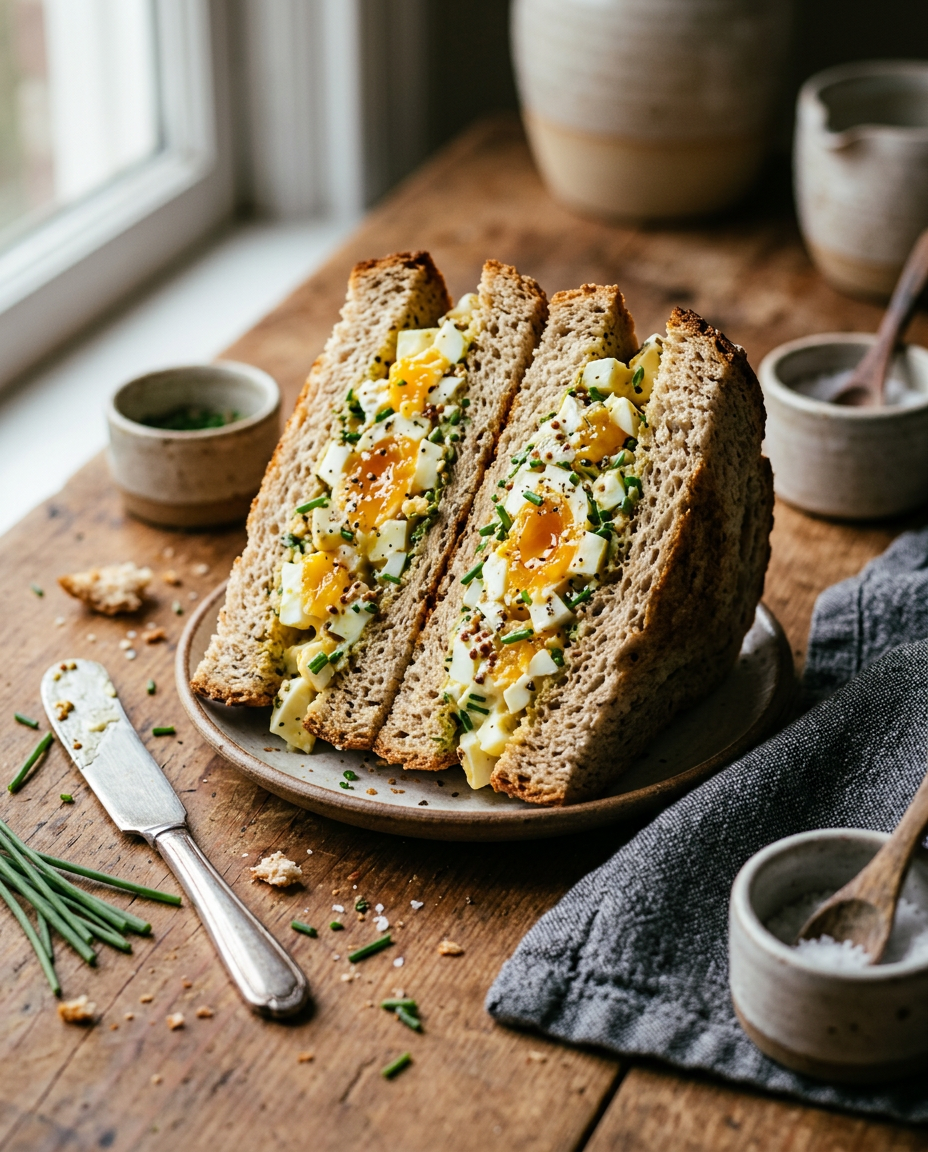
The bread logic for #37's master bowl: the ratio of egg to loaf, the toasting decision, the barrier spread, and the cut. A great egg salad sandwich is architecture — soft filling demands structural bread decisions that a turkey sandwich never faces — and this file makes them explicit.
Egg Salad Sandwich
Prep: 10 minutes (plus #37's bowl, chilled) · Cook: 10 minutes · Total: 20 minutes · Makes 2 sandwiches
Ingredients
The filling
- One batch #37 egg salad (about 500 g), chilled — or the quick half-batch: 4 eggs, 40 g mayo, 15 g sour cream, 1 tsp Dijon, 1 tsp lemon, chives, salt, pepper
- About 120 g (a scant 1/2 cup) of the salad per sandwich — the ratio law below
The bread and its architecture
- 4 slices white bread, Pullman, brioche, or potato bread (about 70 g each) — the soft trio that egg salad's tradition runs on; toasted for structure
- 1 tbsp (15 g) soft butter or an extra thin coat of mayo — the barrier spread
The companions, optional
- Lettuce leaves (about 15 g) — the green layer
- 2 slices tomato (about 60 g), patted dry, in season
- Potato chips alongside — or inside, the diner's secret crunch
- Black pepper, flaky salt at the cut face
Instructions
- Portion by the ratio — the file's core number. 120 g of egg salad per sandwich: a generous, fork-heaped half-cup that stands the bread's width. The common failure is the skimpy 60 g spread that reads as flavored bread; the second failure is the 200 g mound that exits at the second bite. Weigh it twice, learn the look, and the ratio is yours. Checkpoint — the portion, in the bowl, holds a rounded scoop's shape at the spoon's turn — heaped but not a ball.
- Barrier and lay. Butter (or the thin mayo coat) on all four faces of the two sandwiches' bread — the moisture barrier that keeps the salad's mayo from the bread's crumb — then the salad dropped in the center of the bottom slice and spread to within 1 cm of the crusts with the back of a spoon, gentle enough not to compress it. Checkpoint — the layer stands 1.5–2 cm at the center, lofted, with the bread's border kept clean — the border is the grip's real estate and the clean margin is what makes the sandwich eat neat.
- The companions in order. Lettuce flat on the salad, tomato on the lettuce (the #51 moisture order carried), chips pressed in if running them; the crown set on and one gentle press — a set, not a squash. Checkpoint — from the side: bread, butter, salad's loft, lettuce, tomato, bread — the green buffer visible at the sandwich's edge, the tomato nowhere near the bread.
- Cut and serve — the genre's own ceremony. The diagonal cut for the classic presentation, or the four-tea-triangle cut (both diagonals) for the tea-room register; the cut face showing the salad's chunk-and-cream texture (#37's half-chop law visible in cross-section), a crack of black pepper and a pinch of flaky salt over the exposed filling. Checkpoint — eating test: the toast's crisp giving to the salad's cool, chunky-cream center — egg's richness, lemon's lift, chive's onion-note — with the lettuce's snap or the chips' salt-crunch arriving at the finish. It should taste like the best version of the sandwich you grew up on, which is the file's whole mission for the genre.
- Chill the egg salad before it meets bread — warm salad softens the butter barrier and greases the bread's face. Thirty minutes at 4 °C is the minimum; #37's overnight bowl is the ideal.
- Decide the toast by the clock: eating now runs soft untoasted brioche (the tea-room register); traveling or lunchboxing runs a light toast (the structure register). The file defaults to toast — it holds the filling's weight and moisture through a morning.
Troubleshooting
| Symptom | Cause | Fix |
|---|---|---|
| Sandwich soggy by noon | No barrier or untoasted travel bread | Butter both faces; toast for the lunchbox build |
| Salad squeezed out at the bite | Over-portioned or hard-pressed | The 120 g law; one gentle set |
| Bland despite good salad | The salad under-seasoned for cold service | #37's lemon-and-salt at the chill — colder needs brighter |
Storage, Make-Ahead & Variations
- The assembled sandwich holds 3–4 hours at cool with the toast-and-barrier architecture; #37's bowl keeps 2 days and builds fresh each morning — the meal-prep format the genre actually wants. - Variations: the tea-triangle cut with the crusts off; the #37 curry lane on brioche; the avocado-underlayer (the California build); the #59 slider format for the shower tray — this file's ratio scales by the bread's size.