French Dip
| Active time | 50 minutes |
| Hands-off time | 3 hours (roast, rest) |
| Difficulty | Moderate — the low roast and the rest's discipline |
| Key techniques | the 140 °C roast to 55 °C internal, the full rest, the deglazed jus |
| Make-ahead | roast 3 days; jus 4 days frozen 2 months |
French Dip
Prep: 30 minutes · Cook: 3 hours 15 minutes · Total: About 3 hours 45 minutes · Makes 6 sandwiches (with jus left over)
Ingredients
The roast
- 1.5 kg (3 lb) beef top round, sirloin tip, or eye of round — the lean roasts that run this sandwich's tradition
- 2 tbsp (14 g) mixed black pepper and garlic powder, coarsely ground, for the crust
- 1 tbsp (12 g) neutral oil
- 1 tsp (5 g) salt
The jus's aromatics
- 1 onion (about 200 g), quartered
- 1 carrot (about 100 g), in chunks
- 2 garlic cloves, smashed
- 1 tbsp (8 g) tomato paste
- 750 ml (3 cups) beef stock or #110's light stock — plus water as needed
- 1 bay leaf, 3 thyme sprigs (about 3 g)
- 1 tbsp (15 ml) soy sauce or Worcestershire — the umami floor
- Salt and pepper to finish
The sandwiches
- 6 crusty French or torpedo rolls (about 85 g each)
- 6 slices provolone (optional — the "with cheese" vote)
- Horseradish cream or hot mustard, optional — the sharp's seat
Instructions
- Crust and sear the roast, 10 minutes. Pat the roast bone-dry; rub with oil, salt, and the pepper-garlic crust on every face. A heavy pan screaming hot; sear 2 minutes a face to dark brown on all sides — the crust's flavor is the jus's foundation as much as the meat's. Checkpoint — every face dark-brown crusted, the pan's floor carrying a serious fond, the roast's surface no longer moist. A pale roast bakes gray water; the sear is not optional at this temperature.
- Roast low to 55 °C, about 2 to 2½ hours. The aromatics and tomato paste stirred into the pan's fond; the roast set on a rack above them, and the pan into the 140 °C oven. At the 90-minute mark, begin checking: an instant-read thermometer in the thickest point, pulled at 55 °C for medium-rare (the rest carries it to a finished 58–60 °C). Checkpoint — 55 °C read at the center, the roast's exterior mahogany, the juices running faintly pink in the pan — not gray-brown, which means the interior overcooked. The thermometer is the tool; a lean roast at this size crosses from medium-rare to medium in fifteen minutes of oven, and the probe's precision is the sandwich's pink guarantee.
- Rest fully — 30 minutes, tented. The roast to a cutting board, tented loosely with foil, and the patience begins: the rest's full half hour lets the meat's fibers reabsorb their juice, and a lean roast cut early floods its whole flavor onto the board. Meanwhile, the jus builds. Checkpoint — at the 30-minute mark the roast's surface has stopped steaming and the first slice's cut face shows juice retained — glistening, not flooding. The rest is the difference between a sandwich that drips jus only from the dip and one that was dry before it was built.
- Build the jus from the pan, 15 minutes. The roasting pan (fond, aromatics, drippings, everything) set over two burners at medium; the tomato paste toasted in the fond 1 minute; the stock poured in with the herbs and soy, scraping the pan's floor to dissolve every browned fragment into the liquid. Simmer 10–12 minutes to concentrate by a third; strain, skim the fat's surface layer, and season with salt and pepper to a full, savory, drinkable broth. Checkpoint — the jus runs deep brown and crystal clear after the strain, tastes of the roast itself (not just the stock), and sits at a sip's salt level — a jus should be drinkable alone. Weak? Reduce 5 more minutes uncovered; the concentration is the jus's whole job.
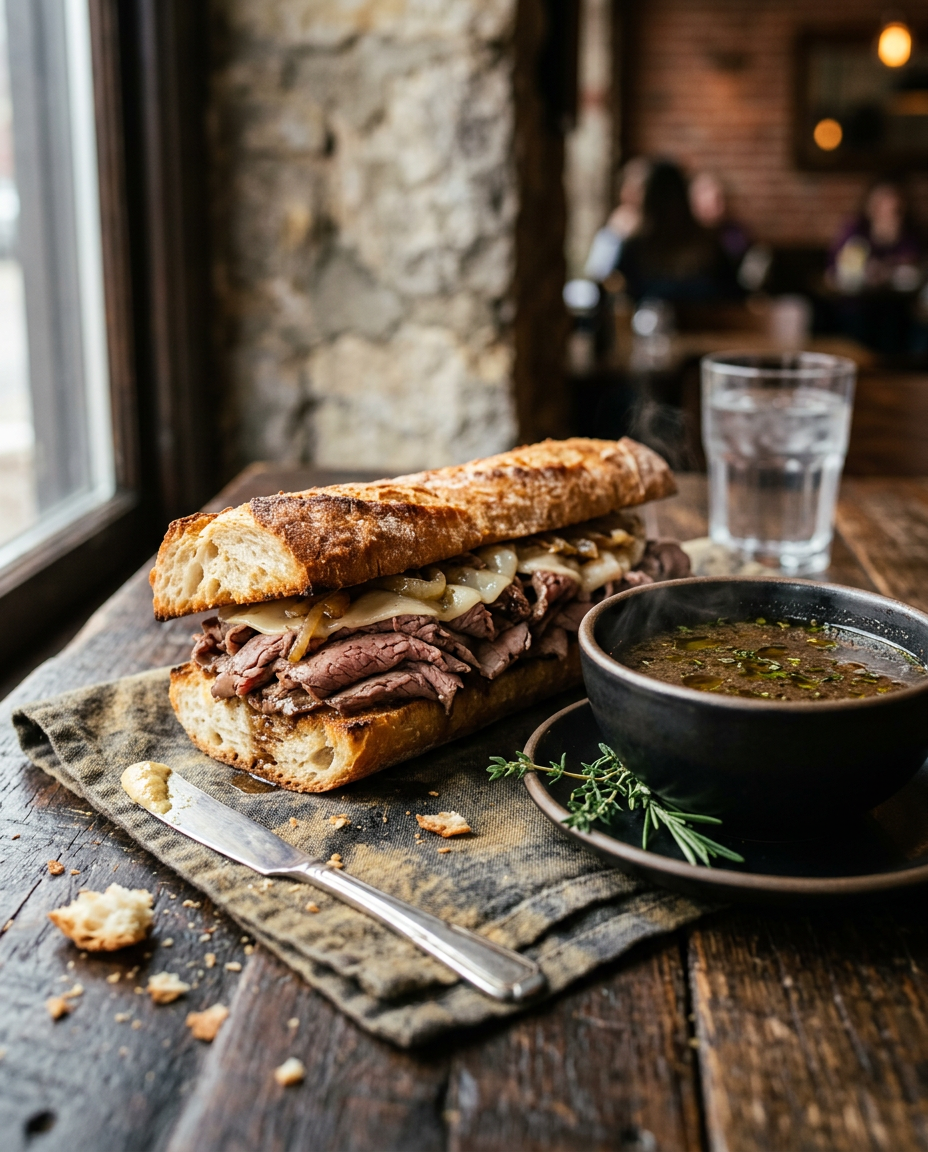
- Slice thin, build, dip. The rested roast sliced across the grain as thin as your knife allows — 2–3 mm, translucent edges — and the slices laid into the rolls (toasted lightly and, the traditional touch, dragged through the jus's surface for the bread's first moistening). Cheese if running, horseradish's smear if sharp; and each sandwich served with a small bowl of the hot jus for dipping. Checkpoint — eating test: the roll's crust giving to the rare beef's juice, the dip's jus running into the bread's channels at each bite — beef, bread, and broth arriving as one soggy-fingered, deeply satisfying unit. The jus should taste like the roast distilled; if it tastes like the stock can, step 4's concentration was rushed.
Doneness & Quality Checkpoints
- Sear to dark crust before the low oven
- 140 °C roast, thermometer to 55 °C — the pink guarantee
- The full 30-minute rest, tented, before any slicing
- Jus strained, skimmed, reduced to drinkable depth
- Sliced 2–3 mm across the grain; bread dragged, not soaked
Finish & Plate
The sandwich and its jus bowl side by side — the dip is the ceremony, and the bowl should hold enough for the whole sandwich's tenure. The sandwich's structural warning, served with love: the dipped French drip does not forgive white shirts, and the format's own etiquette accepts this.
Troubleshooting
| Symptom | Cause | Fix |
|---|---|---|
| Roast gray at the edges, no pink | Oven hot, probe late | The 140 °C doctrine; probe from 90 minutes |
| Jus weak, tastes of stock | Under-reduced, fond unmelted | The 10-minute reduction; scrape everything brown |
| Slices crumble, tear | Sliced with the grain or before resting | Across the grain; the full rest |
Storage, Make-Ahead & Variations
- Roast keeps 3 days refrigerated (4 °C) sliced; jus keeps 4 days refrigerated, 2 months frozen — the bank note above. The assembled sandwich serves in the minute; the dipped one immediately. - Variations: the cheese-smothered lane (provolone melted under the broiler); the horseradish-and-cream build; the onion-confit seat; #86's weeknight version as the honest shortcut sibling.