Maine Lobster Roll
| Active time | 30 minutes |
| Hands-off time | 20 minutes (lobster cool, rest) |
| Difficulty | Moderate — the lobster's exact window |
| Key techniques | the steam's exact clock, the big-chunk law, the buttered roll |
| Make-ahead | lobster meat 1 day; rolls, the minute |
Maine Lobster Roll
Prep: 30 minutes · Cook: 15 minutes · Total: 45 minutes · Makes 4 rolls
Ingredients
The lobster
- 4 live lobsters, 550–650 g each (about 2.4 kg total), or 600 g picked cooked lobster meat from the fishmonger — the honest shortcut
The bind — and only the bind
- 60 g (1/4 cup) mayonnaise — the lightest coat, see the law
- 1 tbsp (15 ml) lemon juice
- 1 tsp (2 g) lemon zest
- 1/4 tsp (1 g) salt, black pepper
- Optional whisper: 1 tsp (1 g) fresh tarragon or chives, minced — Maine runs it plain; the file offers the whisper
The rolls
- 4 split-top (New England-style) hot dog rolls (about 60 g each) — the flat-sided rolls the format demands
- 45 g (3 tbsp) butter, for griddling
Instructions
- Steam the lobsters, 8–9 minutes. Live lobsters into the steamer's rack above the boiling water, covered, timed from the cover's return to steam: 8 minutes for 550 g, 9 for 650 g. The shells run the brightest red, and the meat's done-ness runs at the tail's just-opaque. Checkpoint — the tail's shell is vivid red with no dark spots; an antenna pulls free with a gentle tug (the old fisherman's test); and the claw meat's largest section is opaque white with no translucence. Overcooking is the one fatal error — a minute long at this size turns tail meat from tender-sweet to pencil-eraser, and the file's clock is not advisory.
- Shock, cool, and pick — the patient half hour. Straight to the ice bath 3 minutes; then the picking: twist the claws and knuckles free, split the claws with a nutcracker's firm crack, pull the tail's meat in one piece and remove the vein, and pick the knuckles' sweet hiding pieces with the lobster pick's patience. Every fragment to a bowl; the shells to the stockpot (#110's dividend) or the bin. Checkpoint — about 140–150 g of meat per lobster in big pieces — tails in cylinders, claws in their whole sections, knuckles in nuggets. The picking is not shredding: the meat's whole pieces are the sandwich's architecture, and every piece larger than a knuckle stays whole.
- The bind — the lightest law on this site. Whisk the mayo, lemon juice and zest, salt, and pepper; fold the lobster meat through with two strokes of the spatula — coat, do not mix. The ratio runs roughly a tablespoon of bind per lobster, and the goal is a glisten, not a salad: the lobster should read as lobster held loosely in lemon-mayonnaise light. Checkpoint — every piece glistens and none is buried; a piece lifted from the bowl carries a film, not a coat. The Maine roll's whole doctrine is restraint — the common deli failure (a mayo lobster salad) is exactly what the chunk law exists to prevent.
- Chill the bind 20 minutes while the rolls griddle. The bound lobster to the fridge (4 °C) for its 20-minute set — the flavors marry cold, and the cold lobster against the hot buttered roll is the temperature architecture. The rolls: split-top rolls buttered on both flat sides, griddled in a pan over medium 2–3 minutes a side to deep gold and crisp. Checkpoint — the roll's flat faces run deep butter-gold and crisp at their edges, the crumb inside still soft and steaming faintly — the roll's shape (flat-sided, split down the crown) exists precisely for this griddle, and standard round hot dog rolls are a different, lesser geometry.
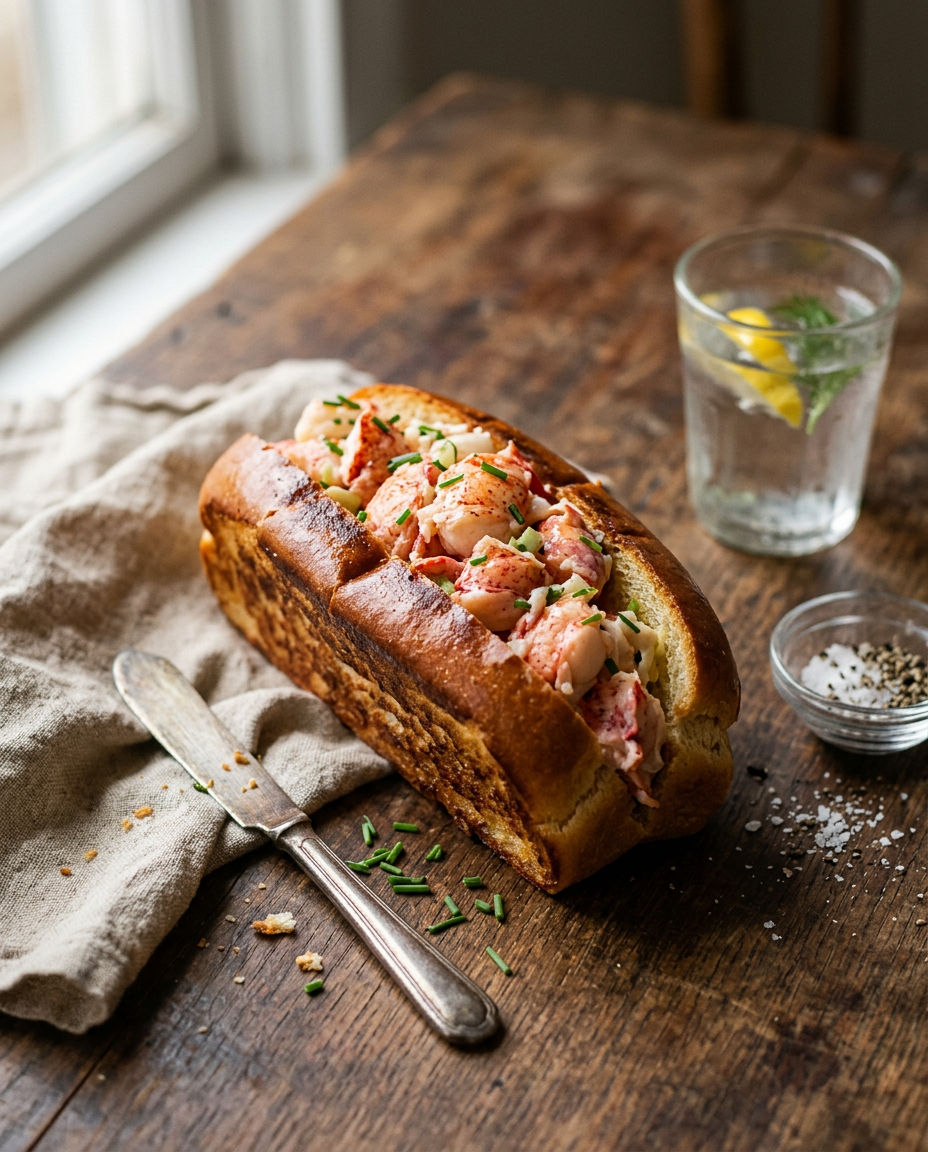
- Pile and serve — the crown's fill. The chilled lobster spooned into the griddled roll's channel, mounded above the crown's edges in big chunks — the pile should look extravagant, because at 140 g of lobster per roll it is. A final grind of pepper; nothing else. Checkpoint — eating test: the buttered roll's crisp, the cold lobster's sweet-tender chunks, the lemon-mayo's brightness between them — hot-and-cold, rich-and-bright, every bite dominated by the lobster itself. It should taste like the coast's entire argument condensed to a roll; if the first taste is mayonnaise, step 3's law slipped and the sandwich deserves a re-do.
Doneness & Quality Checkpoints
- The steam's exact clock — 8–9 minutes at this size, ice-bathed immediately
- Tails and claws in whole pieces; only knuckles in nuggets
- The bind at a film, not a coat — the lightest law
- Cold bind against the hot griddled roll
- The pile above the crown — extravagance is the portion
Finish & Plate
The roll on a small board or a basket's paper liner, the pepper's last grind over the pile, and the traditional sides that need no improvement: potato chips, a pickle, and a cold beer or lemonade. The roll's paper wrap is half the service — the grip keeps the pile's architecture in the eater's hand.
Troubleshooting
| Symptom | Cause | Fix |
|---|---|---|
| Lobster rubbery | Oversteamed or no ice bath | The exact clock; the shock's immediacy |
| Roll soggy before the first bite | Lobster wet from picking or the bind heavy | Pat the meat dry at the picking; the film's ratio |
| Sandwich reads as lobster salad | Overworked bind, shredded meat | Two spatula strokes; the chunk law |
Storage, Make-Ahead & Variations
- Picked meat keeps 1 day refrigerated (4 °C); the bound lobster keeps 1 day (some say it improves — the file says eat it fresh); the griddled roll serves in its minute. - Variations: the Connecticut hot-butter lane above; the #18 shrimp roll as the budget sibling running this exact format; the lobster-and-corn summer build; the brioche bun's modern lane, which the file notes and declines.