Meatball Sub
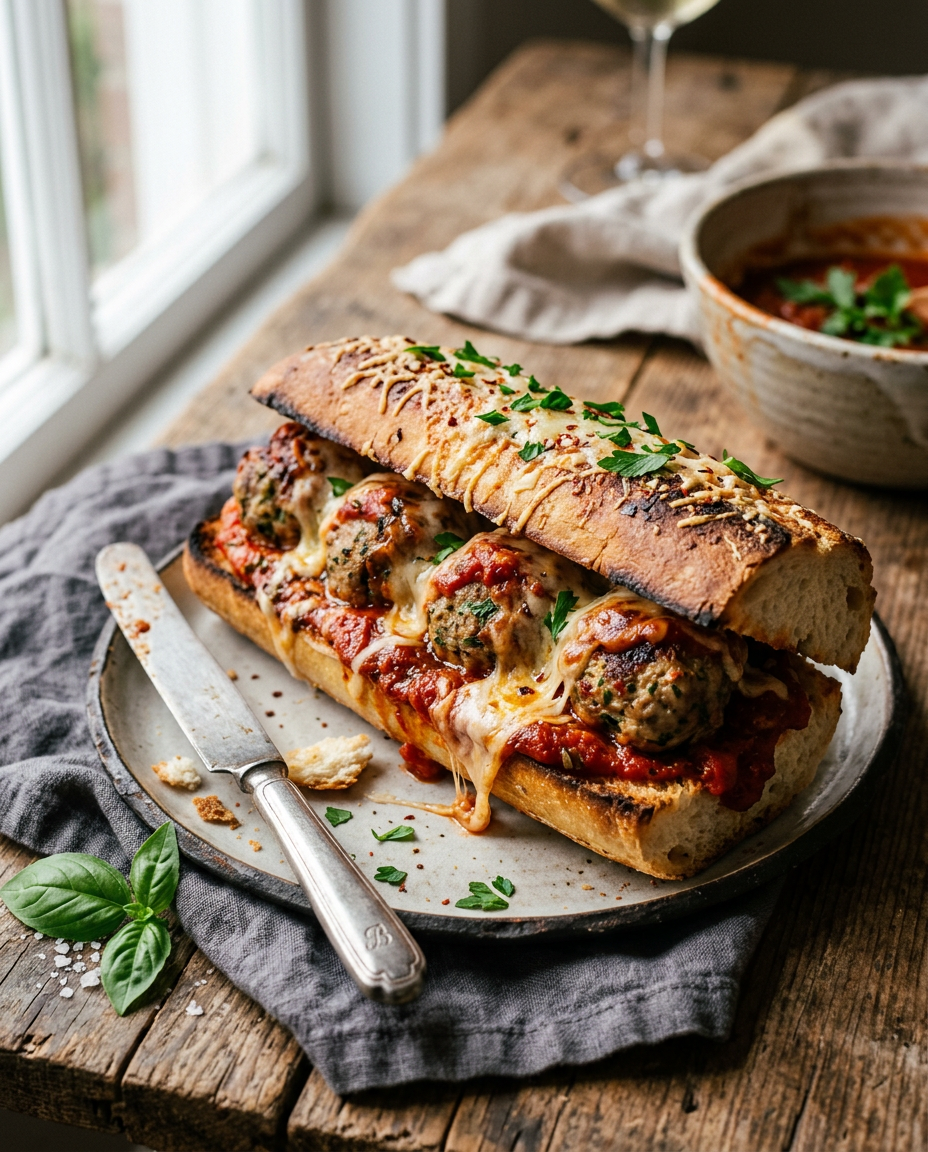
The red-sauce hero's other seat: tender meatballs in a thick tomato sauce, blanketed in mozzarella, broiled to the cheese's blister in a roll engineered to survive. The craft is the meatball's tenderness (milk-soaked bread, the gentle hand), the sauce's thickness (thicker than pasta's — the sub's demand), and the bread's three defenses: the hollow, the toast, and the broiler's speed.
| Active time | 45 minutes |
| Hands-off time | 30 minutes (sauce simmer) |
| Difficulty | Moderate — the tender ball, the defended roll |
| Key techniques | the panade's tenderness, the sauce's thickness, the broiler's melt |
| Make-ahead | meatballs and sauce 3 days; assembled, the broiler's minute |
Meatball Sub
Prep: 30 minutes · Cook: 45 minutes · Total: About 1 hour 15 minutes · Makes 4 subs
Ingredients
The meatballs and panade
- 60 g (about 1 slice) white bread, torn, soaked in 90 ml (about 90 g) whole milk — the panade
- 500 g ground beef (or 350 g beef + 150 g pork, the fuller flavor)
- 50 g (about 1/2 cup) grated parmesan
- 1 egg (about 50 g)
- 2 garlic cloves (about 8 g), grated
- 2 tbsp (8 g) chopped parsley
- 1 tsp (2 g) dried oregano, 1 tsp (6 g) salt, 1/2 tsp (1 g) pepper
The sauce
- 2 tbsp (25 ml) olive oil, 3 garlic cloves (about 12 g) sliced, 700 g crushed tomatoes, 1 tsp (1 g) oregano, 1/2 tsp (2 g) salt, pinch of sugar, 5 g basil — simmered 15 minutes to the spoon-coat
The build
- 4 sub rolls (about 90 g each)
- 200 g low-moisture mozzarella, sliced
- 30 g (about 1/3 cup) grated parmesan
- Optional: a schmear of garlic butter (1 tbsp/14 g per roll) — the defended roll's third wall
Instructions
- Mix gently, roll loosely. The panade mashed to paste with the fork; the meat, parmesan, egg, garlic, parsley, oregano, salt, and pepper added and mixed with the hands just until uniform — 45 seconds, no more. Roll 16 balls (about 40 g each) with a light palm — placed in the hand and nudged to round, never squeezed. Checkpoint — the mixture feels soft and just-holding; the balls are round, faintly tacky, and fragile to a hard press. The gentle hand is the technique: compression at the roll is density at the bite.
- Brown and braise in the sauce. The balls browned in a film of olive oil over medium — 2 minutes a face, two faces, just for the crust's flavor (they need not cook through) — then slipped into the simmering sauce, covered, 20 minutes at the barest murmur, to finish gently in the tomatoes' acid-tender bath. Checkpoint — at the 20-minute mark, a ball cut through runs cooked and juicy-tender (no pink), its texture yielding to the fork's edge without resistance — the panade's proof at the bite.
- Build the defended roll. Rolls split, the crumb pulled to a channel; the faces toasted golden (a dry pan or the oven — the toast is the sauce's barrier); the optional garlic butter's film on the crown. Three meatballs (4 at the hungry table's order) nested in the channel; 2–3 spoons of thick sauce over the balls only — the bread's sides stay dry by design. Checkpoint — the meatballs sit cradled, touching but not crushed, the sauce coating them thickly (it clings, does not run — the sauce's thickness's whole purpose); the roll's walls and crown run dry, awaiting only the cheese.
- The broiler's melt, 2–3 minutes at 230 °C. Mozzarella slices laid over the meatballs' shoulders, parmesan over the mozzarella, and the open rolls under the broiler to the cheese's melt and first brown blisters. Checkpoint — the cheese blisters bronze at its peaks and runs molten into the sauce below; the roll's crown toasts at its edge; the whole sub emerges as one steaming, fused unit. The broiler's speed is the bread's final defense — the melt happens fast enough that the sauce's soak barely starts.
- The crown's close and the two-handed serve. Checkpoint — eating test: the roll's toast giving to the meatball's tender-savory crumble, the sauce's bright-garlic thickness clinging, the mozzarella's pull running from the ball to the bread at every bite, parmesan's salt at the finish — a sub that holds its architecture to the last third, which is the whole engineering's argument. The meatball should be the tenderest thing in the sandwich; if it reads dense, the gentle-hand law slipped.
- The panade first, always: the bread soaks in the milk 10 minutes until it collapses to paste — the meatball's tenderness's whole mechanism (the milk-and-bread paste lubricates the meat's proteins so they cook to tender instead of dense; skip it and the ball runs a meatloaf's grain).
- The sauce simmers while the meatballs mix and roll — the two clocks run together by design.
Doneness & Quality Checkpoints
- Panade soaked to paste; the gentle mix; the loose roll
- Two-face brown, 20-minute sauce braise at the murmur
- Sauce at the spoon-coat thickness — clinging, never running
- The defended roll: hollowed, toasted, dry-walled
- Broiler to the blister — the fast melt, the last defense
Finish & Plate
The closed sub on paper's grip, halved only at the table's bravery — the full sub is the traditional serving. A fork's assistance at the end is honest; the napkin's count is the plate's real side dish.
Troubleshooting
| Symptom | Cause | Fix |
|---|---|---|
| Meatballs dense | Overmixed, squeezed, or panade skipped | The panade's paste; the gentle hand; the nudge's roll |
| Roll soggy by the half | Thin sauce or untoasted walls | The 15-minute reduction; the golden toast |
| Cheese unmelted, bread scorched | Broiler unwatched | The 2–3 minute vigil; distance from the element |
Storage, Make-Ahead & Variations
- The meatballs in sauce keep 3 days refrigerated (4 °C), improving; the broiled sub serves in its minute, and the broiler's revival (2 minutes) restores the day-after honestly. - Variations: the chicken-meatball light lane; the spicy fra diavolo sauce; the pepper-and-onion seat; the #83 chicken parm as the same architecture's other hero; the slider format on the #44 tray for the party's third act.