Monte Cristo
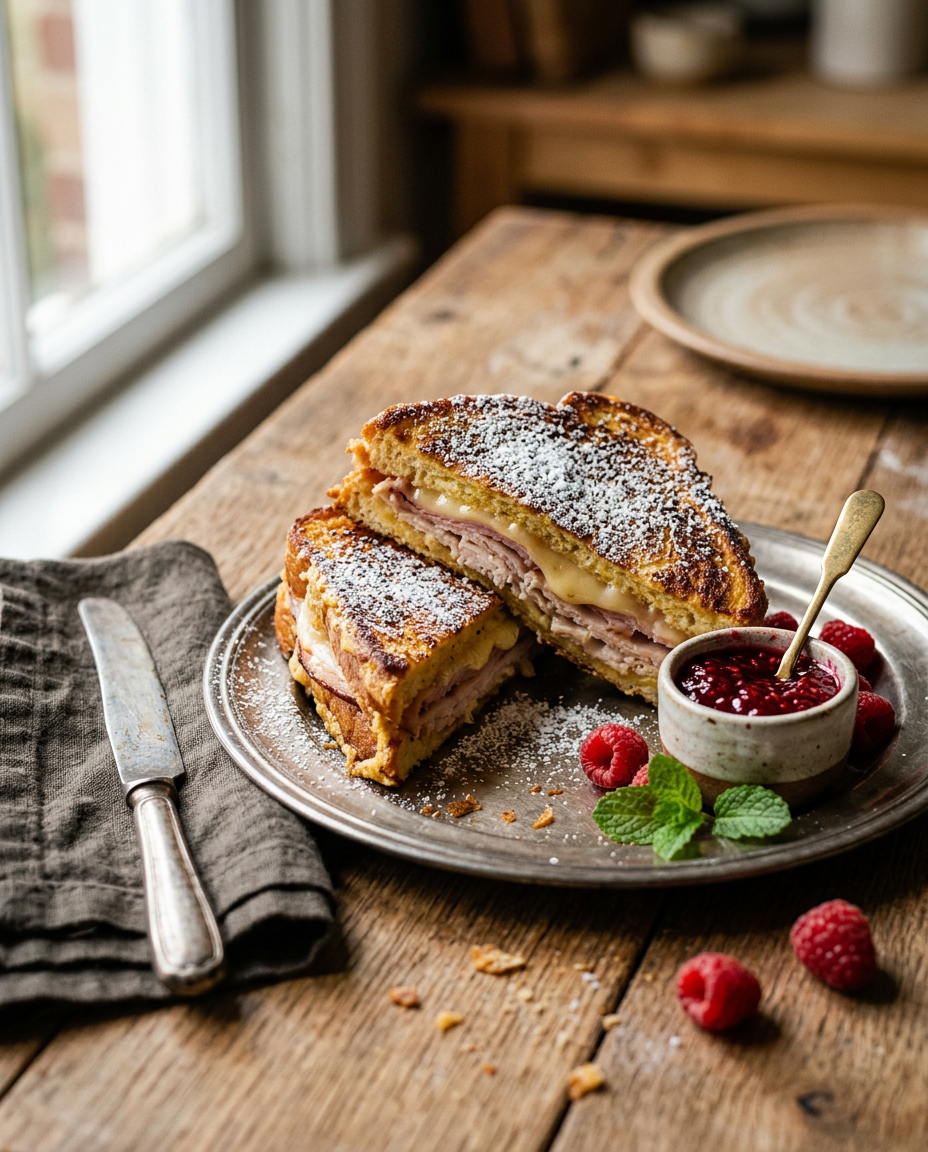
The croque's diner descendant: ham and turkey (sometimes Swiss, always mustard) inside a sandwich that is battered like French toast, griddled golden, dusted with powdered sugar, and served with jam or maple for dipping. Sweet, savory, and rich in equal measure — the 1930s lunch-counter's baroque argument, and a technique file about frying a sandwich in custard without losing it to the pan.
| Active time | 30 minutes |
| Hands-off time | 10 minutes (the set) |
| Difficulty | Moderate — the battered griddle's discipline |
| Key techniques | the tight build, the fast dip, the medium-low griddle |
| Make-ahead | assembled (unbattered) 1 day |
Monte Cristo
Prep: 20 minutes · Cook: 20 minutes · Total: 40 minutes · Makes 4 sandwiches
Ingredients
The sandwiches
- 8 slices white bread, brioche or Pullman (about 65 g each)
- 200 g (about 7 slices) roast turkey
- 200 g (about 7 slices) ham
- 150 g (about 6 slices) Swiss or Gruyère
- 2 tbsp (30 g) Dijon or whole-grain mustard — the tang that holds the richness in line
The batter
- 3 large eggs (about 150 g)
- 90 ml (6 tbsp) milk
- 1 tbsp (8 g) flour
- 1/4 tsp (1 g) salt, 1/4 tsp (0.5 g) nutmeg or cinnamon
- 2 tbsp (28 g) butter, for the griddle
The finish
- Powdered sugar, for dusting (about 8 g)
- Berry jam or maple syrup (about 60 g), for dipping
Instructions
- Build and press the sandwiches. Mustard, cheese, ham, turkey, cheese, mustard, bread; press each sandwich firmly with the flat of your hand for 10 seconds and trim the crusts flush. If the clock allows, rest the built sandwiches 10 minutes (or refrigerate up to a day, covered) — the press and the rest fuse the layers so the batter's dip cannot find seams. Checkpoint — each sandwich reads as one solid block with clean, even edges; no filling visible at the borders. The trimmings, mustard-side up, are the cook's board tax.
- Dip fast, both faces. One sandwich at a time: 4 seconds in the batter's first side, flip, 4 seconds the second, lift with both hands (one flat hand under, one over — the sandwich travels as a unit) straight to the pan. The dip is a coat, not a soak — a soaked Monte Cristo goes to custard's soup at its center and falls apart at the flip. Checkpoint — the bread's faces glisten with batter but have not drunk it; the sandwich still holds its block's rigidity in the hand's carry. If batter pools on the surface after the lift, it was too thick — whisk in a splash of milk.
- Griddle at medium-low, 4 minutes a side, once only. Butter in the pan over medium-low (the batter's sugars brown fast; this runs lower than a grilled cheese), the sandwich laid in and cooked undisturbed to a deep, even gold, then flipped once with a full spatula's support and finished the same. The second side runs 3–4 minutes; both sides dry to the touch at their edges when done. Checkpoint — the shell is evenly golden and set — the batter fried to a thin, crisp membrane around the bread — and the sandwich's center is steaming-hot (the cheese visibly molten at the pressed edges). No gray, wet batter anywhere: pale means undercooked shell, and undercooked batter is the difference between this and a very good reason nobody makes these.
- Dust, halve, dip. Off the pan, the powdered sugar dusted through a sieve while the shell is hot (it catches on the crisp surface and just begins to melt at the warmest points), the diagonal halving, and the jam or maple at the side. Checkpoint — eating test: the batter's crisp shell, the bread's soft custard-edge, then the inside's savory melt — turkey and ham and Swiss with the mustard's tang under the sweetness's counterpoint — and the jam's berry-bright dip resetting the whole cycle for the next bite. The sweet-savory argument should be balanced to the point of constant negotiation; if either side wins, adjust the dust or the mustard, never the batter.
- Build the sandwiches first, and build them tight: mustard on all faces, cheese against bread on both floors, ham and turkey layered between, pressed firmly and the crusts trimmed — a batter-dipped sandwich holds together only if it starts as one solid mass, and the trim's clean edges dip cleaner than ragged ones.
- Whisk the batter to a smooth, thin custard — thinner than French toast's: the flour and the extra egg make a coating that fries to a thin shell rather than soaking in.
Doneness & Quality Checkpoints
- Sandwiches built tight, pressed, trimmed, and rested before any batter
- The 4-second dip — a coat, never a soak
- Medium-low, flipped once, shell dry and golden at both edges
- Center steaming, cheese molten at the pressed seams
- Sugar dusted hot; jam at the side — the negotiation's instruments
Finish & Plate
The diagonal halves stacked against each other, the sugar's snow over the plate's half, the jam in its small cup — the visual is the dish's own tradition, baroque by design. A fork and knife are legitimate here; the Monte Cristo has never pretended to be street food.
Troubleshooting
| Symptom | Cause | Fix |
|---|---|---|
| Sandwich fell apart at the flip | Loose build, over-soaked, or thin batter | Press and rest the build; the 4-second dip; flour in the batter |
| Shell burnt, center cold | Heat too high | Medium-low's patience; the sugars run faster than the bread |
| Reads greasy | Pan overcrowded or butter burnt | Two at a time; fresh butter's film per batch |
Storage, Make-Ahead & Variations
- The built sandwiches keep 1 day refrigerated (4 °C) — batter and griddle at service. The fried sandwich serves in its minute; a reheat at 150 °C (8 minutes) restores most of the shell, never all. - Variations: the ham-only classic; the turkey-and-Swiss lean; the raspberry preserve's traditional dip; #67's viral build as the format's modern, mapled descendant — and #62 as the un-battered ancestor.