New Orleans Muffuletta
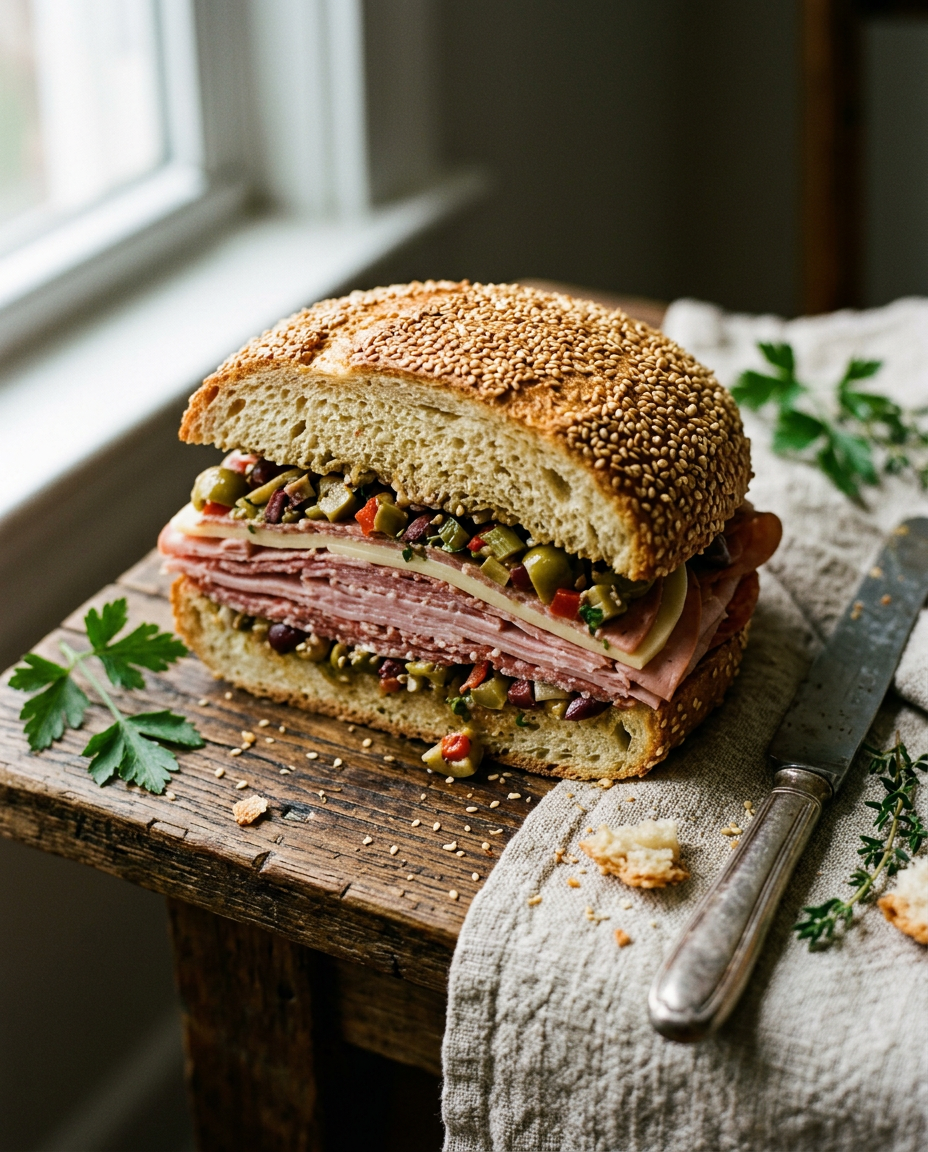
| Active time | 40 minutes |
| Hands-off time | 1 hour to overnight (the salad's soak) |
| Difficulty | Easy — chopping and layering |
| Key techniques | the olive salad's balance, the layered dome, the weighted wait |
| Make-ahead | olive salad 3 weeks; sandwich peaks at 2–24 hours |
New Orleans Muffuletta
Prep: 30 minutes (plus the olive salad's 1 hour) · Cook: 10 minutes · Total: About 40 minutes active (the salad improves for days) · Makes 1 large muffuletta (8 wedges)
Ingredients
The olive salad
- 250 g mixed olives (green and kalamata), pitted, roughly chopped
- 100 g giardiniera (the jar's pickled vegetables), chopped
- 2 tbsp (16 g) capers
- 3 celery stalks' hearts (about 60 g), minced
- 1/2 small onion (about 60 g), minced
- 2 garlic cloves (about 8 g), minced
- 1 tbsp (2 g) dried oregano
- 120 ml olive oil (about 110 g), 2 tbsp (30 ml) red wine vinegar
- 1/4 tsp (1 g) red pepper flakes
- Pinch of sugar (about 1 g)
The layers
- 1 large round muffuletta loaf or a wide sesame-crowned Italian round (about 400 g)
- 150 g sliced mortadella
- 150 g sliced salami (genoa or soppressata)
- 100 g sliced ham
- 200 g sliced provolone
Instructions
- Split and hollow the round. The loaf split horizontally with one cut; the crumb pulled from both halves' centers to a shallow bowl (the crumb's bowl becomes the salad's sponge — see the note), leaving a bread shell of about 1.5 cm walls. Checkpoint — two shallow bread bowls, their crumb mostly gone, the walls and crown intact — the hollow is the soak's reservoir, and an unhollowed loaf sogs its base before its heart.
- Layer the dome in the cold-cut order. The bottom shell: mortadella first (its softness conforms to the bowl), then salami, then ham, the provolone folded over, and repeated — a second cycle of the four layers if the dome runs high — until the filling stands slightly above the shell's rim in an even dome. Checkpoint — the dome's layers read in order at the side and stand proud of the rim — the press will flatten them into the hollow's reservoir, and the dome's height is the filling's honest measure (a flat layering makes a bread-heavy sandwich).
- The olive salad's pour — the sandwich's defining act. The salad spooned thickly over the dome's top (a full 200 g of it, juices and all), and the crown set on; then the remaining salad's oil spooned into the hollowed crown's channel, and the whole sandwich wrapped tightly in paper or film, pressed under a light weight (a plate with a can), and refrigerated. Checkpoint — the wrapped sandwich shows a faint olive-oil stain spreading at its base within the hour — the soak's signature, working downward through the layers. This is the moment the muffuletta stops being a sandwich and becomes a project.
- The wait — 2 hours minimum, overnight the peak. The press and the wait do the cooking-that-is-not-cooking: the oil-soaked salad's brine migrates through the cold cuts and into the hollowed bread's walls, and the layers fuse under the weight into one sliceable round. Checkpoint — at the peak (2–24 hours), the round compresses to two-thirds its built height, cuts cleanly without shedding, and the bread's walls run faintly amber at their crumb — the soak's proof, visible at the cut.
- Quarter and serve at cool room temperature. Checkpoint — eating test: the sesame crown's give, then the layered cold cuts' salt-and-spice depth, the provolone's milk, and the olive salad's briny, celery-crunch, oregano-perfumed voice through every bite — the soaked bread's walls carrying it all like a sponge that learned discipline. It should taste like no other sandwich on this site — and like a hundred years of Decatur Street, which is what it is.
Doneness & Quality Checkpoints
- Olive salad married 1 hour minimum — a day better
- Loaf hollowed to shells; the dome layered proud and even
- The pour's generosity — 200 g with the juices
- The wrapped press and the 2-hour wait, minimum
- The amber walls at the cut — the soak's proof
Finish & Plate
The round quartered into wedges, served at cool room temperature on paper — the muffuletta's own service, no ceremony beyond the wedge's size. It feeds four to eight from one loaf with a jar's worth of salad left over, and a root beer or a Sazerac's afternoon runs beside it by the table's register.
Troubleshooting
| Symptom | Cause | Fix |
|---|---|---|
| Bread's base sogged through | Unhollowed loaf or over-poured base | The hollow's reservoir; the pour in the crown |
| Sandwich dry at the bite | Salad's stint or the wait skipped | The full pour; the hours' patience |
| Wedges shed layers at the cut | No press or cut before the wait | The light weight; the 2-hour minimum |
Storage, Make-Ahead & Variations
- The sandwich peaks at 2–24 hours, holds honestly to 48 (refrigerated, wrapped), and travels like a champion — the picnic and road-trip format that improves en route. The olive salad keeps 3 weeks in its jar. - Variations: the turkey-and-salami lighter dome; the hot muffuletta's ten-minute oven revival (180 °C, foil) for the melted-provolone school; the individual rolls format for parties; the #100 grinder as the same gene pool's unsoaked, salad-on-the-side cousin.