Nashville Hot Chicken — The Full Canon
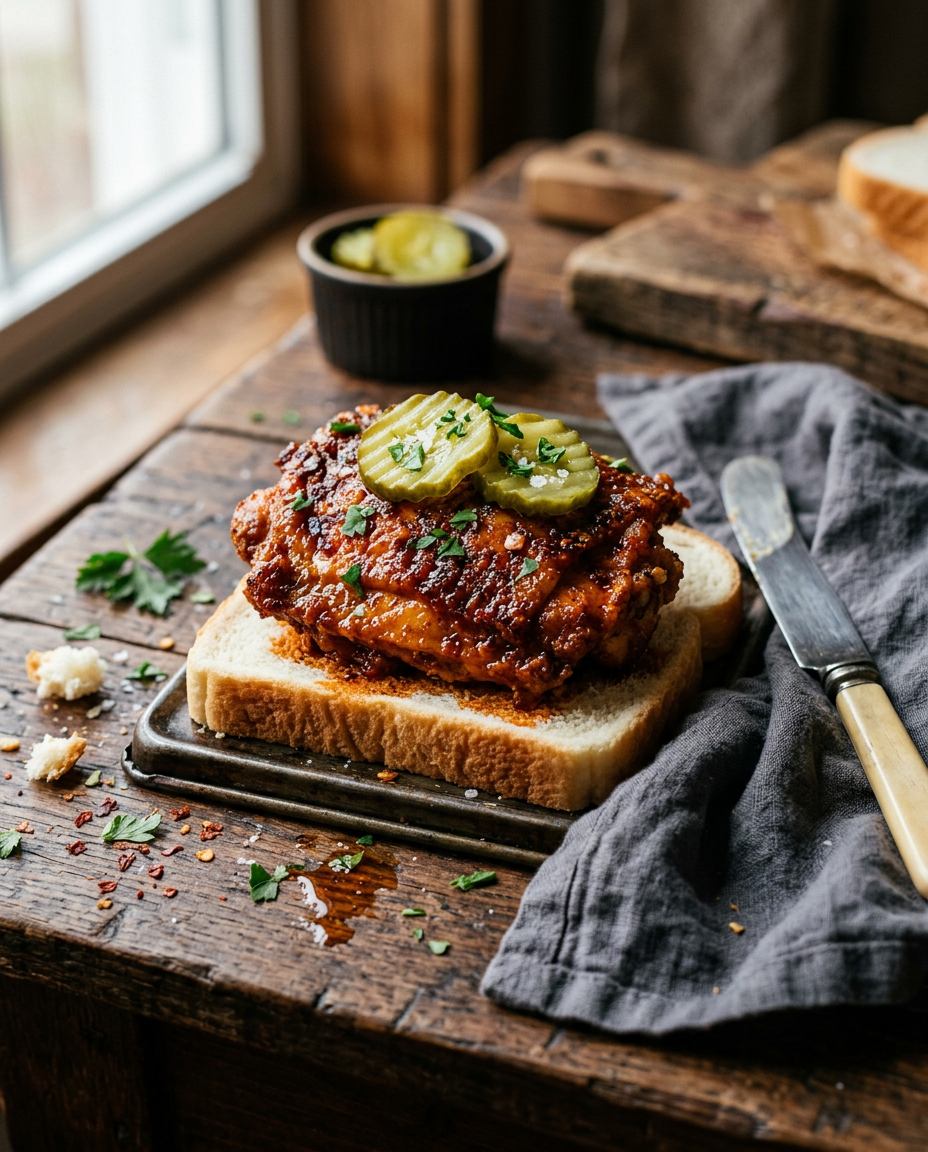
| Active time | 1 hour |
| Hands-off time | 12–24 hours (brine) |
| Difficulty | Advanced — the fry's full attention, the heat's honesty |
| Key techniques | the overnight brine, the dry-wet-dredge, the fryer-oil lacquer, the carryover respect |
| Make-ahead | brined 24 hours; fried, the minute |
Nashville Hot Chicken — The Full Canon
Prep: 30 minutes (plus 12–24 hours' brine) · Cook: 30 minutes · Total: About 1 hour active, 12–24 hours brined · Makes 4 pieces (the sandwich as service)
Ingredients
The brine
- 1 kg bone-in chicken pieces (breasts halved, thighs, drumsticks) or 4 butterflied breast cutlets (about 650 g)
- 500 ml dill pickle brine, 250 ml buttermilk (about 255 g), 1 tbsp (15 g) hot sauce
- 2 tsp (6 g) salt — only if the pickle brine runs low-sodium
The dredge
- 250 g (2 cups) flour, divided
- 60 ml (1/4 cup) of the brine mixture, whisked into half the flour — the wet clumps
- 1 tbsp (7 g) cayenne, 2 tsp (5 g) paprika, 1 tsp (3 g) garlic powder, 1 tsp (5 g) salt, 1 tsp (2 g) black pepper, divided between the dry flour and the wet
The fry
- 1 liter peanut or neutral oil, in a cast-iron pan or heavy Dutch oven, to 2.5 cm depth — deep enough for the pieces' half-submersion and turned
- A thermometer — the fry's non-negotiable tool
The lacquer
- 4 tbsp (about 55 ml) hot frying oil, drawn from the finished fry
- 2 tbsp (14 g) cayenne, 1 tbsp (6 g) paprika, 1 tsp (4 g) brown sugar, 1/2 tsp (2 g) salt, 1/4 tsp (0.5 g) cayenne's cousin — the ghost of cumin, optional
The service
- White bread slices (4, about 60 g) — the canon's own bed
- Pickle slices (about 80 g)
- The sandwich build per #90's crown, if the table votes sandwich
Instructions
- Dredge in the clumps. Brined pieces drained (not patted dry — the damp catches), pressed into the dry seasoned flour, then into the wet clumps, then back to the dry — pressed hard so the clumps adhere; the crust built in three passes. Checkpoint — the crust runs shaggy and craggy with visible clumps — rough is the register; a smooth coat has missed the method. Rest the dredged pieces 10 minutes on the rack while the oil heats.
- Fry at 175 °C, in batches, turned once. The oil to temperature on the thermometer — the batches small enough that the oil holds 170–180 °C through the fry; bone-in pieces 8–10 minutes (turned at 5), boneless cutlets 4 minutes a side; to 74 °C internal, deep red-gold. Checkpoint — the crust runs deep red-gold and the bubbles at the piece's edge slow to a lazy chatter — the fry's own doneness cue alongside the thermometer. While the last batch finishes, draw the lacquer's 4 tablespoons of hot oil.
- The lacquer — the canon's fire, bloomed. The cayenne, paprika, sugar, and salt stirred into the just-drawn hot oil; it bubbles and blooms for 15 seconds off the heat — the smell runs toasty-hot, not raw. Each hot piece brushed or double-dipped on both sides while both are hot. Checkpoint — the crust carries the lacquer's wet orange-red gloss pooled in its crags — the canon's look, unmistakable. The sugar's teaspoon rounds; the fryer-oil base (not fresh oil) is the flavor's difference, carrying the fry's browned flour's depth into the fire.
- The canon's service: the bread bed, the pickles, the wait. The lacquered pieces laid on white bread (the canon absorbs the drip — the bread is a napkin you eat), pickles over and beside, and the carryover respected: the heat builds for the first 5 minutes off the fry — the table warned honestly. Checkpoint — eating test: the crust's shatter under the lacquer's rolling fire — flavor first (paprika, browned flour, the bloom), then the cayenne's build that demands the pickle's cut and the bread's mercy in cycles — the meat within still juicy under all of it, the brine's overnight depth in every shred. The sandwich build (#90's crown) is one honest service; the bread bed is the canon's own, and the file serves both without ranking.
Doneness & Quality Checkpoints
- The 12–24-hour brine — the canon's overnight patience
- The shaggy three-pass crust, clumps visible
- The thermometer's 175 °C held through the batches, 74 °C internal
- The lacquer from the fryer's own oil, bloomed, hot-to-hot
- The carryover's five minutes respected, the table warned
Finish & Plate
The bread-bedded piece, pickles crowning, extra bread and pickles on the plate — the canon's full setting. The sandwich service (#90's slaw-crowned build) runs at the table's vote. Sweet tea, full glasses, and the honesty about what was ordered.
Troubleshooting
| Symptom | Cause | Fix |
|---|---|---|
| Crust smooth, no crags | Wet clumps skipped | The divided dredge — the clumps are the crust |
| Oil temperature crashed | Overcrowded batches | Smaller batches; the thermometer's watch |
| Heat scorching, flavorless | Cayenne unbloomed, no sugar | The 15-second bloom; the rounding teaspoon |
Storage, Make-Ahead & Variations
- The brined chicken keeps 24 hours at its peak; the fried-and-lacquered piece keeps 1 day and re-crisps 8 minutes at 200 °C (re-lacquer from a warmed spoon). The lacquer, mixed dry in a jar, waits weeks for its oil. - Variations: #90's counter-speed sandwich seat; the hot-honey lane; the fish's hot-catfish doctrine transplant; the milder quarter-tablespoon dial for the newcomers' table — with #94's own warning that the dial runs honest in only one direction.