Salade Niçoise
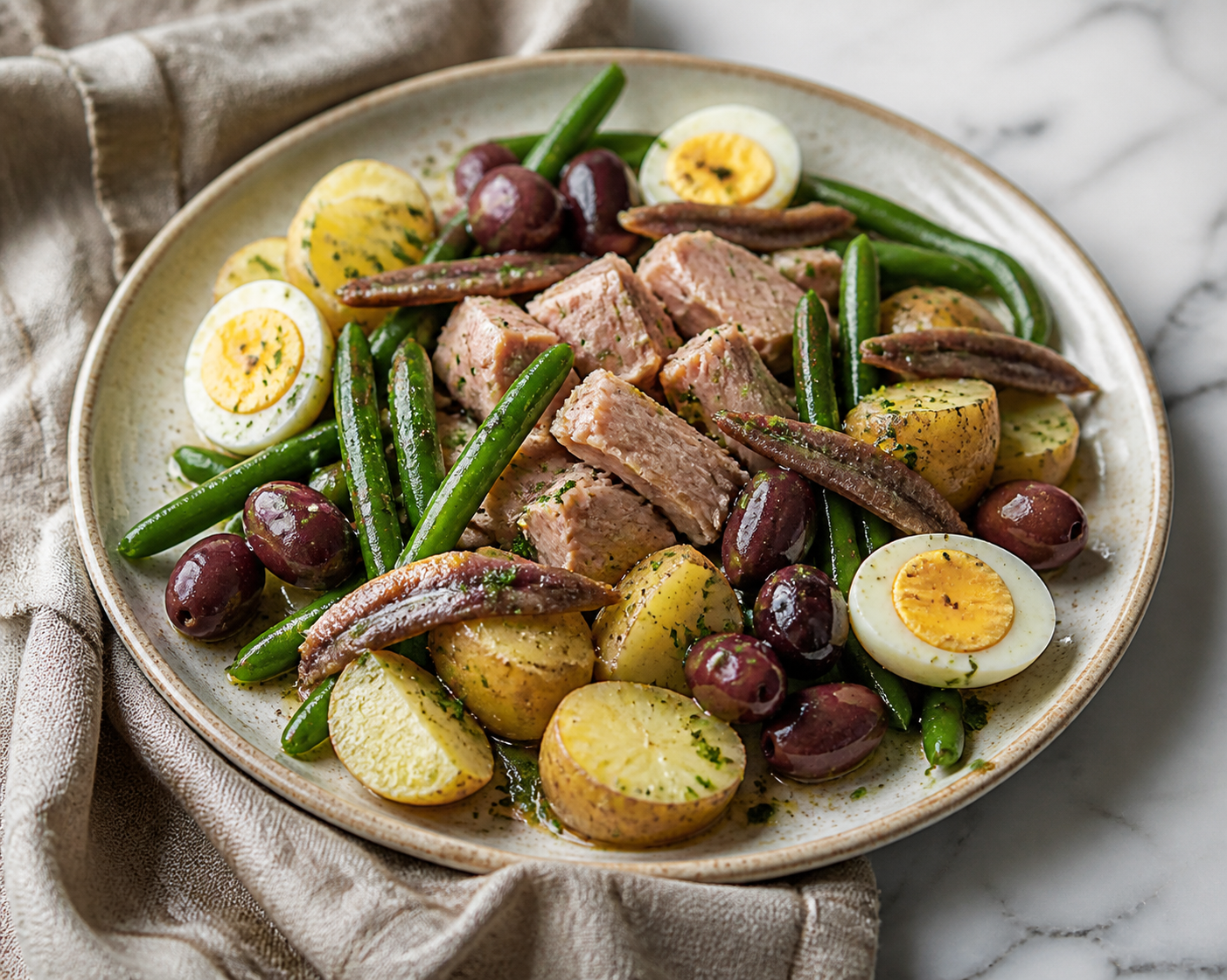
Nice's composed platter: tuna, eggs, green beans, potatoes, tomatoes, and olives arranged — never tossed — in separate zones over lettuce, with the anchovy-garlic vinaigrette poured at the table. The craft is a four-track cooking schedule that lands everything else at the same cool moment, plus the composed-not-tossed law that keeps each ingredient at full identity until the fork does the mixing.
| Active time | 30 minutes |
| Hands-off time | 35 minutes (potatoes, eggs, beans — parallel) |
| Difficulty | Easy |
| Key techniques | the four-track schedule, composed zones, anchovy vinaigrette |
| Make-ahead | components 1 day; assembled platter, 30 minutes |
Salade Niçoise
Prep: 30 minutes · Cook: 35 minutes · Total: About 1 hour 5 minutes · 4 as a main
Ingredients
The four cooked components
- 400 g (about 8 small) waxy potatoes, halved or quartered to bite size
- 4 large eggs (about 200 g), boiled exactly 10 minutes
- 250 g (about 2 handfuls) green beans, trimmed
- 200 g (7 oz) good canned tuna in olive oil, drained — or 300 g fresh tuna steak, seared 1 minute per side for the modern rarer version
The raw zone
- 200 g (about 4 cups) butterhead or Bibb lettuce leaves, torn
- 250 g (about 2 medium) tomatoes, in wedges — cherry tomatoes halved run honest too
- 80 g (about 1/2 cup) niçoise olives, or kalamata's mercy
- 4 anchovy fillets (about 10 g), for the top — optional but the dish's oldest signature
- 2 scallions or 1 small shallot (about 30 g), sliced thin
The vinaigrette
- 60 ml (1/4 cup) extra-virgin olive oil (about 55 g)
- 2 tbsp (30 ml) red wine vinegar or lemon juice
- 1 small garlic clove (about 4 g), grated
- 1 tsp (3 g) Dijon mustard
- 2 anchovy fillets (about 5 g), minced to a paste — the dressing's hidden floor
- 1/2 tsp (1 g) herbes de Provence or fresh thyme leaves
- 1/2 tsp (2 g) salt, black pepper
Instructions
- Cook the potatoes, 20–25 minutes. Cover the potatoes with cold salted water, bring to a simmer, and cook at a gentle bubble until a knife slides through the largest piece with no resistance. Drain, and while they are still hot, toss them with 2–3 tablespoons of the vinaigrette. Checkpoint — the potato is tender to the knife's tip but holds its shape when tossed; the cut faces look glossed, not dry. Warm potatoes take the dressing deep — this is the only component that can be warm.
- Blanch the beans, exactly 3 minutes. Drop the trimmed beans into well-salted boiling water for 3 minutes — they turn emerald and snap-bend without strings — then straight to ice water for 2 minutes to lock the color. Drain and pat dry. Checkpoint — a bean bent double snaps at the fold's edge but does not break clean; the color is bright green at both ends. Limp, olive-drab beans mean the blanch ran long or the ice bath was skipped.
- Build the zones. On a wide platter or individual plates: lettuce as the lawn, then the components arranged in separate territories — potatoes in one arc, beans in another, tomato wedges and olives in their quarters, tuna in fat flakes or sliced seared steaks at the center, eggs in quarters spaced around, anchovy fillets laid over the tuna, scallions scattered. Checkpoint — from above, the platter reads as a map with distinct regions, no ingredient mixed into another's territory. The zones are not fussiness — every ingredient keeps its temperature and texture until the fork chooses the combination.
- Dress at the table and serve. Pour the remaining vinaigrette over the platter in a generous zigzag, crack pepper over, and bring it out with bread and the remaining dressing alongside. Each diner composes across the zones — a bite of tuna, egg, bean, potato, olive in whatever order the eye dictates. Checkpoint — eating test: the forkful is a chord, not a blend — potato's earth, egg's yolk richness, bean's snap, tomato's acid, olive and anchovy's salt, and the vinaigrette's garlic hum running through. Warm potatoes under cold beans is the temperature's own small drama, and it is why the platter must be composed, never tossed.
- Read the schedule first — this dish is a timing puzzle, not a technique test: potatoes 25 minutes in one pot, eggs 10 in another, beans 3 minutes at the end of the potato pot's life or in their own blanch, all cooling while the vinaigrette comes together.
- Everything serves cool (not refrigerator-cold — 20 minutes out of the 4 °C fridge) except the potatoes, which can be warm when the vinaigrette hits them and drink it like a sponge.
- Boil the eggs first, straight from the fridge into already-boiling water, 10 minutes, ice bath: fully set, no green ring — the #9 law.
Doneness & Quality Checkpoints
- Potatoes knife-tender, dressed while warm
- Beans at 3 minutes, emerald, ice-locked, patted dry
- Eggs 10 minutes, no green ring
- Zones distinct on a cool platter — composed, never tossed
- Vinaigrette poured at the table, extra alongside
Finish & Plate
One wide platter for the table or four plates zoned in miniature. Bread is equipment, not garnish — the vinaigrette and tuna oil at the platter's end are the last course. A chilled rosé is the region's own answer and the file's.
Troubleshooting
| Symptom | Cause | Fix |
|---|---|---|
| Platter watery at serving | Wet beans or tomatoes, cold plate sweat | Pat everything dry; 20-minute temper out of the fridge |
| Beans olive-drab and limp | Over-blanched or no ice | 3 minutes, ice water, no negotiation |
| Salad tastes scattered, not unified | Skimpy vinaigrette or no anchovy floor | The minced-fillet vinaigrette is the tie; pour generously |
Storage, Make-Ahead & Variations
- Components keep 1 day refrigerated (4 °C) in separate containers and the vinaigrette 3 days in a jar — the composed platter itself holds 30 minutes before the lettuce wilts under the dressing's acid. - Variations: the purist Niçoise (above); the seared-tuna modern build; quinoa or white beans swapped for the potatoes' starch seat; the #16 tuna bowl is this salad's tossed-and-simplified cousin for the lunch jar.