Italian Panini
| Active time | 15 minutes |
| Hands-off time | 0 |
| Difficulty | Easy |
| Key techniques | the weighted press at medium, the dry-build law, the groove-side-down start |
| Make-ahead | assembled 1 hour; pressed, the minute |
Italian Panini
Prep: 15 minutes · Cook: 12 minutes · Total: 27 minutes · Makes 4 panini
Ingredients
The build, per panino
- 1 ciabatta roll (about 100 g) or 2 squares of focaccia — the panini's own breads, sturdy-crumbed
- 60 g mortadella or prosciutto, or 50 g soppressata for the spicier seat
- 50 g mozzarella or provola — provola's aged nuttiness is the bar-lane's choice
- 30 g (about 2 tbsp) pesto or olive tapenade — the flavor layer, spread thin
- 1 tbsp (10 g) roasted red pepper, patted bone-dry, optional — the wet exception, handled
- 10 g (about 8 leaves) basil
- Olive oil (about 10 ml), for the bread's outsides
- Black pepper
The press
- A panini press, or a heavy pan over a grill pan with a weight (a second pan, a foil-wrapped brick) — the equipment note below
Instructions
- Build thin and layered. Pesto or tapenade on both faces (the flavor's foundation, spread thin to the edges); then provola on the bottom, salumi over it (folded for loft — the #51 law), peppers if running (isolated on the meat, buffered from both bread faces by cheese below and basil above), basil pressed on, the top face closed. A brush of oil on both outsides. Checkpoint — the built panino stands about 4 cm and reads disciplined — every layer thin, the wettest element buffered, the outside oiled not buttered (the Italian lane). The panino's whole philosophy is fewer ingredients, better ones, thinner layers.
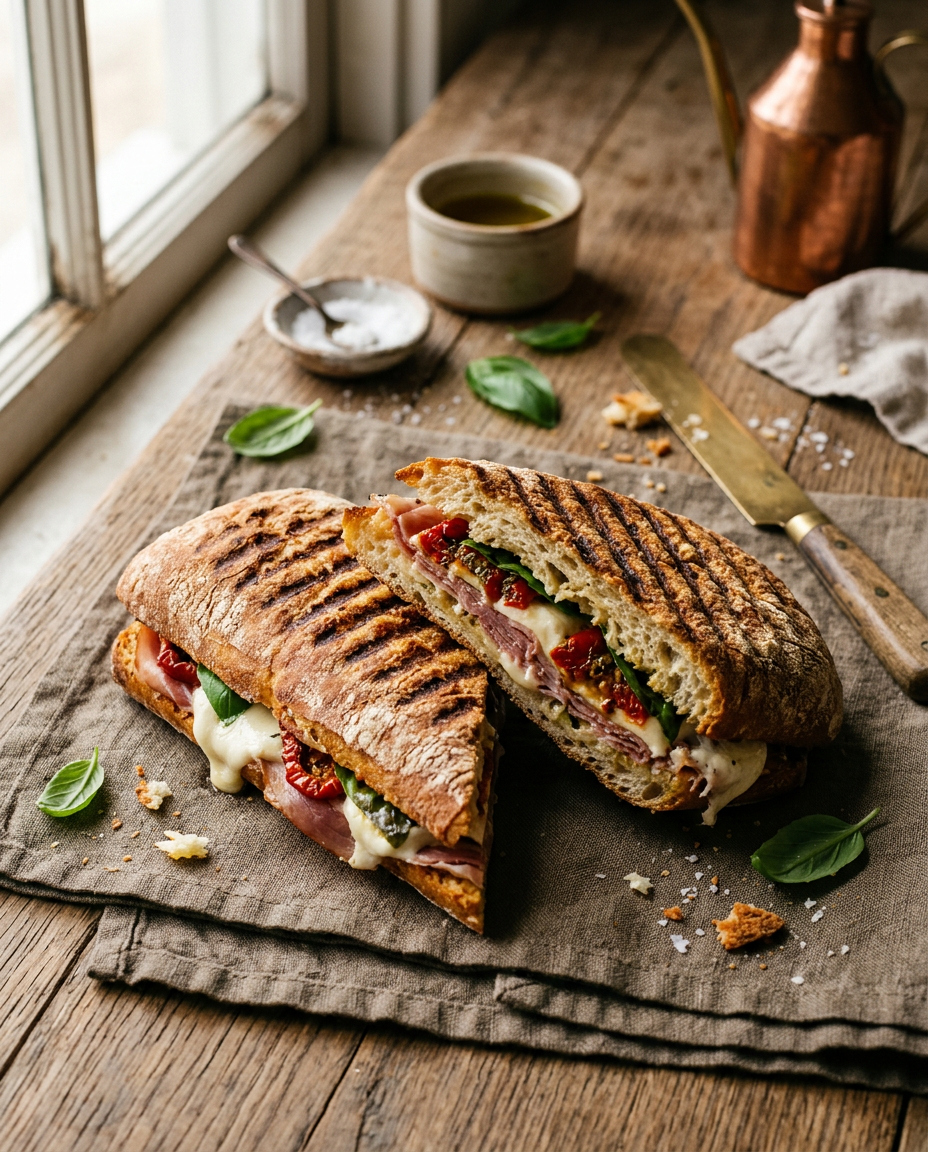
- Press at medium, groove-side down first, 4–5 minutes. Panini press at medium — roughly 190 °C at the plates (or grill pan over medium with the weight on top): the bread's presentation face — the ciabatta's split side — down against the ridges first, the weight set, and the patience begins. Checkpoint — at the 3-minute peek: the contact face is golden with dark stripes forming, the sandwich visibly compressing — the cheese just beginning to move at the seams. Resist lifting the weight repeatedly: every lift releases heat and the press's clock restarts. The full 4–5 minutes at medium is the window where the center reaches molten before the bread's face passes golden-brown.
- The flip, 3–4 minutes. Turn once (the spatula's full support — the compressed sandwich is now one unit and handles easily), press again, and cook the second face to matching gold. Checkpoint — both faces carry the press's stripes (or the grill pan's ridges), the sandwich has compressed to half its built height, and the cheese visibly flows at the edges — a pressed sandwich's molten-fused center, the panini's signature cross-section.
- Rest 1 minute, halve on the diagonal, serve. Checkpoint — eating test: the shell's crisp ridges giving to the dense, fused interior — salumi's spice and fat, provola's nutty pull, pesto's garlic-basil hum, the basil's fresh green lifting the melt — one integrated bite after another rather than a stack of separate layers. The panino's whole textural argument is crisp-outside, dense-molten-inside, and both arrive only at full patience.
Doneness & Quality Checkpoints
- The dry-build law held — every wet element patted and buffered
- Built thin and disciplined, crumb channeled on thick rolls
- Medium heat, real weight, full patience — stripes and compression
- Cheese flowing at the seams before the second face flips
- The fused interior in the cross-section, not a stack of layers
Finish & Plate
The diagonal halves, stripé-face up — the panini's signature served visible. A small bitter-green salad with a sharp vinaigrette on the side cuts the richness, the Italian table's own counterpoint. It splits a beer at lunch or anchors one with soup at dinner.
Troubleshooting
| Symptom | Cause | Fix |
|---|---|---|
| Bread burnt, cheese unmelted | Heat too high, weight too light | Medium; a real weight; the full 4–5 first side |
| Interior soggy, steamed | Wet ingredients un-isolated | The dry-build law; pat and buffer |
| Sandwich slid apart at the flip | Built loose or lifted early | Fold for loft; leave the weight down |
Storage, Make-Ahead & Variations
- Assembled panini hold 1 hour before the press; pressed, they serve in the minute (a re-crisp at medium for 2 minutes a side restores most of the shell). The components keep days — the format's meal-prep is a stocked deli drawer. - Variations: the three-ingredient purist's build (above); the chicken-and-provolone lane with #34's poach; the vegetable build (zucchini ribbons, roasted pepper, provola — all patted dry); the #81 unpressed caprese as the no-heat sibling in the same bread family.