Patty Melt
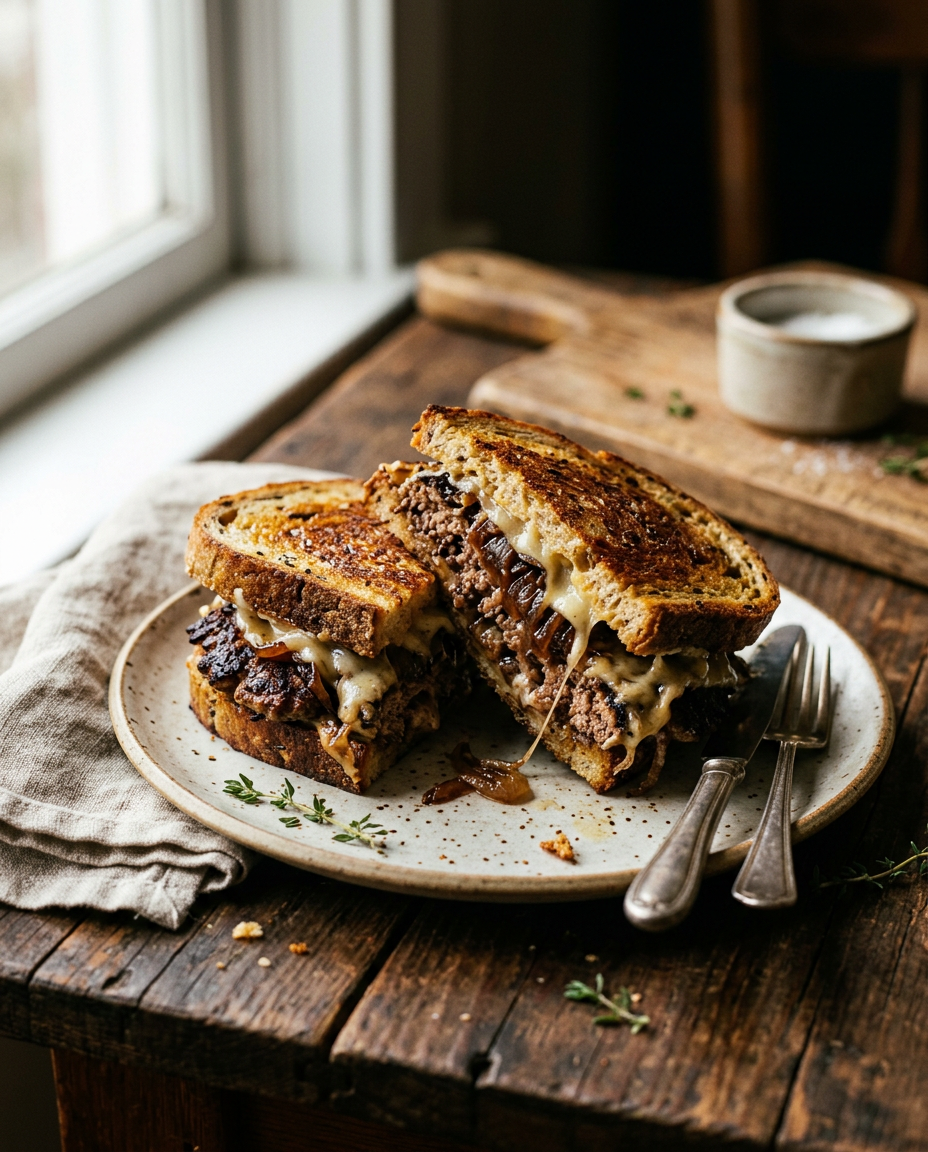
The diner's burger-and-sandwich treaty: a formed beef patty sized to the bread, caramelized onions, Swiss cheese, and rye — griddled in butter like a grilled cheese that happens to contain a hamburger. This record is the classic build: the patty formed thin to the bread's shape, onions cooked down slow and dark, and the two-stage griddle that melts the cheese through without burning the rye. #76 runs the smash-style sibling.
| Active time | 35 minutes |
| Hands-off time | 25 minutes (onions) |
| Difficulty | Moderate — two slow clocks, one pan's patience |
| Key techniques | the bread-shaped patty, dark-caramel onions, the low griddle |
| Make-ahead | onions 4 days; assembled, the minute |
Patty Melt
Prep: 25 minutes · Cook: 25 minutes · Total: 50 minutes · Makes 4 patty melts
Ingredients
The patties
- 600 g (1.3 lb) ground beef, 80% lean
- 1 tsp (5 g) salt, 1/2 tsp (1 g) black pepper
- 1 tsp (3 g) onion powder — the patty's own savory floor
The onions
- 2 large onions (about 500 g), halved and sliced thin
- 2 tbsp (28 g) butter
- 1/2 tsp (2 g) salt
The build
- 8 slices marbled or seeded rye bread (about 70 g each)
- 200 g (about 8 slices) Swiss cheese
- 4 tbsp (56 g) butter, softened, for the griddling
Optional
- 2 tbsp (30 g) thousand island or Russian dressing, the diner's spread — the #52 jar's lane
Instructions
- Caramelize the onions slow and dark, 25–30 minutes. Butter in a wide pan over medium; onions and salt in, cooked down with the occasional stir — they release water (5 minutes), turn jammy (15 minutes), and go deep brown-sweet (25 minutes). Drop the heat at the first signs of browning spots; the last ten minutes run at medium-low, and the onions' color should end mahogany, not black. Checkpoint — the onions have collapsed to a quarter of their raw volume, glossy and sticky, sweet enough to eat by the forkful — no moisture left in the pan. The diner's shortcut (10-minute blond onions) makes a different, lesser sandwich; the patty melt's onions are its sweetness and its moisture, and they must be truly dark.
- Cook the patties to the bread's shape, 3–4 minutes per side. Seasoned beef patties into the pan over medium-high (a film of butter); 3–4 minutes undisturbed to the first side's crust, flip once, 3 minutes more — to 71 °C at the patty's center, no pink in a sandwich this thin. Rest 5 minutes on a plate. Checkpoint — each patty is deeply crusted on both faces, cooked through, still flat and bread-shaped — the trace test: hold a slice of rye over a resting patty; the patty should show at the bread's edges, not hide beneath it. Any patty that puffed into a dome gets pressed flat with the spatula's firm push in the last minute — this is a sandwich.
- Assemble: rye, dressing (if running), Swiss, patty, onions, Swiss, rye. Butter the outsides; inside, the cheese always against the bread — both floors — with the patty and onions between the cheese layers, the #52 law carried whole. The onions spread across the patty in a generous, even bed. Checkpoint — from the side: butter, rye, Swiss, patty, dark-onion bed, Swiss, rye, butter — cheese at both floors for the melt's anchor, the onions sealed between the patty and the upper cheese, no leaks at the borders.
- Griddle low and pressed, 4–5 minutes per side. A heavy pan over medium-low; the melts in (two at a time — crowding drops the pan's heat), pressed gently with the spatula, cooked to the first side's deep gold. Flip with full support and finish the second side — the cheese should be fully molten by the second side's finish, visible flowing at the seams. Checkpoint — both faces deeply gold-buttered (rye's sugars run faster than white bread's — this runs one notch below the grilled cheese's heat), the sandwich compressed, the cheese's first strings at the cut's moment. If the bread browns before the cheese melts, the heat ran high — the patty melt's window is low and slow, and 9–10 total minutes is the honest budget.
- Halve on the diagonal and serve at once. Checkpoint — eating test: buttered rye's crisp, Swiss's nutty melt, the patty's crusted beef, and the onions' sweet-dark depth — the whole sandwich fused into one stratum that pulls in strings at the bite. It should taste like a cheeseburger and a grilled cheese resolved their differences; the rye's tang and the onions' sweetness are the treaty.
- Start the onions first — 25 minutes of their own, below; everything else builds in their last ten.
- Form the patties to the bread's silhouette: lay a slice of rye on the counter, trace its shape in your mind, and divide the beef into four thin patties pressed to slightly larger than the bread (they shrink as they cook). Thin is the law — 1 cm raw — because a patty melt is a sandwich, not a burger; the patty must lie flat inside it.
- The two-stage plan: patties cooked and rested, onions done, then the assembled melts griddled low — the file's method runs the components in sequence rather than the diner's one-griddle juggle.
Doneness & Quality Checkpoints
- Onions at mahogany and jammy — 25 minutes, no shortcut
- Patties thin, bread-shaped, crusted, 71 °C, rested
- Cheese at both bread floors; onions sealed between
- Medium-low griddle, 4–5 minutes a side, cheese flowing at the seams
- The diagonal pull at the cut
Finish & Plate
The diagonal halves, strings at the cut face, a pickle spear beside — the diner's full setting. A milkshake is the canonical pairing and the file's blessing; a beer runs equally honest.
Troubleshooting
| Symptom | Cause | Fix |
|---|---|---|
| Rye burnt, cheese unmelted | Griddle hot | Medium-low; the 9–10-minute budget |
| Onions bitter, black spots | Heat too high late | Medium-low for the last ten; stir at the darkening |
| Sandwich slides apart | Cheese not at the floors, onions at the border | The assembly law; onions bedded inside |
Storage, Make-Ahead & Variations
- Caramelized onions keep 4 days refrigerated (4 °C) and patties keep 2 cooked — the make-ahead that turns the build into a 12-minute project. The griddled melt serves in its minute. - Variations: #76's smash sibling; the cheddar-and-sourdough western lane; the patty melt with the #52 Russian spread's full pour; the mushroom-and-Swiss melt running the same architecture vegetarian.