Peanut Butter and Jelly
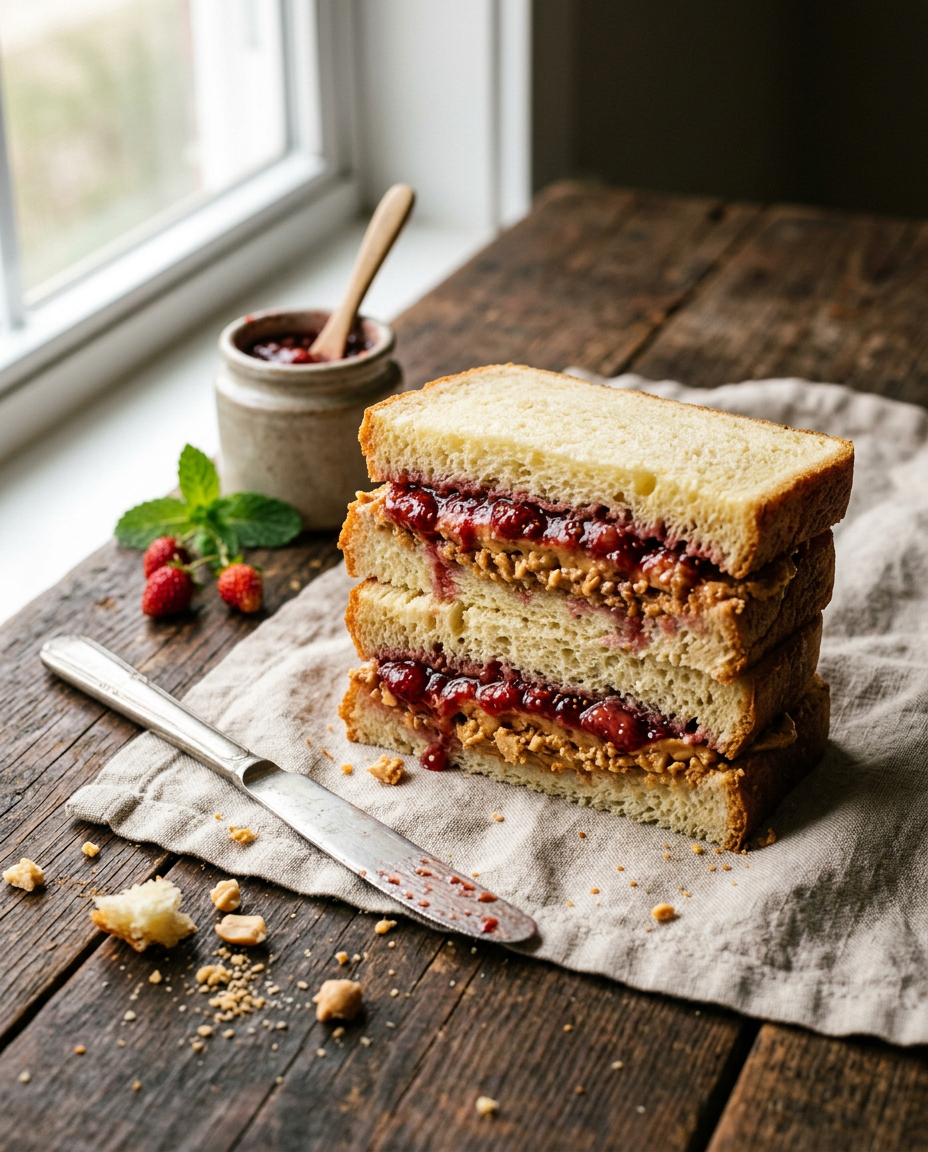
The first sandwich most of us ever loved, rebuilt with the three laws that separate a great one from a sad one: both-faces spreading (the jelly's waterproofing), the corner-to-corner ratio, and the strawberry-vs-grape decision made on purpose. Five minutes, one knife, no apologizing to anyone.
Peanut Butter and Jelly
Prep: 5 minutes · Cook: No cook · Total: 5 minutes · Makes 1 sandwich
Ingredients
The build
- 2 slices soft white bread, potato bread, or whole wheat (about 60 g) — the soft loaf is the classic's own texture; artisan sourdough is a different sandwich
- 2 tbsp (32 g) peanut butter, smooth or crunchy — the crunch decision is yours and yours alone
- 1 tbsp (20 g) jelly, jam, or preserves — strawberry for the seed-crunch school, grape for the nostalgic, apricot for the grown-up
The upgrades, optional but earned
- 1 tbsp (12 g) butter, softened, on the jelly side's crust — the lunchbox secret
- A pinch of flaky salt over the jelly
- Banana, sliced (about 60 g) — the Elvis-adjacent lane
- Honey, a thin drizzle (about 7 g)
Instructions
- Spread the peanut butter on one face, corner to corner. The peanut butter face takes the heavier coat — its stiffness makes it the structure layer — and the full-coverage spread is the sandwich's waterproofing: bread's last dry corner is the jelly's leak's first address. Checkpoint — no bare bread at any edge; the layer stands 3 mm. The corner-to-corner discipline sounds fussy for a PBJ, and it is the difference between the bite at the center and the bite at the crust being the same sandwich.
- Spread the jelly on the other face, corner to corner, stopping just short of the crust. The jelly runs lighter — one tablespoon to the peanut butter's two — and the crust's short margin keeps it from squeezing out at the press. Checkpoint — the jelly's layer is translucent-thin, even, and unstirred-through (stirring works it into the bread); it should sit on the surface like paint.
- Close, press gently, and cut on the diagonal. Set the jelly face onto the peanut butter, press once with the flat of your palm — a light set, not a crush — and cut corner to corner. The diagonal cut is the classic's geometry: two triangles, each with a handle of crust. Checkpoint — eating test: the bread's softness, the peanut butter's roast-salt cling, and the jelly's sweet-bright flood meeting in the center — no jelly eruption at the edges, no dry corners, the ratio the same in every bite. A PBJ made to these three laws quietly outclasses its reputation, and the file stands by that.
- Pull the peanut butter from the pantry and stir it if it is the natural kind — the oil's separation is the only failure this sandwich commonly meets. Cold, unstirred natural peanut butter tears bread; stirred, it spreads like the sweetened kind's mercy.
- One knife, wiped between spreads — peanut butter in the jelly jar is a household's small forever-war.
Troubleshooting
| Symptom | Cause | Fix |
|---|---|---|
| Jelly squirts out at the press | Over-spread or crushed | The crust-margin law; one gentle press |
| Soggy by lunchbox noon | Jelly against bare bread | Peanut butter on both faces, jelly between — the packed-lunch architecture |
| Dry corners | Short spreading | Corner to corner, always — it takes 20 extra seconds |
Storage, Make-Ahead & Variations
- Serves the minute it is made; the packed version survives to noon by the both-faces law (peanut butter both sides, jelly sealed between — the lunchbox architecture above). The griddled version serves immediately, no exceptions. - Variations: the banana lane; the honey-and-salt build on toast; almond or cashew butter with apricot preserves for the adult table; the freeze-and-thaw packed sandwich, a real lunchbox tradition that rethaws to surprising freshness by noon.