Philly Cheesesteak
| Active time | 30 minutes |
| Hands-off time | 40 minutes (freeze, rest) |
| Difficulty | Moderate — the thin slice and the screaming griddle |
| Key techniques | the freeze-and-slice, hard sear in batches, the chop-and-fold |
| Make-ahead | beef sliced 1 day; assembled, the minute |
Philly Cheesesteak
Prep: 20 minutes (plus 30 minutes' freeze) · Cook: 20 minutes · Total: About 1 hour 10 minutes · Makes 4 sandwiches
Ingredients
The meat
- 700 g (1.5 lb) ribeye steak, boneless — the traditional cut; the note has the honest substitutes
- 1 tsp (5 g) salt, 1/2 tsp (1 g) black pepper
- 2 tbsp (25 ml) neutral oil
The onions and peppers
- 2 large onions (about 500 g), sliced thin
- 2 bell peppers (about 300 g), sliced — the "wit" debate's own question
- Optional: 4 hot cherry peppers, sliced — the Philly accent
The cheese
- 250 g (about 8 oz) Cheez Whiz, the Pat's-and-Geno's register — or
- 250 g provolone, sliced — the old-school bar lane — or
- 200 g American, sliced — the friendly middle
The rolls
- 4 long Italian or Amoroso-style rolls (about 90 g each), split lengthwise, hinged
Instructions
- Cook the onions (and peppers) down first, 10–12 minutes. A wide pan or griddle over medium with a film of oil; the onions and peppers softened, stirred occasionally, to deeply golden and floppy — not caramelized dark (that is #71's project), just sweet and fully wilted. Hold them on the griddle's cool edge or in a bowl. Checkpoint — the onions are golden, glossy, and completely limp — no crunch anywhere — and the pan's floor carries a fond. They will finish inside the beef's chop.
- Hard sear the beef in batches, 2–3 minutes a batch. The griddle now screaming hot — a drop of water skitters and vanishes (a surface near 230 °C) — a film of oil, and a quarter of the sliced beef scattered across the full surface in one thin layer. Do not stir: let it sear 90 seconds undisturbed to brown hard on its first face, then season with salt and pepper, and begin the chop. Checkpoint — the beef's ribbons brown at their faces and gray nowhere — a loud, violent sizzle throughout, steam never rising (steam means crowd or cool pan). Batch discipline is the law: thin-sliced beef dumped all at once boils gray in its own juice, and gray beef is the cheesesteak's one unrecoverable sin.
- The chop and the fold — the sandwich's signature move. With two spatulas (or one spatula and a bench scraper), chop the searing beef against the griddle — cutting the ribbons into bite lengths, mixing the browned and just-cooked — then gather the chopped mass into a roll-shaped pile, lay the cheese directly on the hot pile, and give it 20–30 seconds to soften before folding the whole through with the spatula: meat, cheese, and the returned onions folded into one molten mass. Checkpoint — the pile on the griddle reads as one glossy, cheese-bound mass — ribbons of beef, threads of onion, molten cheese visibly running through rather than sitting on top. The chop's purpose is exactly this fusion: every bite carries all three, and no strand of beef is longer than a bite.
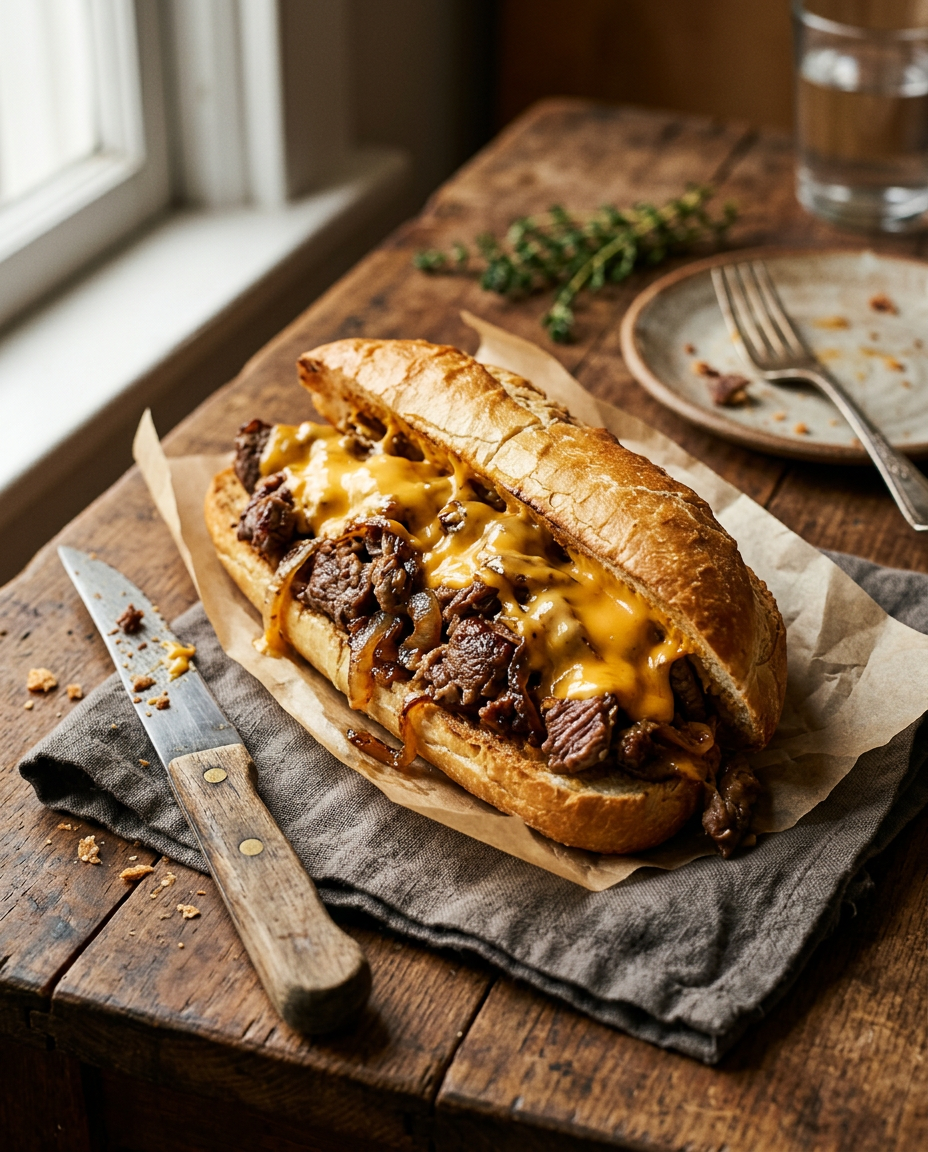
- The scoop — the roll meets the pile. The split roll's hinged mouth laid open on the griddle's edge for 30 seconds to warm and steam-soften; then the spatula slid under the pile and the whole mass rolled into the roll's channel in one motion, the griddle's own gesture. Checkpoint — the filled roll: the meat's mass running the roll's full length, packed to the top of the channel, the cheese's strings from pile to roll at the first bite's pull. The roll should feel heavy and full — a cheesesteak that needs filling at the ends was scooped shy.
- Serve immediately, wrapped in the paper. Checkpoint — eating test: the roll's steamed-soft chew giving to the molten chop — beef's crust-and-juice, onion's sweet, cheese's salt-slick — one integrated bite after another, dripping, two-handed, complete. The roll should barely hold the mass, and that structural tension is the sandwich's own identity.
Doneness & Quality Checkpoints
- Ribeye frozen-firm and sliced paper-thin across the grain
- Onions fully wilted and golden — sweet, never dark-caramelized
- Screaming griddle, thin batches, browned faces, no gray
- The chop-and-fold: one cheese-bound mass, no strand longer than a bite
- Roll steam-softened, scooped full, wrapped in paper
Finish & Plate
The paper-wrapped whole, eaten standing, two-handed, head tilted forward — the format's own etiquette, unchanged on Ninth Street for ninety years. A side of hot cherry peppers and a birch beer are the traditional complements.
Troubleshooting
| Symptom | Cause | Fix |
|---|---|---|
| Beef gray, steamed | Crowded pan or cool griddle | Small batches, screaming surface, no stirring |
| Thick, chewy ribbons | Steak sliced soft | The freeze's 35 minutes; slice thinner |
| Sandwich slides apart | Cheese on top, not folded | The 20-second melt and the fold-through |
Storage, Make-Ahead & Variations
- The sliced beef keeps 1 day refrigerated (4 °C) — the freezer doctrine's dividend; cooked onions keep 4 days. The assembled sandwich serves in its minute, wrapped in paper. - Variations: the pizza steak (tomato sauce and mozzarella's lane); the mushroom cheesesteak; the chicken cheesesteak (the same doctrine on thigh meat); #48's chopped cheese as the New York bodega's cousin, born of a different city's answer to the same question.