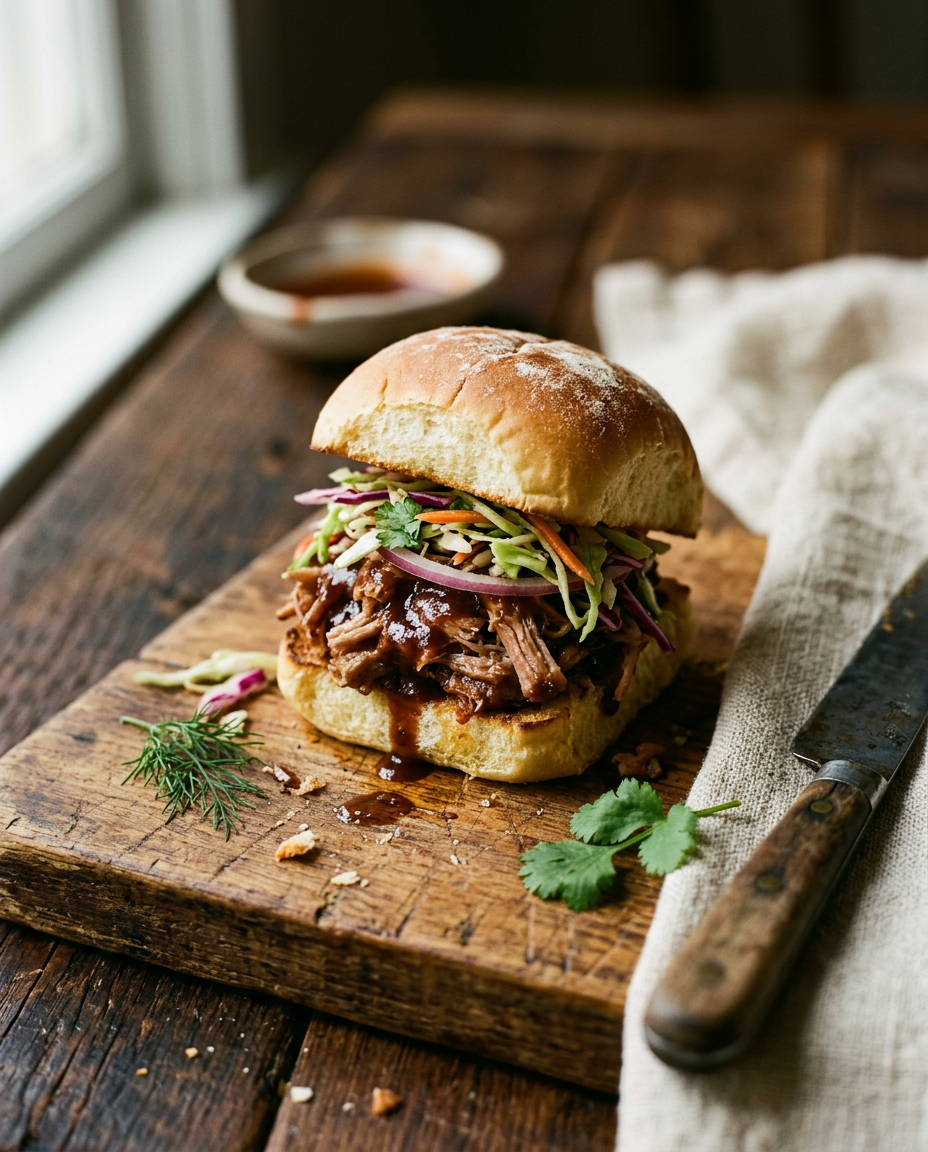
Pulled Pork Sliders
| Active time | 40 minutes |
| Hands-off time | 3 hours 15 minutes (braise) |
| Difficulty | Moderate — patience, not skill |
| Key techniques | the low braise to pull-tender, the rest-and-pull, the slaw lid |
| Make-ahead | pork 4 days; assembled, 15 minutes |
Pulled Pork Sliders
Prep: 25 minutes · Cook: 3 hours 30 minutes · Total: About 4 hours (mostly hands-off) · Makes 12 sliders
Ingredients
The pork and rub
- 1.5 kg (about 3 lb) boneless pork shoulder (Boston butt), tied or netted
- 2 tbsp (14 g) sweet paprika
- 1 tbsp (9 g) brown sugar
- 2 tsp (4 g) smoked paprika — the indoor method's smoke
- 2 tsp (5 g) salt
- 1 tsp (2 g) black pepper
- 1 tsp (2 g) garlic powder
- 1/2 tsp (1 g) cayenne
The braising liquid
- 250 ml (1 cup) chicken stock or water
- 2 tbsp (30 ml) apple cider vinegar
- 1 onion (about 200 g), halved and sliced
The sauce
- 180 ml (3/4 cup) apple cider vinegar
- 60 g (1/4 cup) ketchup
- 30 g (2 tbsp) brown sugar
- 1 tsp (5 g) Dijon or yellow mustard
- 1 tsp (3 g) hot sauce, or 1/2 tsp cayenne
- 1/2 tsp (2 g) salt
The build, per slider
- 12 soft dinner rolls or small brioche buns (about 340 g)
- 250 g (about 2 cups) #24's classic coleslaw, lightly dressed — the cooling lid
- Extra sauce at the table
Instructions
- Rub and sear — the flavor's foundation. Mix the rub's spices; coat the pork on every face. Heat a heavy Dutch oven over medium-high and brown the pork 3–4 minutes per side to a deep crust — 12–15 minutes total. The crust is not decoration: those browned juices become the braising liquid's body. Checkpoint — every face deeply browned, the pot's floor carrying dark fond, and the pork lifting without sticking. A pale pot bakes a flat braise; the sear is the smoker's substitute.
- Braise low and covered, 3 hours at 150 °C. Scatter the onion into the pot, add the stock and vinegar (the liquid to a 1 cm depth, not a submersion — this is a braise, not a boil), cover, and into the oven. At the 2-hour mark, turn the pork once; at 3 hours, begin testing. Checkpoint — the pull test: a fork twisted into the shoulder's thickest point slides in with no resistance and the meat around it separates into fibers when the fork turns. The target is the 90–95 °C internal range — collagen's full melt — and if the fork meets any real grip, back in the oven for 30-minute increments. The hour is an honest servant, not a tyrant.
- Rest, then pull — with the braising gold. Rest the pork 20 minutes under foil (the juices redistribute; pulled from the oven, the meat floods and dries simultaneously). Then pull: two forks, or clean hands, shredding along the muscle's grain into bite threads, dropping every piece into the bowl. Skim the braising liquid's fat (or not — the file runs it rich), and moisten the pulled pork with 100–150 ml of the liquid. Checkpoint — a handful of the pork holds together when squeezed and releases into threads when opened — moist but not wet, no pool at the bowl's bottom. The braising liquid is the moisture's whole architecture; sauce alone runs sweet and thin.
- Sauce and warm. Warm the sauce's ingredients in a pan 3–4 minutes to dissolve the sugar, pour about two-thirds over the pulled pork, and toss. The sauced pork can hold warm (lowest oven, covered, 20–30 minutes) or cool and re-warm later — the flavors improve overnight. Checkpoint — taste: tang first (the vinegar-forward sauce), then the pork's slow-cooked depth, then heat — every thread coated but the meat still reading as meat, not sauce carrier.
- Build — the split lid and the slaw crown. Split the rolls; a spoon of pork piled on the bottom, pressed gently to settle; the slaw's pinch on top — the cooling, crunching lid that makes a slider a complete idea — and the crown. A pick through the middle if the party runs formal. Checkpoint — eating test: the roll's softness giving to the pork's tangy richness, then the slaw's cold crunch cutting both — one bite, three temperatures and textures. The slider should need two bites only because the first was so good.
Doneness & Quality Checkpoints
- Deep sear on every face before the braise begins
- 150 °C oven, 1 cm liquid, 3 hours to the fork-turn test
- 20 minutes' rest before pulling; braising liquid as the moisture
- Sauce at two-thirds — the pork stays the point
- Slaw as the crown, never folded under
Finish & Plate
A board of assembled sliders, the sauce in a squeeze bottle at the side, the remaining slaw in a bowl with a spoon — the sliders go fast, and the open build lets the slow eaters rebuild. It pairs with everything a summer table runs: corn, chips, the #12 esquites, and whatever the cooler holds.
Troubleshooting
| Symptom | Cause | Fix |
|---|---|---|
| Pork shreds but tastes dry | Moisture skipped or rushed rest | The braising-liquid toss; the 20-minute rest |
| Pork will not pull | The clock ran short | 30-minute increments past 3 hours, no guesswork |
| Sliders soggy at the base | Sauce over-poured or slaw wet | Two-thirds sauce law; slaw dressed light and drained |
Storage, Make-Ahead & Variations
- Pulled pork keeps 4 days refrigerated (4 °C) in its liquid and sauce, 2 months frozen — the make-ahead champion. Slaw keeps 2 days. Assembled sliders hold 15 minutes. - Variations: the #95 full-size sandwich with pickles instead of slaw; the smoky register (chipotle in the sauce); the Alabama white-sauce lane (mayo-vinegar, no sugar); the #44's tray format running this pork under the poppy-seed sauce for the party-math build.