Roast Beef Sandwich
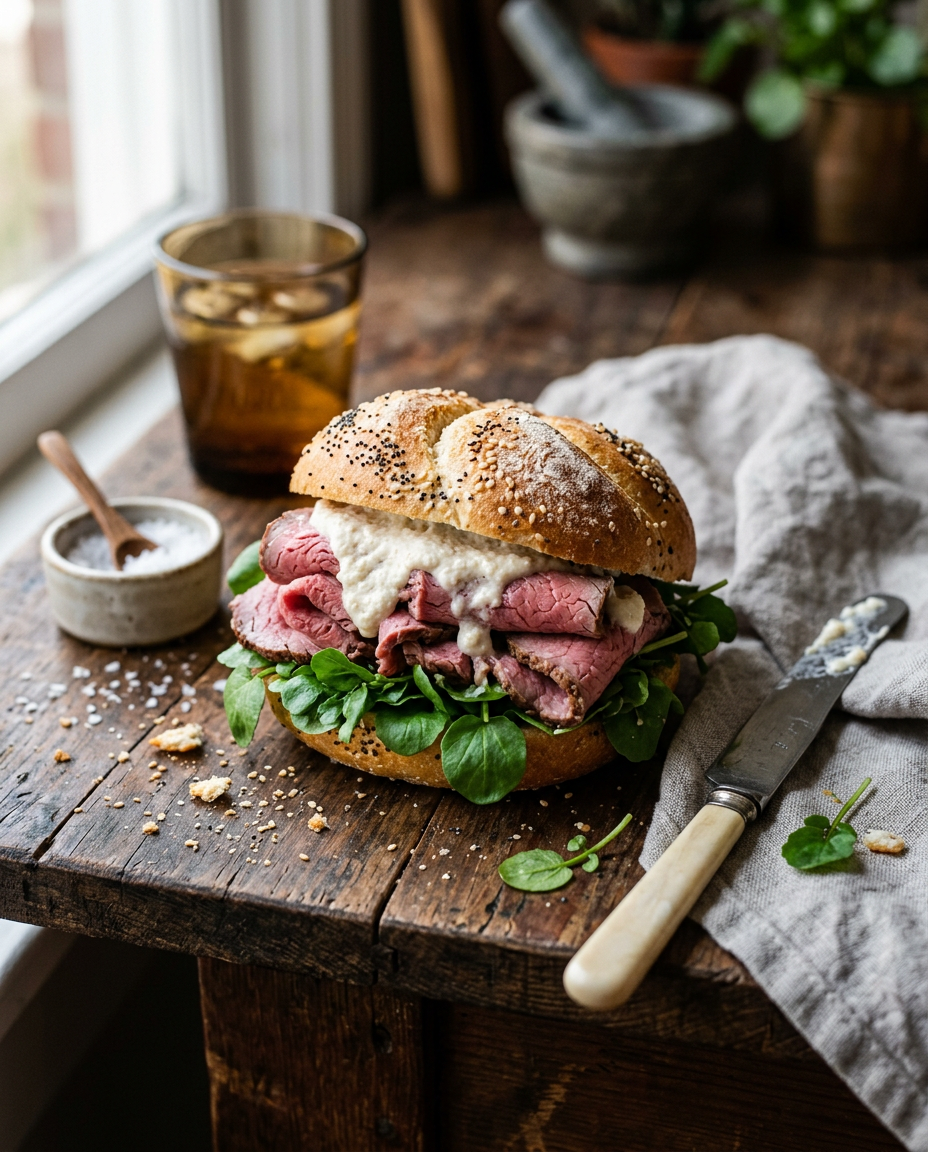
The deli counter's crown cut at home: rare roast beef sliced thin — #73's doctrine, no dip required — on a good roll with horseradish cream's fire and the simple garnishes that let the beef speak. This is the sandwich the weekend roast was always going to become, and the craft is the roast's pink (already covered) and the horseradish's honest ratio.
| Active time | 20 minutes (plus the roast's project, ahead) |
| Hands-off time | The roast's 3 hours + rest, run ahead |
| Difficulty | Moderate — the roast carries it |
| Key techniques | rare slicing, the horseradish cream's ratio, the cold-cold build |
| Make-ahead | roast 3 days; cream 2 days; assembled, the hour |
Roast Beef Sandwich
Prep: 30 minutes · Cook: 3 hours (the roast, ahead) · Total: About 15 minutes active at the sandwich's hour · Makes 6 sandwiches (roast runs ahead)
Ingredients
The beef
- 1.5 kg top round or sirloin tip, roasted per #73's doctrine: seared, the 140 °C oven to 55 °C, the full 30-minute rest — or the counter's rare-sliced mercy (400 g), honestly noted
The horseradish cream
- 100 g (about 7 tbsp) sour cream
- 2 tbsp (about 20 g) prepared horseradish, drained — the jar's white, not the red beet's lane
- 1 tsp (5 g) Dijon, pinch of salt, 1 tsp (5 ml) lemon juice
The build, per sandwich
- 1 crusty kaiser, onion roll, or bulkie (about 85 g), split
- 100 g rare roast beef, sliced 2 mm
- Lettuce or arugula (about 10 g), tomato 2 slices (about 50 g) in season, red onion's few threads (about 10 g)
- Black pepper; the jus's optional cup at the side (#73's jar, if the fridge runs it)
Instructions
- Whisk and rest the cream. Sour cream, horseradish, Dijon, salt, lemon — whisked 20 seconds and rested 15. The cream should taste cool-first, fire-second: the horseradish's arrival a beat behind the sour's calm, building at the swallow's finish. Checkpoint — a spoon's taste makes the eyes water faintly at the third second — the right register. Too gentle? More horseradish by the teaspoon; the cream's job is to argue with the beef's richness, and a polite cream is a missed argument.
- Build in the cold order. Roll split (toasted lightly if the day runs damp — the barrier); horseradish cream on both faces; lettuce on the bottom; the beef folded in lofted shingles (the #51 law — folds for height and tenderness); tomato and onion over the beef; black pepper; the crown. Checkpoint — the layers: bread, cream, lettuce, folded rare beef, tomato, onion, bread — the wet buffered on the lettuce's fence, the beef's pink folds visible at the sandwich's edge, the cream's white at both faces.
- The optional dip's honest note. If the fridge holds #73's jus (or #86's quick jar), warm a small cup and serve it beside — the rare beef's dip is the French dip's inheritance in this build, and the sandwich runs complete without it: the two formats' honest difference, cold-cold here, hot-dipped there. Checkpoint — eating test: the roll's chew, the rare beef's clean mineral sweetness in cold folds, the horseradish cream's cool-fire cycle, tomato's acid and onion's bite in turns — a sandwich that tastes like the roast's whole weekend concentrated into the best possible leftover. The cream should be the voice between every two bites of beef; the black pepper at the finish.
- The roast runs the weekend ahead or the counter's morning-of: sliced 2 mm across the grain, cold from the fridge (4 °C) — the cold-cold build is this sandwich's temperature doctrine (the rare beef's cleanest flavor runs at the deli's register: cold meat, cool garnishes, the roll's soft chew).
- Make the horseradish cream first and rest it 15 minutes: the horseradish's volatile fire mellows into the sour cream's cool — the ratio's balance arrives with the wait, not at the whisk.
Doneness & Quality Checkpoints
- The roast rare at 55 °C, rested full, sliced 2 mm — or the counter's rare, honestly noted
- The cream's rest and its water-at-three-seconds register
- The cold-cold build's order — lettuce's fence under the beef
- The folds' loft, the pink visible
- The dip optional and named as such
Finish & Plate
The halved sandwich on a deli paper's grip, a pickle spear beside, the jus cup at the optional seat. It is lunch's whole argument at the delicatessen's register — and the weekend roast's best legacy.
Troubleshooting
| Symptom | Cause | Fix |
|---|---|---|
| Cream polite, no burn | Old horseradish's fade | The fresh jar; the ratio's dial up |
| Beef gray at the fold | Roast's doctrine breached or the counter's well-done | The 55 °C law; rare at the slicing counter, by name |
| Sandwich dry | Thin beef, no cream at both faces | 100 g's measure; the cream's both-face law |
Storage, Make-Ahead & Variations
- The sliced roast keeps 3 days refrigerated (4 °C); the cream keeps 2; the built sandwich holds 2–3 hours at cool — the lunchbox's cold-cold format. - Variations: the #73 French dip's hot format; the roast-beef-and-cheddar with the #5 maple-Dijon's swap; the arugula-and-parmesan's Italian-leaning build; the open-faced warm roast with gravy — Sunday's second sitting, the genre's own other half.