Smash-Style Patty Melt
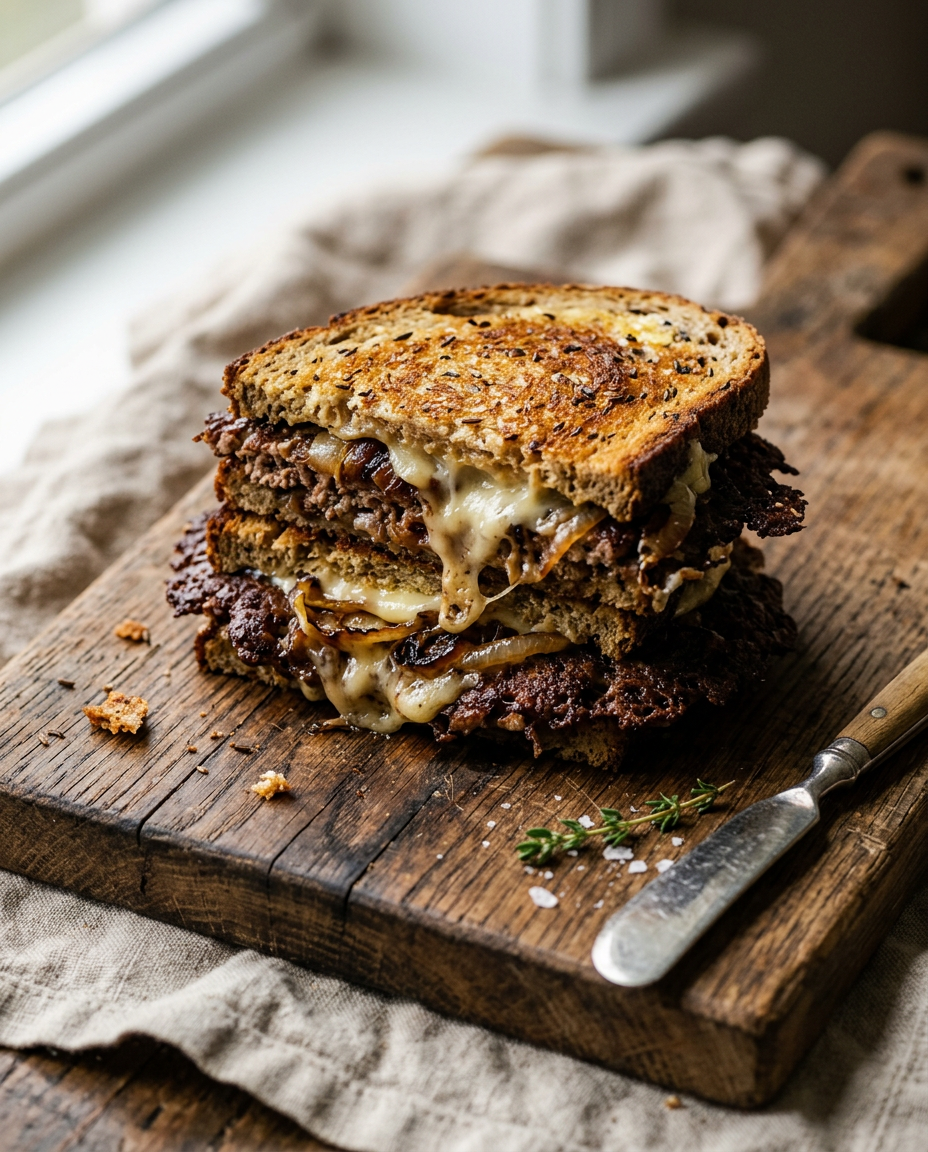
The patty melt's smash-burger rewrite: loose beef smashed thin directly on the griddle — maximum crust, no formed interior — then layered with the classic's dark onions and Swiss on rye and finished like a grilled cheese. #71 forms a patty and cooks it whole; this record's doctrine is the smash: the crust is the flavor, the crust is the texture, and there is more of it per bite than any formed patty can carry.
| Active time | 35 minutes |
| Hands-off time | 25 minutes (onions) |
| Difficulty | Moderate — the smash's commitment |
| Key techniques | the 45-second smash, the double-thin layer, the low assembly griddle |
| Make-ahead | onions 4 days; assembled, the minute |
Smash-Style Patty Melt
Prep: 20 minutes · Cook: 25 minutes · Total: 45 minutes · Makes 4 melts
Ingredients
The beef
- 600 g (1.3 lb) ground beef, 80% lean, kept cold and loose (not packed into balls until the griddle moment)
- 1 tsp (5 g) salt, 1/2 tsp (1 g) pepper
The onions
- 2 large onions (about 500 g), sliced thin
- 2 tbsp (28 g) butter, 1/2 tsp (2 g) salt
The build
- 8 slices rye bread (about 70 g each)
- 200 g (about 8 slices) Swiss cheese
- 4 tbsp (56 g) butter, softened, for the griddling
- Optional: 2 tbsp (30 g) mustard — the smash lane runs mustard more often than the classic
Instructions
- Caramelize the onions to mahogany, 25–30 minutes, per #71's law and clock. Hold at the pan's cool edge when done. Checkpoint — deep brown, glossy, jammy — the smash melt's only sweetness, and it must be true.
- Smash thin, two patties at a time, 45 seconds a side. The griddle at screaming (a water drop skitters — surface near 230 °C): a loose fist of beef (about 75 g, barely held together) dropped on the dry-hot surface and smashed immediately and hard with the spatula's full weight into a thin, ragged disc, 3 mm at its thin edges — pressed for a full 10 seconds, then left alone 90 seconds to crust. Season the raw top face; flip with the scraper's edge under the crusted face; 45 seconds more, and off. Checkpoint — the smashed patty's first face is deeply, darkly crusted — the Maillard's lace at the thin edges, mahogany at the center — and the patty is stiff and crisp-edged, not floppy. The 10-second hard press and the 90-second patience are the whole doctrine: the press multiplies the beef's contact surface, and the crust that forms there is this sandwich's entire flavor argument. Two smashed patties per melt — the thin layers stack.
- Assemble with the two-thin-layer law. Butter the bread's outsides; mustard (if running) on the insides; then per melt: Swiss on the bottom slice, two smashed patties laid edge to cover (their ragged edges overlapping — the coverage of two thin discs beats one thick), the onion bed over them, Swiss on top, the crown. Cheese at both bread floors, the #52 law carried: the smash layers are stiff and crisp, and the cheese's melt is the mortar that holds them. Checkpoint — from the side: rye, Swiss, two thin crusted layers, dark onions, Swiss, rye — the whole stack still under 3 cm, the smash melt's architecture deliberately flatter and denser than #71's formed build.
- Griddle low, 4 minutes a side, once only. Medium-low — the rye's sugars and the patties' pre-cooked state both run faster than a raw-formed melt — pressed gently, flipped once with full support, finished to deep gold and fully molten cheese. Checkpoint — both faces deep gold-buttered, the cheese flowing at every seam, the whole melt fused — at the cut, the cross-section shows the two crusted layers as distinct dark strata between the cheese's molten bands. That double dark stratum is the smash melt's visual signature, and the moment of its identity.
- Halve and serve at once. Checkpoint — eating test: crisp rye, molten Swiss, and then the smash's argument — a dense, crust-heavy bite with the onions' sweet and the mustard's tang running through it, every mouthful carrying more browned-beef edge than any formed patty ever laid on bread. It should taste like the griddle itself took a side in the patty melt's family argument — and won on texture.
- The onions run first, exactly as #71's: 25–30 minutes to deep mahogany jam. Start them before anything else touches the pan.
- The smash doctrine's two tools: a screaming-hot griddle or cast-iron pan, and a stiff spatula (or a second spatula pressed on top — the double-spatula press) plus a bench scraper for the scrape. The smash happens once, hard, at the raw face's first contact — there is no second chance at the crust.
Doneness & Quality Checkpoints
- Onions at true mahogany — the shared long clock
- The 10-second hard smash on a screaming surface, 90 seconds undisturbed
- Two thin crusted layers per melt, ragged edges overlapping
- Cheese at both bread floors — the mortar law
- Medium-low assembly griddle to deep gold and full melt
Finish & Plate
The diagonal halves, the double dark stratum visible at the cut face — the smash melt's own portrait. A pickle spear and the milkshake's invitation, per #71's court; the family table stands.
Troubleshooting
| Symptom | Cause | Fix |
|---|---|---|
| Patties gray, no crust | Pan shy of screaming or pressed late | Water-drop test; smash at the drop's moment |
| Patties crumbled at the flip | Scraped up instead of under | The scraper's edge slides under the crust |
| Melt burnt before the cheese melts | Griddle hot at assembly | Medium-low; the patties are already cooked |
Storage, Make-Ahead & Variations
- Caramelized onions keep 4 days refrigerated (4 °C); smashed patties keep 2 days and re-crisp 45 seconds a side on the screaming pan. The assembled melt serves in its minute. - Variations: the cheddar lane; the pickled-jalapeño and pepper-jack build; the double-smash (four layers) for the committed; #71's formed sibling as the family's other seat — and the family's argument, which the file restates is the point.