Som Tam — Green Papaya Salad
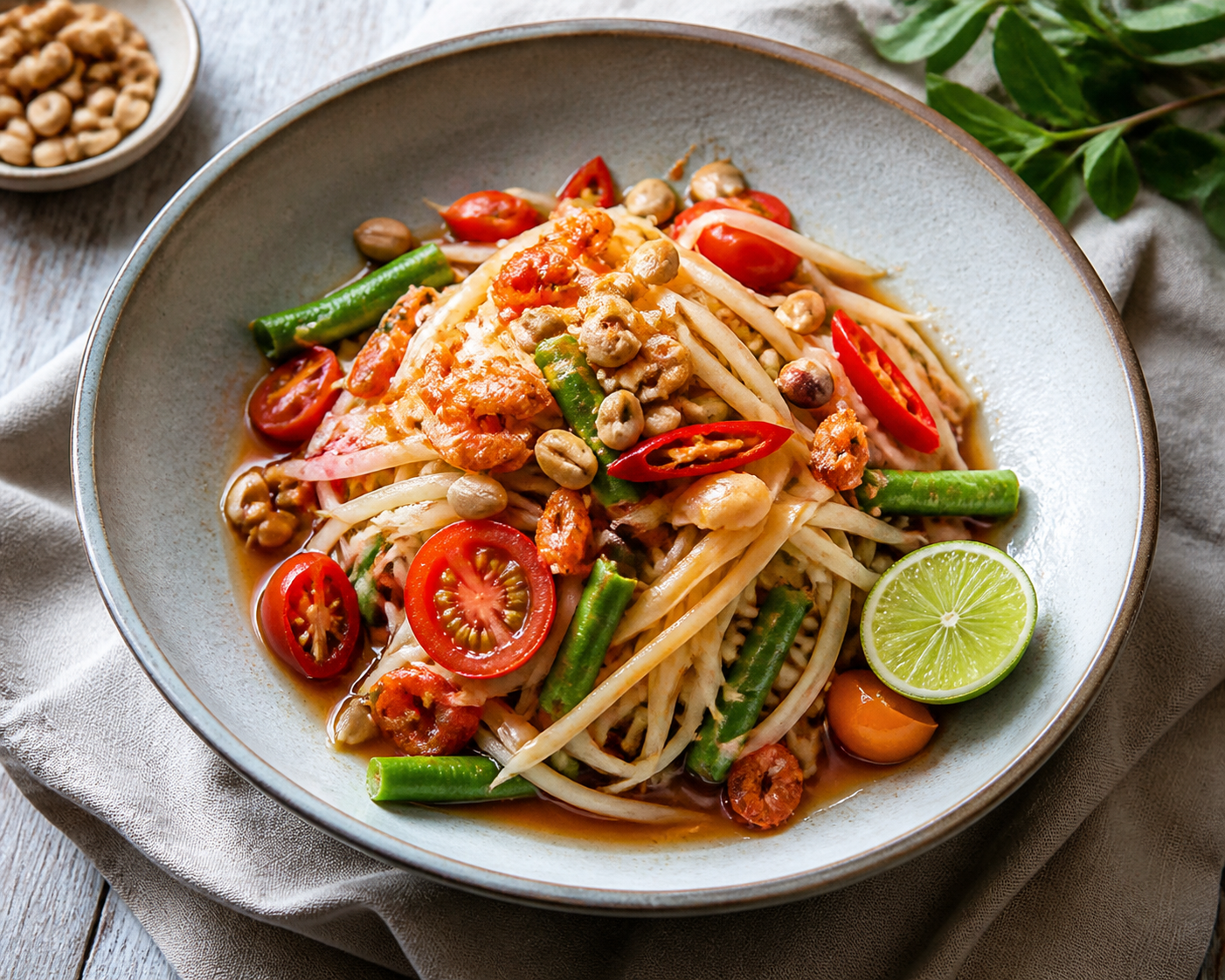
| Active time | 25 minutes |
| Hands-off time | 0 |
| Difficulty | Moderate — mortar rhythm, julienne discipline |
| Key techniques | the bruising pound, sauce-first-then-solids, palm sugar dissolve |
| Make-ahead | 30 minutes dressed; components 4 hours |
Som Tam — Green Papaya Salad
Prep: 25 minutes · Cook: No cook · Total: 25 minutes · 4 as a side, 2 as a main
Ingredients
The fruit and crunch
- 500 g (about 1 small) green papaya, peeled, seeded, shredded into julienne — about 4 cups
- 100 g (1 cup) green beans, cut in 4 cm lengths, lightly smashed
- 2 medium carrots (about 200 g), julienned — the honest volume-filler and color
- 4–6 cloves garlic (about 20 g) — the mortar's first casualty
- 2–5 bird's eye chilies (about 10 g), to taste — 2 is polite, 5 is Isan
The dressing
- 4 tbsp (60 ml) lime juice, from about 3 limes
- 3 tbsp (45 g) palm sugar, finely chopped — light brown sugar substitutes honestly
- 3 tbsp (45 ml) fish sauce
- 1 tbsp (10 g) dried shrimp, optional but traditional — the umami floor
- 1 tsp (5 g) tamarind paste, optional, for the sour roundness
The finish
- 40 g (1/2 cup) roasted peanuts, coarse chopped
- 2 tbsp (10 g) dried shrimp extra, if you run the full street register
- Lime wedges and extra chilies, to serve
Instructions
- Pound the aromatics to a rough paste. In the mortar (or a sturdy bowl with the end of a rolling pin), pound the garlic and chilies with a pinch of sugar for 20–30 seconds to a coarse, bruised paste — not smooth, just broken and wet. This releases the chili's oils into the dressing base that everything else will join. Checkpoint — the mortar smells sharply of raw chili and garlic, and the mixture looks like wet rubble. A smooth paste has gone too far — texture at this stage becomes flavor later.
- Add the dressing liquids and dissolve the palm sugar. Add the fish sauce, lime juice, palm sugar, dried shrimp, and tamarind if using. Pound and stir with the pestle for 30–60 seconds, pressing the sugar against the mortar's wall to dissolve it. Taste on a papaya shred — the balance law is sour first, then sweet, then salt, with heat behind. Checkpoint — no sugar grit when you rub the dressing between your fingers; the taste should be assertive in all four registers. Sour leads in the glass, salt follows in the swallow, sweet rounds, heat finishes.
- Bruise the papaya, beans, and tomato in the dressing. Add the drained papaya, carrot, and beans. Pound lightly — a quarter of the pestle's force — while turning the mixture with a spoon in your other hand, 1–2 minutes. You are bruising, not crushing: the shreds should soften slightly, go glossy, and bend without breaking. Checkpoint — the papaya has visibly relaxed and every strand carries dressing; a shred bent over your finger folds instead of snapping. This is the texture stage the whisk version never reaches — the dressing is inside the fruit now, not on it.
- Finish and serve immediately. Fold in the peanuts, turn once more, and tip into a bowl with the extra dried shrimp and lime wedges. Som tam waits for no one — the crunch you built starts fading at 15 minutes and is gone within the hour. Checkpoint — eating test: an explosion in sequence — crunch, sour lime, chili burn, fish-salt, sweet at the swallow, and the peanut's fat cooling the whole thing down for the next bite. Served with sticky rice, pressed into a ball between bites, this is a complete meal exactly as the street serves it.
Doneness & Quality Checkpoints
- Garlic and chilies bruised to wet rubble, never a smooth paste
- Palm sugar fully dissolved in the acid before the fruit lands
- Papaya pounded to glossy bend — folded over a finger, not snapped
- Four-register balance: sour, salt, sweet, heat, tasted on a shred
- Served inside 15 minutes of the final pound
Finish & Plate
A shallow bowl with edges — you will want to chase the last dressing with something. Sticky rice on the side in the traditional format, or a fried egg over the top for the full Isan meal register (som tam with fried egg is a legitimate breakfast there, and the file endorses it here). Extra lime and chilies at the table for diner-side tuning.
Troubleshooting
| Symptom | Cause | Fix |
|---|---|---|
| Salad watery at the bottom | Wet papaya after the ice bath | Pat dry thoroughly; pound, do not soak |
| Dressing tastes sharp only | Palm sugar undissolved or short | Rub the sugar into the acid at the wall; balance leads sour but sweet must stand |
| Papaya limp, no snap | Over-pounding or aging fruit | Quarter-force pounds; buy rock-hard green fruit |
| One-note burn | Chilies pounded too fine or too many | Fewer, bruised whole-er; sugar and lime up |
Storage, Make-Ahead & Variations
- The dressed salad keeps 1 hour at its peak, 6 hours refrigerated (4 °C) as a soft version the file does not endorse for guests. Undressed shreds hold 4 hours in ice water; the dressing keeps 3 days in a jar — shake before pounding the fresh batch. - Variations: som tam thai with cherry tomatoes added at the pound (the most common street format); the crab version (salted black crab, the Isan original, for the brave); apple or cucumber substitution when papaya fails; peanut-only for the nut-allergic table, with extra dried shrimp for the umami floor.