Thai Crunch Salad
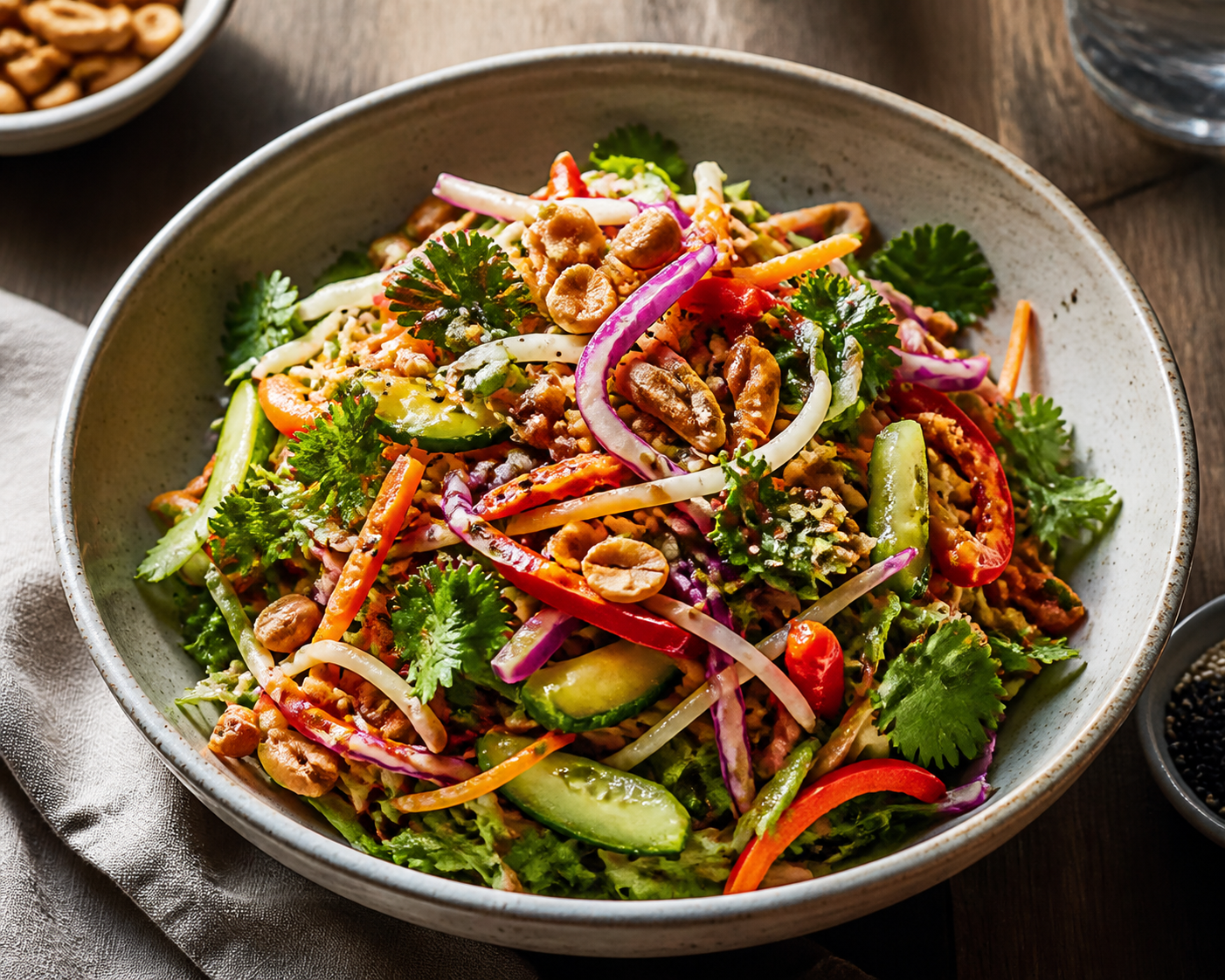
| Active time | 25 minutes |
| Hands-off time | 0 (dressing can rest 30 minutes) |
| Difficulty | Easy — knife work only |
| Key techniques | the sogginess clock on cabbage, dressing-first, toast-at-service |
| Make-ahead | dressed components hold 4 hours; fully dressed holds 1 hour |
Thai Crunch Salad
Prep: 25 minutes · Cook: No cook · Total: 25 minutes · 4 as a main, 6 as a side
Ingredients
The crunch base
- 450 g (1/2 medium) napa or green cabbage, cored and shredded fine — or half cabbage, half Brussels sprouts, shaved
- 2 medium carrots (about 200 g), julienned or coarsely grated
- 1 red bell pepper (about 150 g), cut in thin matchsticks
- 3 scallions (about 60 g), sliced thin on a steep angle
- 1 English cucumber (about 300 g), halved, seeded, sliced into half-moons
The dressing
- One full batch of peanut lime dressing (about 300 ml), made ahead or in parallel
The texture choir
- 80 g (3/4 cup) sliced almonds, toasted
- 60 g (1 1/2 cups) crispy chow mein noodles, or 40 g fried shallots
- 15 g (1/2 cup) chopped fresh cilantro, leaves and tender stems
- 1 tbsp (6 g) sesame seeds, toasted
- 1 serrano or bird's eye chili (about 8 g), sliced thin — optional heat
- Lime wedges, to serve
The protein option
- 400 g (14 oz) cooked shredded chicken, or 450 g firm tofu, pressed and seared
Instructions
- Salt the cabbage lightly, then wait 10 minutes. Toss the shredded cabbage with 1/2 tsp (2 g) salt in the serving bowl and let it sit. The salt pulls surface water from the cabbage so the dressing coats instead of dilutes — the same reason you salt cucumbers before pickling. Checkpoint — after 10 minutes the cabbage has visibly relaxed and a tablespoon of water pools if you tilt the bowl. Pour that water off, then pat the cabbage with a towel.
- Build the dressed base. Add the carrots, pepper, scallions, and cucumber to the cabbage. Pour over about three-quarters of the dressing and toss with your hands — hands dress a chopped salad more evenly than any tool, and you can feel when every strand is coated. Checkpoint — every strand glistens but no dressing pools at the bowl's bottom. Pooling means under-tossed or over-poured; add the reserved dressing only at service.
- Hold or serve — the clock rules. This dressed base holds at cool room temperature for 1 hour or refrigerated (4 °C) for up to 4 hours, getting slightly better for the first hour as the cabbage softens into the dressing. Delicate add-ins would die in that window; this bowl has none, which is the whole design. Checkpoint — before serving, taste a forkful from the bottom of the bowl where dressing settles: it should still taste balanced, not sweet-heavy. If the dressing thickened in the cold, let the bowl sit 15 minutes and re-toss.
- The choir, at the last minute. Add the chicken or tofu if using, the cilantro, and chili, then toss once. Top with the almonds, crispy noodles, and sesame seeds after the salad lands on the plate — or serve them alongside and let each bowl dress its own crunch. Checkpoint — eating test: the first bite should crackle from three directions (cabbage, nuts, noodles) under the dressing's sweet-tart heat, with cilantro lifting the finish. If any element has gone quiet, the clock won — the file's whole argument is the order.
Doneness & Quality Checkpoints
- Cabbage salted, drained, and patted — no dilute dressing
- Matchstick cut throughout — one size, five textures per forkful
- Dressing at three-quarters, reserved quarter added at service
- Crunch toppings added in the final minute, never transported in the bowl
- Bottom-of-bowl taste balanced before serving
Finish & Plate
Serve in a wide, shallow bowl — depth traps the toppings, width shows the choir. Offer lime wedges and the reserved dressing at the table; the salad is hearty enough to anchor a lunch with the chicken folded through, and it stands beside grilled anything at dinner. At a potluck, set it out cool from the fridge (4 °C) — this is one of the few salads whose serving temperature and holding temperature are the same.
Troubleshooting
| Symptom | Cause | Fix |
|---|---|---|
| Salad watery after an hour | Cabbage unsalted or cucumber overripe | Salt-and-drain next time; add cucumber at service for long holds |
| Toppings soggy | Transported in the bowl | Toppings travel separately, always |
| Dressing disappears into the salad | Under-measured batch | The reserved quarter exists for this — add and re-toss |
Storage, Make-Ahead & Variations
- Dressed base refrigerates (4 °C) up to 4 hours; undressed base 2 days in a sealed bag. Toasted nuts keep a week in a jar at room temperature. - Variations: the snap-pea spring swap; shredded rotisserie chicken for the no-cook main; rice noodles tossed in at service for the noodle-salad register; a spoon of sambal stirred into the dressing for the version that runs hot.