Turkey Sandwich — The Everyday Build
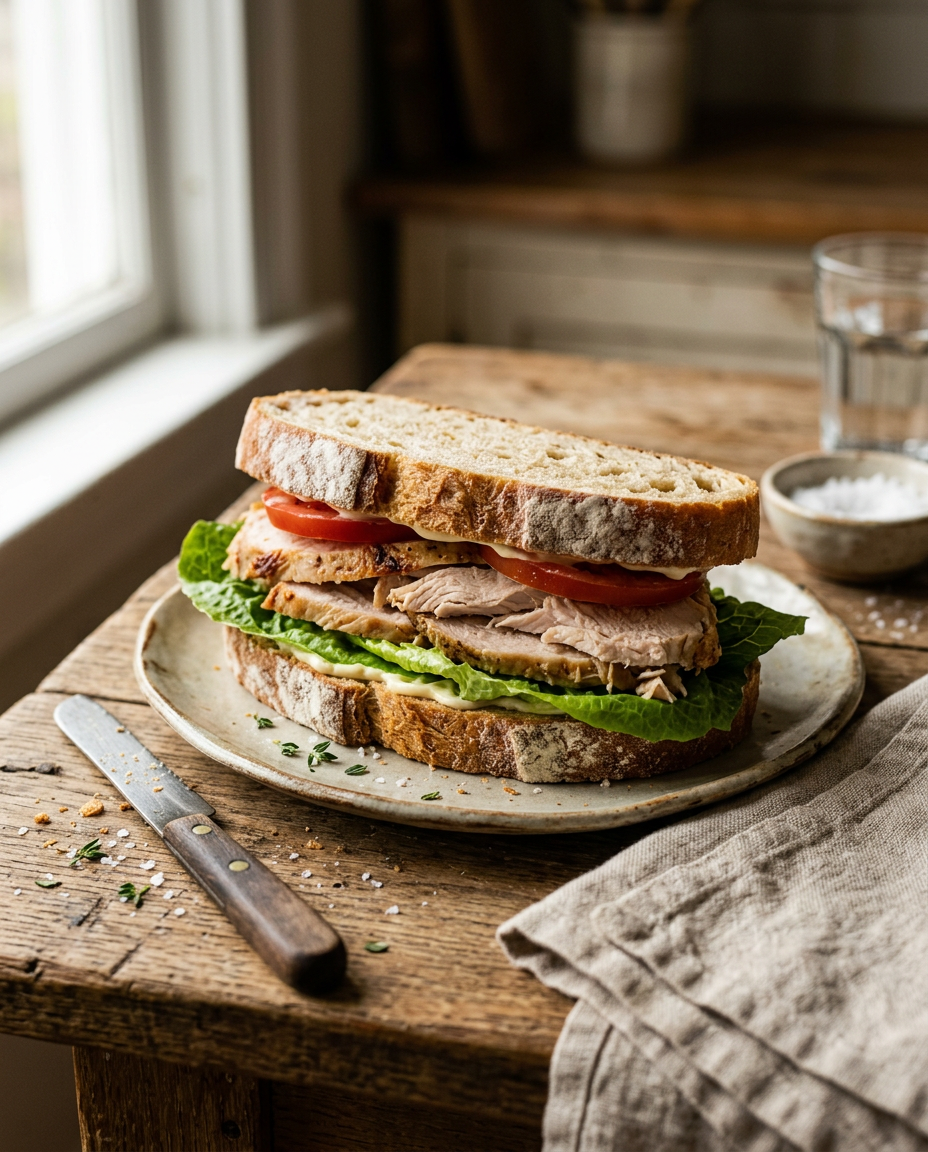
The single-decker weekday build that #50's club ceremony never mentions: good bread, a real barrier spread, turkey folded rather than stacked, and the two or three fresh things that keep it from tasting like an obligation. The file's law: thickness and folding — sandwich-shop turkey is folded for height and tenderness, never laid flat, and it makes all the difference.
Turkey Sandwich — The Everyday Build
Prep: 10 minutes · Cook: 5 minutes · Total: 15 minutes · Makes 1 sandwich
Ingredients
The build
- 2 slices bread (about 70 g) — whatever the house runs, from Pullman to the bakery's country loaf; toasted if the fillings run wet
- 2 tbsp (30 g) spread: mayonnaise, or mayo on one face and whole-grain or Dijon mustard on the other — the two-spread law
- 120 g sliced roast turkey — thick-cut from the #31 roast, or the deli's oven-roasted (not the smoked round; it is a different sandwich)
- Salt and black pepper, on the turkey
The fresh two or three
- 2–3 leaves lettuce (about 20 g), or arugula's pepper lane
- 2 slices tomato (about 60 g), patted dry — only in season
- 1 tbsp (10 g) red onion, shaved thin; or pickles; or 2 tbsp (20 g) #24's slaw
The upgrades, earned
- 30 g sharp cheddar or Swiss
- 1 tbsp (15 g) cranberry sauce — the day-after lane
- A spread of #1's caesar dressing for the deli-regal build
Instructions
- Spread both faces — the two-spread law. Mayo on one (the moisture barrier), mustard on the other (the tang), or mayo on both for the classic. Corner to corner, the #49 law carried: bare corners are dry corners. Checkpoint — both faces carry a visible, even film; the mustard face shows the grain of the bread through a thin coat, not a hide.
- Fold, don't stack, the turkey. Take each slice and fold it once into a loose quarter or half — the fold's ridge up — and shingle the folded slices across one bread face, edge to edge, ridges running the same direction. The folds give the layer height, air, and tenderness: a folded slice's edge bites soft where a flat stack's edge compresses to felt. Checkpoint — the turkey layer stands 1.5–2 cm of folded, ridged slices — visibly lofted, not a flat blanket. Salt and pepper directly on the turkey, the layer that needs it most (the #50 law, inherited here).
- The fresh layer in the moisture order. Lettuce against the turkey (dry against dry), then tomato on the lettuce — never tomato on bread or on turkey, where its water soaks and slicks. Onion or pickles or slaw over the tomato, cheese if running (the cheese belongs against the bread's other face, where its firmness anchors the bite). Checkpoint — from the side: bread, spread, folded turkey, lettuce, tomato, onion, cheese, spread, bread — the wet layers buffered on both sides by dry.
- Close, set, cut. Crown on, one gentle press, and the diagonal cut if the day deserves it. Wrap for 20 minutes in parchment if it travels — a brief wrapped rest softens the bread's crust and marries the layers, the lunchbox's one mercy. Checkpoint — eating test: the bread's chew against the turkey's folded tenderness, the mustard's tang and mayo's round under it, lettuce's snap and tomato's acid arriving clean — a simple sandwich that tastes like care because four laws were kept. It should be better than it needs to be; that is the whole genre's quiet argument.
- Toast if wet: tomato, slaw, or cranberry in the build means toast both slices to warm-dry — the barrier spread plus toast is the only architecture that survives to noon.
- Lay out the turkey slices and check the thickness: the target is 3–4 mm slices. Deli-shaved turkey (1 mm) is the common failure — it compresses to paper and the sandwich tastes of bread and regret.
Troubleshooting
| Symptom | Cause | Fix |
|---|---|---|
| Sandwich tastes of nothing | Shaved-thin turkey, under-seasoned | 3–4 mm slices; salt on the layer |
| Soggy by noon | Wet fillings, untoasted bread | Toast for wet builds; the moisture-order law |
| Turkey layer dense, felt-like | Stacked flat | Folded with the ridges up — the whole technique |
Storage, Make-Ahead & Variations
- The built sandwich holds 2–3 hours (toasted) or 30 minutes (untoasted, wet fillings); components keep days. The wrapped 20-minute rest is the packed lunch's one upgrade. - Variations: the day-after lane above; the #50 club when the weekend calls for ceremony; the melt (#101's build with this filing); the #34's chicken salad as the spread-and-filling combined.