Vegan Grilled Cheese
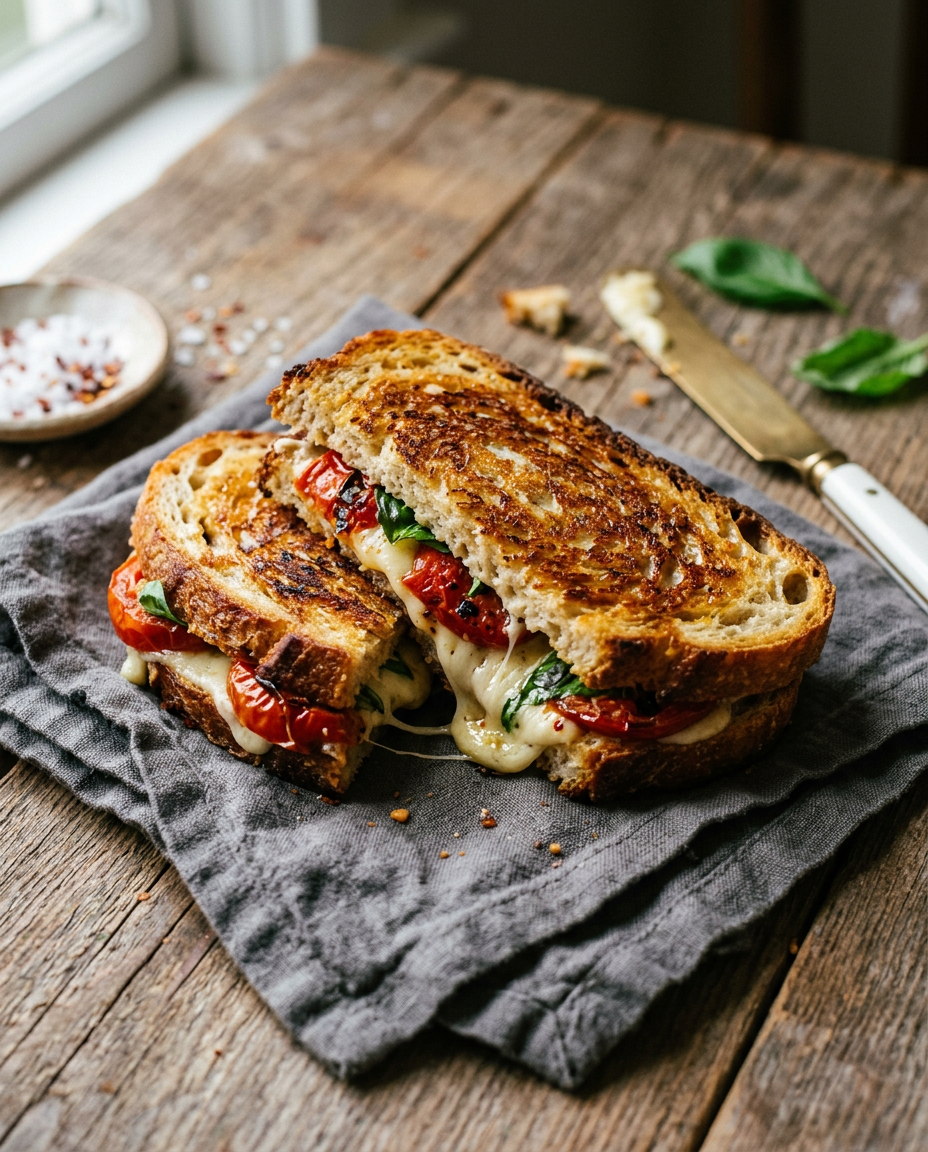
The physics lesson of the family: plant cheeses do not melt like dairy — their proteins and fats lack casein's melt lattice — and this build's honesty names every trade and every fix. The answer runs three lanes: a good commercial vegan cheese (checked against the melt test), the covered-pan steam that carries what the cheese can't, and the nutritional-yeast cashew cream that runs the from-scratch depth.
Vegan Grilled Cheese
Prep: 5 minutes · Cook: 12 minutes · Total: 17 minutes · Makes 2 sandwiches
Ingredients
The cheese lane, three options
- 160 g commercial vegan cheese, sliced or grated — the coconut-oil-based slices and shreds melt best; read the label's first ingredients and see the melt test below
- Or the cashew cream: 100 g raw cashews soaked 2 hours (or boiled 15 minutes), blended with 60 ml water, 2 tbsp (8 g) nutritional yeast, 1 tsp (5 ml) lemon juice, 1/2 tsp (2 g) salt, and 1/4 tsp (0.5 g) smoked paprika
- Or the hybrid (the file's recommendation): 100 g commercial cheese for the melt's structure + 3 tbsp of the cashew cream for the depth's flavor
The bread and outside
- 4 slices sturdy sourdough or white (about 300 g) — vegan by nature at most bakeries; check the milk's absence on enriched loaves
- 2 tbsp (30 g) vegan mayonnaise — the outside's even film, #88's law carried
Instructions
- Mayo the outsides; fill per the lane. The vegan mayo's film on all four outsides; the inside faces built per the lane chosen — commercial slices covering the bread fully (the full-coverage law matters more here than at #88's: vegan cheese's melt runs local, and an uncovered corner never receives it), or the cashew cream spread thick with the commercial slices over it (the hybrid's strata). Checkpoint — every inside face fully covered — no bare bread anywhere; the hybrid's cream visibly sandwiched between bread and slices.
- Griddle low with the lid, 5–6 minutes a side, covered. A heavy pan over low (a surface nearer 140 °C than #88's 150 — the vegan cheese's oils separate at dairy's temperatures); the sandwich pressed gently, and a lid over the pan for the whole cook — the trapped steam's moisture is the melt's assistant, softening what the heat alone cannot. Checkpoint — the bread runs even, deep gold (the mayo film's signature shine), and the cheese at the edges has softened into a flow — a vegan cheese's "melt" reads as a soft, stretching droop rather than dairy's run; judge it by the droop, not the run.
- The flip, once, gentle — the structure's law. The second side runs the same 5–6 covered minutes to matching gold. Checkpoint — at the finish, a corner lifted shows the interior soft and integrated — the slices' edges merging with the cream's layer (or each other), no rigid plaques standing. The covered patience is what the physics asked for.
- Rest 1 minute, halve, pull-test. Checkpoint — eating test: the bread's gold shell, the interior's soft-creamy chew — the hybrid's depth from the nutritional yeast's umami and the smoked paprika's hint, the commercial slice's gentle stretch — a sandwich that tastes like grilled cheese's cousin with its own personality rather than an apology for the original. The tomato soup's partnership stands unmodified, and the file notes the soup's vegan too, by accident of history.
- The melt test, the shopping's one discipline: a single slice of the candidate cheese on a hot pan for 30 seconds — a good one softens and spreads; a bad one stays a rigid plaque or seizes into oil. The label's claims melt; the pan decides.
- The cashew cream (if running it) made ahead and warmed slightly at the build — it spreads and melts by softness rather than by structure.
Troubleshooting
| Symptom | Cause | Fix |
|---|---|---|
| Cheese stayed rigid | The label's bad melt or heat too high | The pan's melt test at shopping; low, covered |
| Oily, greasy interior | Overheated — the oil separated | The 140 °C lane; the lid's steam's gentleness |
| Tastes thin, "worthy" | Commercial-only lane, no depth | The hybrid's cashew cream — the umami's fix |
Storage, Make-Ahead & Variations
- Serves in the minute (a re-crisp at low, covered, 3 minutes a side runs a partial revival); the cashew cream keeps 3 days refrigerated (4 °C); the assembled-uncooked sandwich holds an hour. - Variations: the caramelized-onion lane (#71's onions are vegan by nature); the tomato-and-basil insert (#80's caprese melt at this register); the everything-seed crust on the mayo's outside; the #88 dairy classic as the family's master seat and this file's physics contrast.