Veggie Hummus Stack
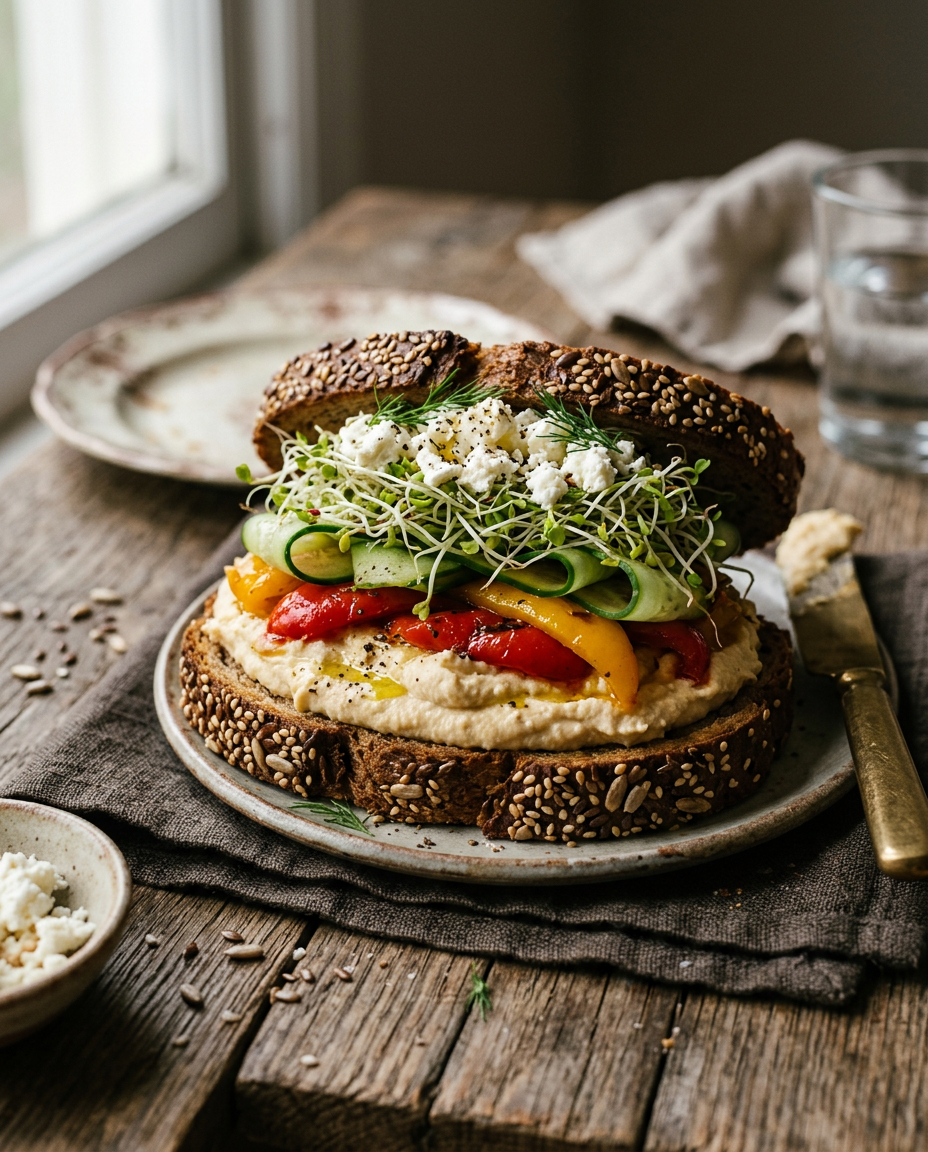
The vegetarian workhorse: hummus as the sandwich's protein, barrier, and moisture layer at once — thick enough to waterproof the bread, substantial enough to carry the meal — stacked with the crunch and color of the market's vegetables. The craft is the thickness of everything: thick hummus, thin vegetables, and the press that fuses it.
Veggie Hummus Stack
Prep: 15 minutes · Cook: 5 minutes · Total: 20 minutes · Makes 2 sandwiches
Ingredients
The build
- 4 slices multigrain, sourdough, or 2 pitas or flatbreads (about 80 g each slice or bread)
- 200 g (about 3/4 cup) thick hummus — store's honest tub or the quick batch below
- 1/2 English cucumber (about 150 g), sliced thin
- 1 carrot (about 80 g), shaved into ribbons with a peeler
- 1/2 red bell pepper (about 75 g), sliced thin
- 1/2 avocado (about 100 g), sliced
- 40 g (about 1 cup) sprouts or arugula
- 2 tbsp (16 g) feta crumbles — optional
- 1 tbsp (15 ml) olive oil (about 14 g), lemon, salt, pepper
The quick hummus, if building
- 400 g (1 can) chickpeas, drained and rinsed; 60 g (4 tbsp) tahini; 1 garlic clove; 45 ml (3 tbsp) lemon juice; 2 tbsp (30 ml) ice water; 1/2 tsp (2 g) salt — blended 2 full minutes to whipped
Instructions
- Lay the hummus thick on both faces. A full 50 g per slice, spread to the edges — the waterproofing and the protein in one layer. On most sandwiches a spread runs thin; here it is the sandwich, and the edge-to-edge thickness is what makes the stack hold. Checkpoint — no bread visible; the layer stands 3–4 mm, matte and thick. The bread's faces now cannot see moisture — every vegetable's water stops at the hummus wall.
- Stack thin, in the crunch's order. Bottom face: cucumber ribbons (patted), carrot ribbons over them, pepper threads, avocado slices, sprouts, feta if running — each vegetable in a thin, even layer, the stack building height from repetition rather than any one layer's bulk. Checkpoint — the stack stands 3 cm of distinct thin strata, wettest (cucumber, avocado) buffered on both sides, driest (sprouts, pepper) at the architecture's edges. From the side, the sandwich should read like a color chart.
- Oil, lemon, and press. The top slice's hummus face down; olive oil's few drops and lemon's squeeze over the sprouts just before closing, salt and pepper; then one firm-but-gentle press with the palm — firmer than most sandwiches get, because the hummus and the thin vegetables fuse under pressure into one slicable stratum. Checkpoint — the pressed sandwich compresses to 2 cm and holds together at a lift of one corner — the press did its work when nothing shifts.
- Halve with the serrated saw and serve, or griddle the sourdough lane. Checkpoint — eating test: the bread or pita's chew, the hummus's lemon-garlic cream, and the vegetables' crunch arriving in sequence — cucumber's cool, carrot's sweet, pepper's snap, avocado's butter, sprouts' grass — a sandwich that eats like a garden with a paycheck. If it slips at the bite, the griddle's lane below or a firmer press next time.
- The hummus's thickness is the law: it must stand on the knife without sliding. A loose tub hummus waters the bread and the sandwich fails by noon — thicken a wet tub by stirring in 2 tbsp more tahini, or use the quick batch above, whose ice-water whip runs thick and light at once.
- Salt the cucumber slices lightly in a colander 10 minutes and pat dry — the #63 law carried, for the same reason.
Troubleshooting
| Symptom | Cause | Fix |
|---|---|---|
| Sandwich soggy by noon | Thin hummus, wet cucumber | The thickness law; the salt-and-pat |
| Stack slides at the bite | No press, or thick-cut vegetables | The firm press; the thin-strata discipline |
| Tastes worthy but dull | Untoasted nuts of flavor missing | The feta's salt, the lemon at the close — both, always |
Storage, Make-Ahead & Variations
- Assembled holds 3–4 hours with the thickness law; the quick hummus keeps 4 days refrigerated (4 °C) and the vegetables 2 cut — the meal-prep stack that assembles in 5 minutes all week. - Variations: the griddled lane above; the roasted-vegetable winter build (squash, red pepper, at 200 °C, 25 minutes, cooled); the #42 tabbouleh fold; the Everything-bagel seasoning's dust on the griddled lane's butter.