Viral French Toast Breakfast Sandwich
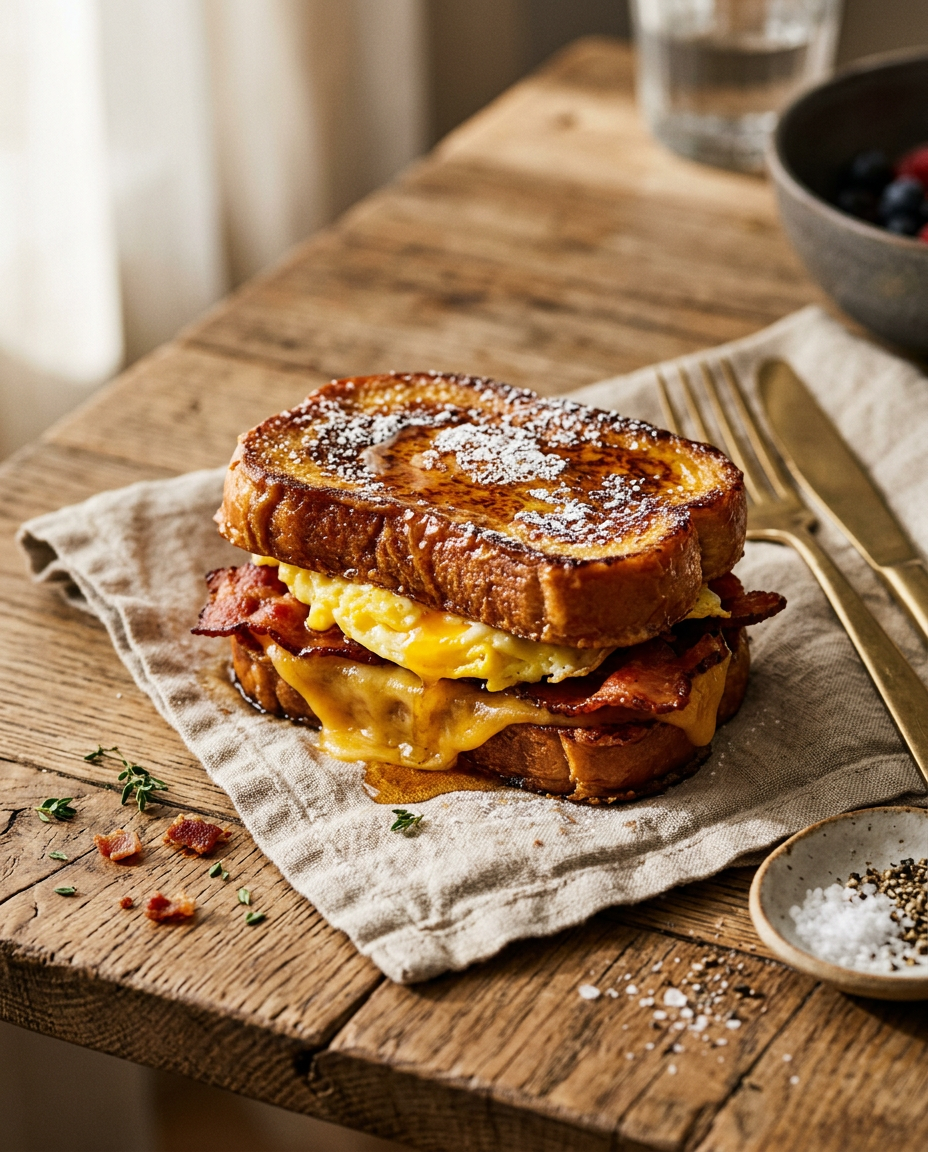
The format the internet reinvented in 2023: bread soaked in French toast custard, griddled to its golden hull, then made into the sandwich itself — egg and cheese (and bacon, by the table's vote) inside a sweet, maple-scented envelope. The technique is the two-stage cook: the custard's bread needs its own gentle griddle before it becomes bread again, and the sweet-outside-savory-inside contrast is the whole trick.
| Active time | 20 minutes |
| Hands-off time | 0 |
| Difficulty | Easy — two pans' choreography |
| Key techniques | the custard soak's measure, the two-stage griddle, sweet-savory balance |
| Make-ahead | none — a minute-zero format |
Viral French Toast Breakfast Sandwich
Prep: 10 minutes · Cook: 12 minutes · Total: 22 minutes · Makes 2 sandwiches
Ingredients
The custard and its bread
- 4 thick slices brioche or challah, 2 cm (about 200 g) — the custard's own breads
- 2 large eggs (about 100 g)
- 60 ml (1/4 cup) milk
- 1 tbsp (15 g) maple syrup or sugar, plus more for the finish
- 1 tsp (2 g) cinnamon, 1/4 tsp (1 g) salt, 1 tsp (5 ml) vanilla
The savory inside
- 4 slices bacon (about 75 g), cooked crisp, or 4 slices ham (about 75 g)
- 2 large eggs (about 100 g), fried or run per #54's pad
- 2 slices cheddar or American cheese (about 40 g)
- 1 tbsp (14 g) butter
- Salt, pepper
The finish
- Maple syrup for dipping, or a drizzle over the cut — the table's own decision
- Powdered sugar's dusting, the full-viral register
Instructions
- Dip and griddle the custard bread — the outside stage. Butter in a nonstick pan over medium-low; each bread slice dipped 10 seconds per side in the custard (let the excess drip 3 seconds) and laid in the pan. 2–3 minutes per side to an even, deep gold — the custard's egg sets and the maple's sugars brown; the heat runs lower than plain French toast's because this bread's job is structure, not pudding. Checkpoint — both faces deep gold and dry to the touch's edge, the slice still firm enough to lift flat — a custard slice that flops soaked too long or griddled too cool. The 10-second dip is the measure: soaked through the outer half only, a French toast hull with bread's heart.
- The savory inside, in parallel. Bacon done ahead; the two eggs fried in a second pan (butter, 2–3 minutes to the whites' full set and the yolks' run — or #54's pad method for the tidy build), cheese standing by. Checkpoint — egg whites fully set, yolks domed and liquid; bacon crisp-drained. The inside's elements ready at the same minute the bread's last face comes off.
- Assemble hot — the contrast's law. On one griddled slice (its French toast face down, making the sandwich's inside): cheese, bacon, the fried egg, pepper, then the top slice, French toast face up. The sweet faces run outside and in — every bite carries the hull's maple-cinnamon edge against the savory core. Checkpoint — the cross-section: golden custard hull, melted cheese, bacon's crisp, the yolk's run beginning at the pierce, the second hull. Built while everything is hot, because the cheese must melt against the bread's warmth and the yolk must run at the bite.
- Cut, dust, dip — the finish's theater. The diagonal cut (the yolk's run is the photograph), the powdered sugar's dust for the full-viral register, and the maple on the side for dipping. Checkpoint — eating test: the hull's sweet crunch giving to the savory middle — bacon's salt, egg's yolk-richness, cheese's melt — the maple's perfume arriving at the swallow and resetting the sweetness for the next bite. The sweet-savory contrast should be the headline of every single bite; if the sandwich reads only sweet, the inside underseasoned or the custard over-sweetened — check the balance at the cut before serving the second one.
- Whisk the custard in a shallow dish wide enough for the bread to lie flat — the soak is a quick dip, not a bath (this is a sandwich, not a slab of French toast), 10 seconds a side.
- Stage the savory elements first: bacon cooked and draining, cheese sliced, the frying pan ready — because the custard bread's window from griddled to cooling is short, and the inside must be ready to land when the outside is.
Doneness & Quality Checkpoints
- The 10-second dip a side — a hull, not a soak
- Medium-low griddle to dry, deep gold — structure, not pudding
- The savory elements staged and landing at the bread's minute
- Built hot — the cheese melts on the hull's warmth, the yolk runs at the bite
- Sweet-outside, savory-inside, every bite
Finish & Plate
The diagonal halves, yolk-side up on the plate's tilt, the sugar's dust and the maple's cup at the side — the presentation is half the format's identity, and the file honors it. Coffee balances the sweetness; orange juice's acid cuts it.
Troubleshooting
| Symptom | Cause | Fix |
|---|---|---|
| Bread fell apart on the griddle | Over-soaked or thin bread | The 10-second law; the 2 cm slice |
| Custard face pale, wet | Heat too low or rushed | Medium-low with patience to deep gold, dry at the edge |
| Sandwich reads dessert-only | Custard over-sweet, inside bland | 1 tbsp maple in the custard, salt and pepper on the egg |
Storage, Make-Ahead & Variations
- A minute-zero format; the custard (eggs, milk, syrup, spice) keeps 2 days refrigerated (4 °C) in a jar and the bacon cooks ahead — the morning build drops to 10 minutes. - Variations: the sausage patty swap; the hash-brown insert for the full diner plate in a hand; the savory-lean lane (custard's sugar halved, Gruyère inside) for the table that skips the maple; #68's Monte Cristo as the lineage's senior, richer seat.